Real-time AI-curated news from 99,796+ articles across 50+ sources. Sentiment analysis, importance scoring, and key takeaways — updated every 15 minutes.
AIBullisharXiv – CS AI · May 97/10
🧠Researchers introduce PCNET, a probabilistic circuit-based method that detects hallucinations in large language models as geometric anomalies in the factual manifold, achieving 99% detection accuracy. The approach uses PC-LDCD decoding to correct hallucinations selectively without corrupting originally correct outputs, demonstrating significant improvements across multiple benchmarks.
AINeutralarXiv – CS AI · May 97/10
🧠Researchers propose Safety Bottleneck Regularization (SBR), a defense mechanism against harmful fine-tuning attacks on large language models. The approach anchors a model's unsafe responses to safe outputs via the unembedding layer, reducing harmful capabilities while maintaining performance on legitimate tasks.
AI × CryptoBullisharXiv – CS AI · May 97/10
🤖Researchers demonstrated quantum-enhanced large language models by integrating Cayley-parameterised unitary adapters into pre-trained LLMs and executing them on IBM's 156-qubit quantum processor. The approach improved Llama 3.1 8B's perplexity by 1.4% using only 6,000 additional parameters, marking the first practical validation of quantum-classical hybrid AI on real quantum hardware at scale.
🏢 Perplexity🧠 Llama
AIBullisharXiv – CS AI · May 97/10
🧠ReaComp introduces a method to compile reasoning traces from large language models into reusable symbolic program synthesizers that eliminate runtime LLM calls. The approach achieves 91.3% accuracy on benchmark tasks while reducing token usage by 78%, demonstrating that neuro-symbolic hybrid systems can outperform pure LLM inference on complex program synthesis problems.
AIBullisharXiv – CS AI · May 97/10
🧠Litespark-Inference introduces custom SIMD kernels that enable efficient large language model inference on standard consumer CPUs by exploiting ternary neural networks (weights constrained to -1, 0, +1), replacing floating-point multiplication with simple addition and subtraction. The solution achieves dramatic performance improvements—9.2x faster latency and 52x higher throughput on Apple Silicon—making AI workloads accessible to billions of underutilized personal computers.
AIBullisharXiv – CS AI · May 97/10
🧠Researchers introduce LOVER, an unsupervised verifier that uses logical constraints to improve LLM reasoning without requiring expensive labeled datasets. The method achieves performance comparable to supervised approaches by enforcing logical consistency rules across multiple reasoning paths.
AIBullisharXiv – CS AI · May 97/10
🧠Researchers introduce ViTok-v2, a 5-billion-parameter Vision Transformer autoencoder that achieves native resolution support and stable scaling without adversarial losses. The breakthrough advances image tokenization for generative AI by improving reconstruction quality across multiple resolutions while maintaining generation capabilities.
AIBullisharXiv – CS AI · May 97/10
🧠Researchers introduce FinAgent-RAG, an advanced AI framework designed to answer complex financial questions by combining iterative retrieval, reasoning, and self-verification. The system achieves 76-78% accuracy on financial benchmarks while reducing computational costs by 41%, demonstrating practical viability for institutional financial analysis.
AIBullisharXiv – CS AI · May 97/10
🧠Researchers propose Selective Eligibility Traces (S-trace), a new method for reinforcement learning that improves credit assignment in large language models by selectively identifying critical reasoning steps rather than uniformly crediting entire trajectories. The approach demonstrates performance gains of 0.49-3.16% across Qwen models while improving sample and token efficiency compared to existing critic-free algorithms.
CryptoBearishCrypto Briefing · May 97/10
⛓️Wall Street is flagging heightened systemic risk from concentrated momentum trades, particularly around US jobs data releases. These trades could amplify market volatility and pose spillover risks to cryptocurrency markets and broader financial stability.
CryptoNeutralNewsBTC · May 97/10
⛓️Bitcoin dropped below $80,000 on May 4 due to internal market structure rather than external macro factors, driven by 14,600 BTC in profit-taking from short-term holders and accumulated leverage positions. XWIN Research Japan's analysis reveals the rally created conditions for its own interruption, though large holder exchange inflows remain muted, suggesting strategic participants have not begun aggressive distribution.
$BTC$ETH$XRP🧠 ChatGPT
CryptoBullishBitcoinist · May 97/10
⛓️Cryptocurrency-backed political action committees are significantly increasing their spending in US elections, with Fairshake PAC and allies deploying $7.2 million across five states ahead of congressional elections. This represents a major push by the crypto industry to influence electoral outcomes and shape future cryptocurrency regulation through political contributions.
AI × CryptoNeutralCrypto Briefing · May 97/10
🤖China has unveiled the LineShine supercomputer with ambitions to surpass the US's El Capitan system, potentially reshaping global technological competition. This development carries significant implications for AI advancement, cryptographic capabilities, and the broader geopolitical tech landscape.
AIBullishCrypto Briefing · May 97/10
🧠Jan Leike has assumed leadership of Anthropic's alignment science team, signaling the company's commitment to advancing AI safety research. This move could establish new industry standards for AI alignment and influence how the broader tech sector approaches safety-critical AI development.
🏢 Anthropic
AI × CryptoBearishCrypto Briefing · May 97/10
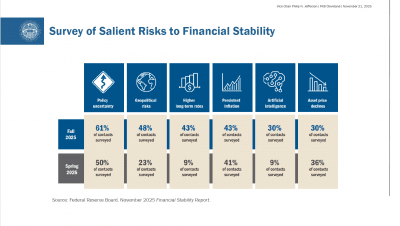
🤖The Federal Reserve's Spring 2026 survey identifies geopolitical tensions and artificial intelligence risks as primary threats to financial stability. These concerns could disrupt energy markets, compromise cybersecurity infrastructure, and reshape employment dynamics across the global economy.
GeneralBearishCrypto Briefing · May 97/10
📰The S&P 500 options market has accumulated $2.6 trillion in call options, driven by AI enthusiasm and triggering a gamma squeeze dynamic. This shift signals that derivatives-driven mechanics may increasingly override traditional valuation frameworks in determining short-term equity price movements.
CryptoBullishCrypto Briefing · May 97/10
⛓️US government peace hopes are driving a notable market shift, with stocks, gold, and Bitcoin rising simultaneously while crude oil prices decline. This unusual convergence reflects changing investor sentiment toward geopolitical risk and suggests evolving perceptions of these assets' roles in portfolio diversification.
$BTC
CryptoBearishCrypto Briefing · May 97/10
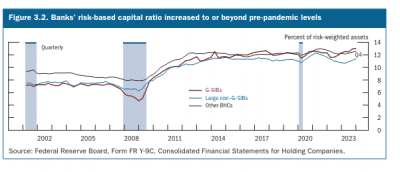
⛓️The Federal Reserve released its Financial Stability Report identifying systemic vulnerabilities in the US financial system and recommending cautious financial strategies. The report notably lacks comprehensive assessment of cryptocurrency risks, highlighting a gap in regulatory oversight as digital assets grow in significance.
GeneralBearishCrypto Briefing · May 97/10
📰US Central Command has confirmed the deployment of three naval destroyers (USS Truxtun, Rafael Peralta, and Mason) to the Arabian Sea following Iranian attacks. The increased military presence in this critical energy corridor raises concerns about potential disruptions to regional stability and global energy markets, which could have cascading effects on cryptocurrency mining operations that depend on stable power supplies.
AINeutralCrypto Briefing · May 97/10
🧠SpaceX has entered a partnership with Anthropic to enhance AI compute capabilities, potentially reshaping competition with OpenAI. The development highlights growing concerns about tech industry transformation efficiency and the critical importance of model optimization in the AI race.
🏢 OpenAI🏢 Anthropic
AIBullishCrypto Briefing · May 97/10
🧠OpenAI's Codex has reached 90 million installations in a single week following the GPT-5.5 rollout, marking a significant acceleration in AI-assisted coding adoption. This surge reflects growing developer demand for advanced code generation tools and signals potential shifts in software development efficiency and security practices.
🏢 OpenAI🧠 GPT-5
CryptoBullishCrypto Briefing · May 97/10
⛓️Ripple's CEO has characterized a recent judge's ruling on XRP's regulatory status as a pivotal moment for cryptocurrency clarity. The decision is expected to strengthen institutional adoption by reducing regulatory uncertainty, though legal complexities in the broader crypto space persist.
$XRP
AINeutralMIT Technology Review · May 87/10
🧠In week two of Elon Musk's lawsuit against OpenAI, the company mounted a defense while evidence emerged that Musk allegedly attempted to recruit Sam Altman away from the organization. The trial centers on Musk's claims that he was deceived into donating $38 million based on false promises about maintaining OpenAI's nonprofit structure.
🏢 OpenAI
AIBearishCrypto Briefing · May 87/10
🧠The Trump administration is preparing an AI security order targeting US government agencies, which may introduce stricter regulatory oversight and enhanced disclosure requirements for AI companies. This executive action could reshape how AI systems are implemented and monitored within federal operations.
CryptoBearishcrypto.news · May 87/10
⛓️Kraken's parent company Payward filed a second amended complaint alleging that Etana Custody orchestrated a Ponzi-like scheme that diverted over $25 million in client funds, with the lawsuit targeting CEO Russell. The case represents a significant custody and fraud incident within the cryptocurrency ecosystem.