Models, papers, tools. 20,239 articles with AI-powered sentiment analysis and key takeaways.
AI × CryptoBearishThe Block · Mar 176/10
🤖Cango reported a $452.8 million net loss in its first full year as a bitcoin mining operation. The company has been selling bitcoin to repay debt and fund its transition into AI services.
$BTC
GeneralBullishDaily Hodl · Mar 176/10
📰Morgan Stanley CIO Mike Wilson believes U.S. equity markets are nearing the end of their current correction phase after months of economic and geopolitical pressures. The investment bank's chief strategist suggests the stock market sell-off began well before recent events and may be approaching a turning point.
AIBullishMarkTechPost · Mar 176/10
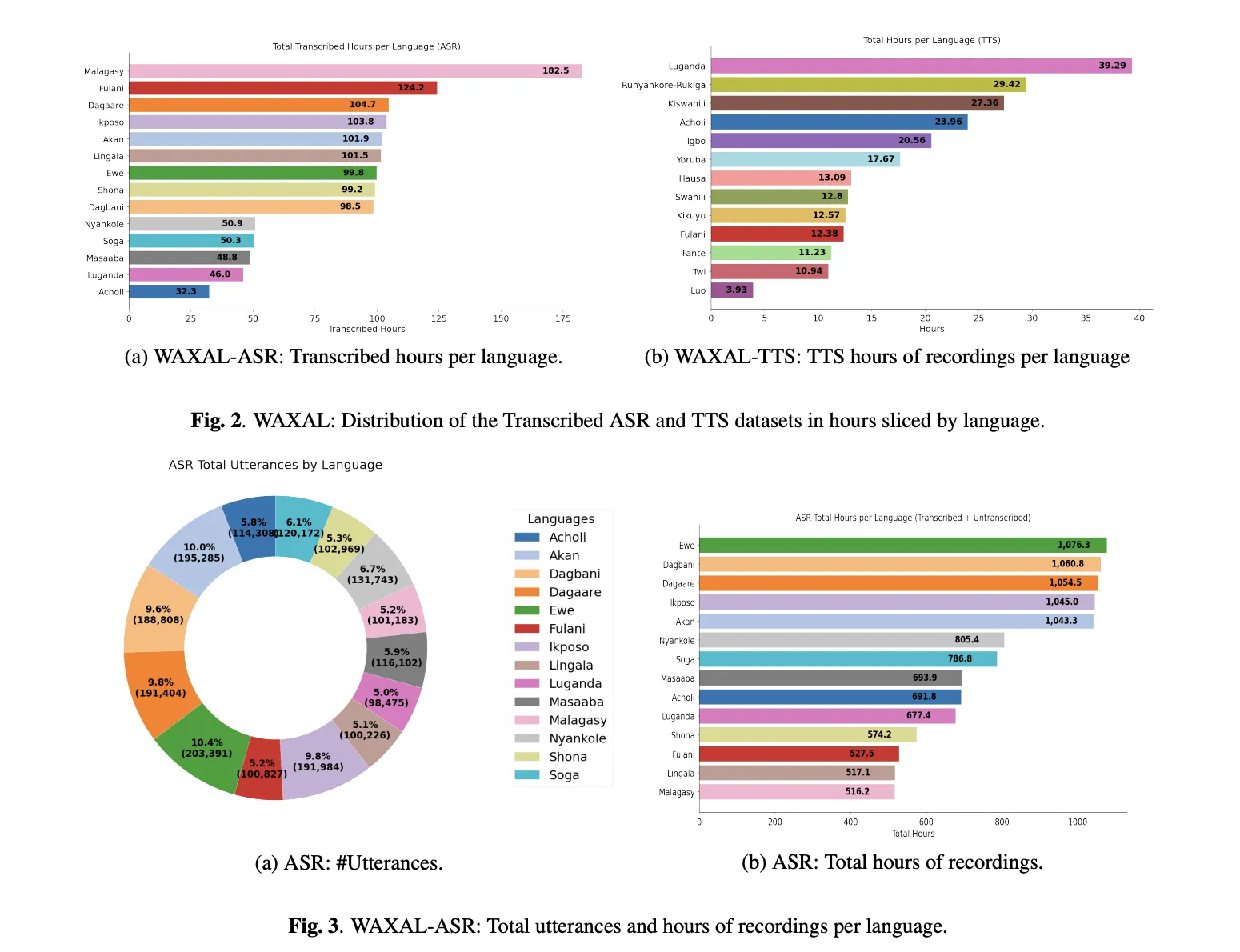
🧠Google AI has released WAXAL, an open multilingual speech dataset covering 24 African languages to improve Automatic Speech Recognition and Text-to-Speech systems. This addresses the significant data distribution problem where African languages remain poorly represented in speech technology training corpora.
🏢 Google
GeneralNeutralFortune Crypto · Mar 177/10
📰An analysis of 50 companies revealed that CEOs in the lowest-performing tier still received 87% of their target bonuses despite poor performance. Boards are expected to implement additional compensation protection measures as Iran-related economic disruptions threaten business operations.
AI × CryptoNeutralCoinTelegraph · Mar 176/10
🤖Messari has appointed Diran Li as its new CEO, who is positioning the crypto data and research firm as an AI-first company. The strategic pivot comes alongside staff cuts as the company focuses on serving institutional clients through AI-powered research and products.
AIBullisharXiv – CS AI · Mar 176/10
🧠Researchers propose a dual-path AI framework combining Variational Autoencoders and Wasserstein GANs for real-time fraud detection in banking systems. The system achieves sub-50ms detection latency while maintaining GDPR compliance through selective explainability mechanisms for high-uncertainty transactions.
AIBullisharXiv – CS AI · Mar 176/10
🧠Researchers developed plan conditioning, a training-free method that significantly improves diffusion language model reasoning by prepending short natural-language plans from autoregressive models. The technique improved performance by 11.6 percentage points on math problems and 12.8 points on coding tasks, bringing diffusion models to competitive levels with autoregressive models.
🧠 Llama
AIBullisharXiv – CS AI · Mar 176/10
🧠Researchers developed a Hierarchical Takagi-Sugeno-Kang Fuzzy Classifier System that converts opaque deep reinforcement learning agents into human-readable IF-THEN rules, achieving 81.48% fidelity in tests. The framework addresses the critical explainability problem in AI systems used for safety-critical applications by providing interpretable rules that humans can verify and understand.
AIBullisharXiv – CS AI · Mar 176/10
🧠Researchers propose EMBRAG, a new framework that combines large language models with knowledge graphs to improve reasoning accuracy and reduce hallucinations. The system generates multiple logical rules from queries and applies them in embedding space, achieving state-of-the-art performance on knowledge graph question-answering benchmarks.
AIBullisharXiv – CS AI · Mar 176/10
🧠Researchers introduce DOVA (Deep Orchestrated Versatile Agent), a multi-agent AI platform that improves research automation through deliberation-first orchestration and hybrid collaborative reasoning. The system reduces inference costs by 40-60% on simple tasks while maintaining deep reasoning capabilities for complex research requiring multi-source synthesis.
AIBullisharXiv – CS AI · Mar 176/10
🧠Researchers developed a method to control AI safety refusal behavior using categorical refusal tokens in Llama 3 8B, enabling fine-grained control over when models refuse harmful versus benign requests. The technique uses steering vectors that can be applied during inference without additional training, improving both safety and reducing over-refusal of harmless prompts.
🧠 Llama
AINeutralarXiv – CS AI · Mar 176/10
🧠Researchers propose MESD (Multi-category Explanation Stability Disparity), a new metric to detect procedural bias in AI models across intersectional groups. They also introduce UEF framework that balances utility, explanation quality, and fairness in machine learning systems.
AINeutralarXiv – CS AI · Mar 176/10
🧠A new research paper identifies the 'AI-Fiction Paradox' - AI models desperately need fiction for training data but struggle to generate quality fiction themselves. The paper outlines three core challenges: narrative causation requiring temporal paradoxes, informational revaluation that conflicts with current attention mechanisms, and multi-scale emotional architecture that current AI cannot orchestrate effectively.
AIBullisharXiv – CS AI · Mar 176/10
🧠Researchers introduce EviAgent, a new AI system for automated radiology report generation that provides transparent, evidence-driven analysis. The system addresses key limitations of current medical AI models by offering traceable decision-making and integrating external domain knowledge, outperforming existing specialized medical models in testing.
AINeutralarXiv – CS AI · Mar 176/10
🧠A comprehensive research study examines the relationship between Supervised Fine-Tuning (SFT) and Reinforcement Learning (RL) methods for improving Large Language Models after pre-training. The research identifies emerging trends toward hybrid post-training approaches that combine both methods, analyzing applications from 2023-2025 to establish when each method is most effective.
AIBullisharXiv – CS AI · Mar 176/10
🧠Researchers propose GRPO (Group Relative Policy Optimization) combined with reflection reward mechanisms to enhance mathematical reasoning in large language models. The four-stage framework encourages self-reflective capabilities during training and demonstrates state-of-the-art performance over existing methods like supervised fine-tuning and LoRA.
AINeutralarXiv – CS AI · Mar 176/10
🧠Researchers propose a new framework for improving safety in multimodal AI models by targeting unsafe relationships between objects rather than removing entire concepts. The approach uses parameter-efficient edits to suppress dangerous combinations while preserving benign uses of the same objects and relations.
AINeutralarXiv – CS AI · Mar 176/10
🧠Researchers propose a hierarchical planning framework to analyze why LLM-based web agents fail at complex navigation tasks. The study reveals that while structured PDDL plans outperform natural language plans, low-level execution and perceptual grounding remain the primary bottlenecks rather than high-level reasoning.
AINeutralarXiv – CS AI · Mar 176/10
🧠Researchers propose the Content Creation with Spillovers (CCS) model to address how GenAI and LLMs create positive spillovers where creators' content can be reused by others, potentially undermining individual incentives. They introduce Provisional Allocation mechanisms to guarantee equilibrium existence and develop approximation algorithms to maximize social welfare in content creation ecosystems.
AINeutralarXiv – CS AI · Mar 176/10
🧠Researchers introduce AgentProcessBench, the first benchmark for evaluating step-level effectiveness in AI tool-using agents, comprising 1,000 trajectories and 8,509 human-labeled annotations. The benchmark reveals that current AI models struggle with distinguishing neutral and erroneous actions in tool execution, and that process-level signals can significantly enhance test-time performance.
AIBullisharXiv – CS AI · Mar 176/10
🧠Researchers introduce ArgEval, a new framework that enhances Large Language Model decision-making through structured argumentation and global contestability. Unlike previous approaches limited to binary choices and local corrections, ArgEval maps entire decision spaces and builds reusable argumentation frameworks that can be globally modified to prevent repeated mistakes.
AINeutralarXiv – CS AI · Mar 176/10
🧠Research reveals that Large Language Models struggle with dynamic Theory of Mind tasks, particularly tracking how others' beliefs change over time. While LLMs can infer current beliefs effectively, they fail to maintain and retrieve prior belief states after updates occur, showing patterns consistent with human cognitive biases.
AINeutralarXiv – CS AI · Mar 176/10
🧠Researchers introduce Gradient Atoms, an unsupervised method that decomposes AI model training gradients to discover interpretable behaviors without requiring predefined queries. The technique can identify model behaviors like refusal patterns and arithmetic capabilities, while also serving as effective steering vectors to control model outputs.
AIBearisharXiv – CS AI · Mar 176/10
🧠Researchers introduced BrainBench, a new benchmark revealing significant gaps in commonsense reasoning among leading LLMs. Even the best model (Claude Opus 4.6) achieved only 80.3% accuracy on 100 brainteaser questions, while GPT-4o scored just 39.7%, exposing fundamental reasoning deficits across frontier AI models.
🧠 GPT-4🧠 Claude🧠 Opus
AIBullisharXiv – CS AI · Mar 176/10
🧠Researchers introduce OpenHospital, a new interactive arena designed to develop and benchmark Large Language Model-based Collective Intelligence through physician-patient agent interactions. The platform uses a data-in-agent-self paradigm to rapidly enhance AI agent capabilities while providing evaluation metrics for medical proficiency and system efficiency.