
Boston Dynamics’ Atlas robot lifts and carries full fridge autonomously
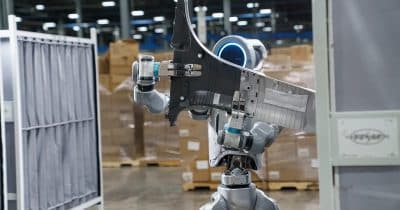
Boston Dynamics' Atlas robot has demonstrated the ability to autonomously lift and carry a full refrigerator, showcasing advanced capabilities in handling heavy objects. This development highlights significant progress in autonomous robotics for industrial automation, with implications for workplace safety and operational efficiency.
Boston Dynamics' latest Atlas demonstration marks a tangible advancement in autonomous robotics capabilities. The robot's ability to independently manage a complex task—lifting and transporting a full refrigerator—represents a step beyond pre-programmed movements toward genuine autonomous decision-making in real-world conditions. This accomplishment matters because industrial environments frequently require handling of heavy, awkwardly-shaped objects that pose safety risks and physical strain to human workers.
This development builds on years of robotics research focused on computer vision, force control, and spatial reasoning. Boston Dynamics has progressively demonstrated Atlas performing increasingly sophisticated tasks, from parkour to object manipulation. These incremental milestones signal that the robotics industry is approaching practical deployment thresholds where autonomous systems can tackle genuinely useful work rather than controlled demonstrations.
The industrial automation market represents enormous economic opportunity. Manufacturers, warehouses, and logistics operations continuously seek solutions to labor shortages, workplace injuries, and operational bottlenecks. Autonomous heavy-lifting robots could address multiple pain points simultaneously, improving throughput while reducing worker compensation claims and safety incidents. Early adoption could provide competitive advantages in cost structure and reliability.
The trajectory suggests robots like Atlas will gradually move from research environments into commercial operations over the next 2-5 years. Key metrics to monitor include deployment timelines, cost-per-unit economics, and real-world performance benchmarks against human operators. Success will depend on reliability in uncontrolled environments, maintenance requirements, and integration with existing industrial systems rather than laboratory performance alone.
- →Atlas demonstrates autonomous handling of complex real-world objects, advancing beyond basic robotic tasks.
- →Autonomous heavy-lifting robots address critical industrial challenges including worker safety and labor shortages.
- →Success depends on real-world reliability and cost-competitiveness, not laboratory demonstrations.
- →Commercial deployment timeline likely spans 2-5 years as technology matures from proof-of-concept.
- →Industrial automation market represents significant economic opportunity for robotics companies and early adopters.