
European Union designs €30B carbon market tool to stabilize prices
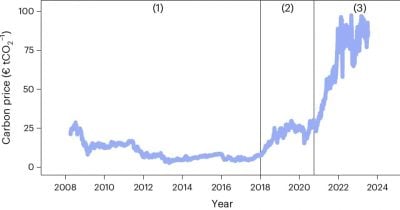
The European Union is establishing a €30 billion carbon market stabilization tool designed to smooth price volatility in its emissions trading system. The mechanism aims to support clean technology investment by maintaining predictable carbon permit pricing, though its effectiveness depends on sustained price stability.
The EU's introduction of a €30 billion carbon market stabilization tool represents a significant policy intervention in one of the world's largest cap-and-trade systems. This mechanism addresses a critical challenge facing environmental policy: the volatility of carbon permit prices can undermine investment confidence in clean technologies by making compliance costs unpredictable for industries. By creating a buffer to dampen price swings, the EU seeks to encourage sustained capital allocation toward decarbonization initiatives.
Carbon market volatility has historically plagued emissions trading schemes across jurisdictions. When permit prices spike unexpectedly, it creates compliance cost shocks that discourage long-term green investments. Conversely, price collapses reduce the incentive for emissions reductions. The EU's approach mirrors price-stabilization mechanisms used in commodity markets, though applying it to environmental policy is relatively novel at this scale.
For investors and clean technology developers, this tool could lower investment risk by reducing carbon price uncertainty—a key variable in project economics. Companies evaluating whether to fund renewable energy, electrification, or carbon capture technologies can model returns with greater confidence if permit prices remain within a predictable range. However, the tool's success requires careful calibration; overstabilization could undermine the market's core function of incentivizing emissions reductions.
The coming months will reveal whether the €30 billion allocation proves sufficient to meaningful stabilize permit prices across economic cycles. Observers should watch for coordination challenges between EU institutions managing the facility and market responses from trading participants. The EU's experience could influence other jurisdictions designing their own carbon markets.
- →EU deploys €30B stabilization tool to reduce carbon permit price volatility and support clean tech investment
- →Price predictability enables longer-term decarbonization project planning and capital deployment decisions
- →Mechanism's effectiveness depends on calibration—too much intervention could weaken market-based emissions reduction incentives
- →Policy demonstrates growing recognition that environmental markets require structural support mechanisms similar to commodity markets
- →Outcome will likely influence carbon market design in other regions and jurisdictions