
H100 rental prices slide after early May surge, says Ornn AI Inc
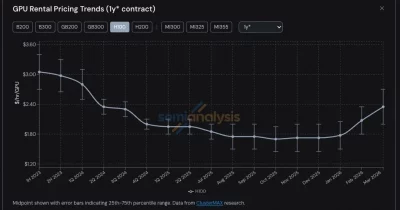
GPU rental prices for NVIDIA H100 chips have declined following a surge in early May, according to Ornn AI Inc. The GPU rental market is increasingly functioning as a financial sector, with price volatility creating both budgeting challenges for AI developers and new trading opportunities for market participants.
The H100 GPU rental market demonstrates the maturation of artificial intelligence infrastructure into a tradeable asset class. Early May's price spike likely reflected heightened demand from AI model developers and enterprises scaling their machine learning operations, but the subsequent decline suggests either demand normalization or increased supply entering the market. This volatility mirrors traditional commodity markets where supply-demand imbalances create price discovery mechanisms.
GPU rental pricing has become strategically important as enterprises evaluate the total cost of ownership for AI workloads. Rather than purchasing expensive hardware outright, organizations increasingly rent computational capacity, making pricing trends directly relevant to AI adoption timelines and profitability calculations. The shift transforms what was once a simple infrastructure procurement decision into a financial hedging consideration.
For the broader ecosystem, this market evolution has dual implications. On one hand, price volatility creates friction for AI companies attempting to budget operational expenses—sudden cost spikes can compress margins on AI services. Conversely, the emerging trading opportunities attract financial actors and arbitrageurs who provide liquidity and price stability over time. This financialization pattern parallels the development of oil futures and other commodity markets.
Monitoring H100 rental price trends reveals underlying demand patterns in the AI sector more accurately than traditional metrics. Sustained price elevation would signal robust AI development activity, while persistent declines might indicate market saturation or shift toward alternative architectures like AMD's MI300 series.
- →H100 GPU rental prices declined after surging in early May, reflecting market normalization or increased supply
- →GPU rental market is transforming into a financial sector with trading opportunities and price volatility
- →Pricing fluctuations create budgeting uncertainty for AI developers and enterprises scaling operations
- →GPU rental pricing serves as a real-time indicator of AI sector demand and infrastructure investment cycles
- →Financialization of GPU markets may eventually stabilize prices through derivatives and hedging instruments