
3D-printable humanoid legs let robotics experiments run wild
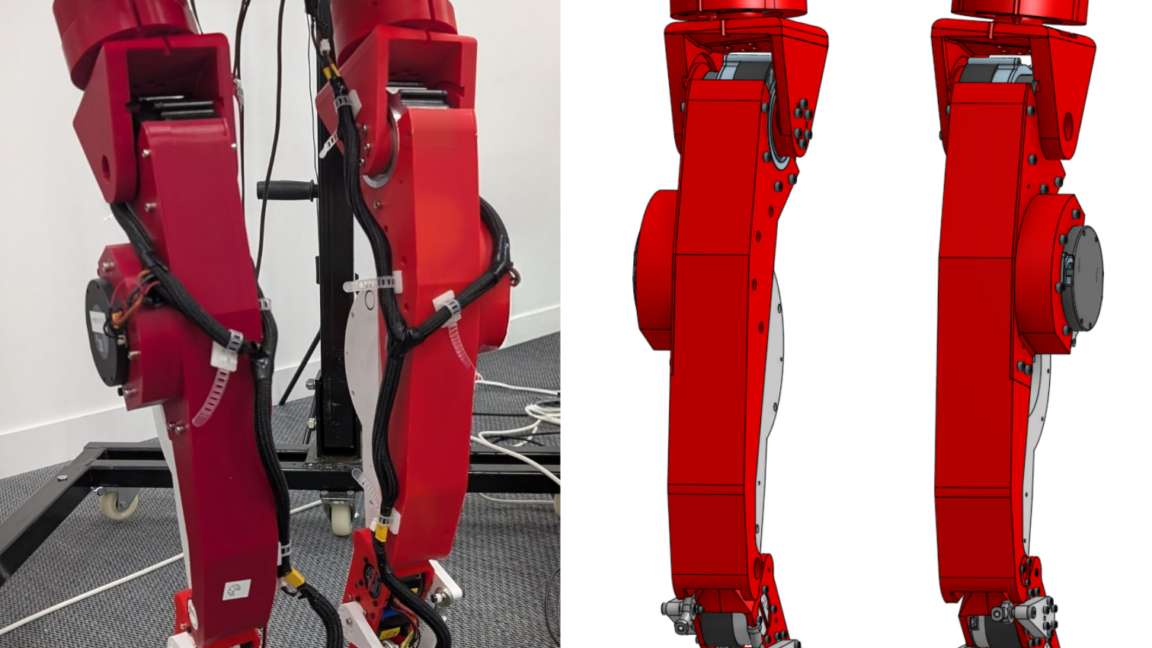
Hugging Face has launched a $2,500 bipedal robot project featuring 3D-printable humanoid legs designed for builders and researchers. The initiative democratizes robotics experimentation by making advanced hardware accessible to a broader community of developers and academics.
Hugging Face, known for democratizing machine learning through open-source tools, extends this philosophy into physical robotics with an affordable bipedal platform. The $2,500 price point represents a significant cost reduction compared to existing humanoid research robots, which typically command six-figure price tags. By designing 3D-printable components, the project eliminates manufacturing barriers and enables rapid iteration—researchers can modify designs locally without expensive tooling or long supply chains. This approach mirrors the open-source software model that made transformers and large language models accessible to small teams.
The timing reflects broader industry momentum toward embodied AI, where roboticists increasingly pair large language models with physical systems. Universities, hobbyists, and small companies have struggled to experiment with bipedal locomotion due to cost and complexity. Hugging Face's entry into hardware signals confidence in the robotics market and positions the company as an infrastructure provider across AI domains, from language models to embodied agents.
For the robotics and AI industries, this democratization could accelerate innovation in legged locomotion, balance control, and robot learning. More accessible platforms typically spawn unexpected use cases and competitive designs. However, the true impact depends on documentation quality, community adoption, and whether the platform achieves sufficient modularity to support diverse research directions. The project also raises questions about liability and safety standards as non-specialists gain access to bipedal platforms.
Observers should track adoption metrics among universities and research institutions, emergence of derivative designs, and whether this spurs similar initiatives from competitors like Boston Dynamics or academic labs.
- →Hugging Face launches $2,500 bipedal robot with 3D-printable legs to lower barriers to robotics research.
- →Open-source hardware design allows researchers to customize and iterate on designs locally without expensive manufacturing.
- →Project democratizes embodied AI experimentation, previously limited to well-funded institutions and companies.
- →Timing aligns with growing interest in pairing large language models with physical robotic systems.
- →Success depends on community adoption, documentation quality, and safety standards for non-specialist builders.