
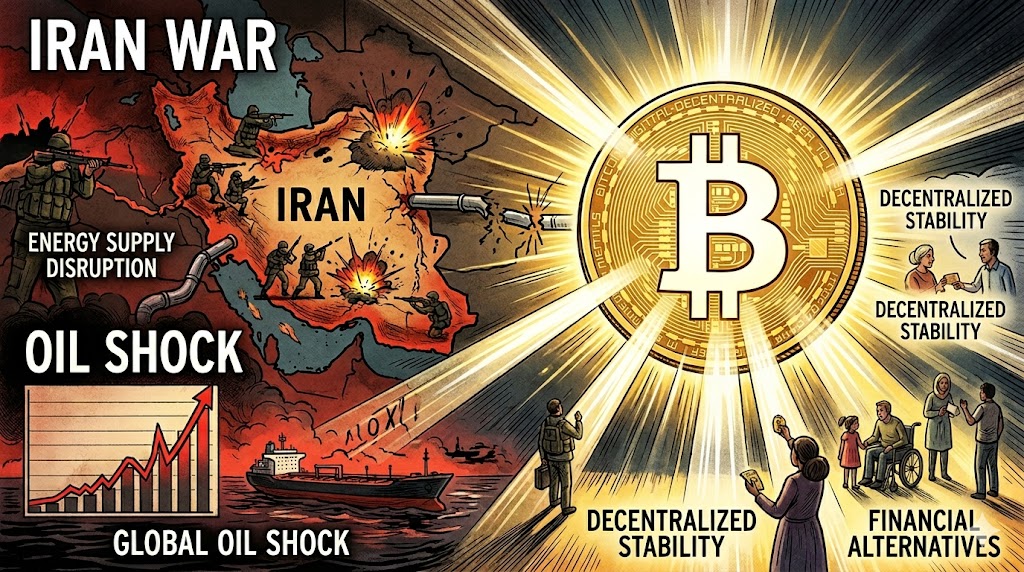
Geopolitical tensions from the Iran War are driving renewed interest in Bitcoin's role as a trustless payment system outside traditional financial infrastructure. The market is repricing Bitcoin as investors recognize its value proposition during periods of international instability and potential sanctions.
Geopolitical conflicts create structural demand for alternative payment systems that operate independently of government control and traditional banking channels. The Iran War highlights a critical use case for Bitcoin: enabling transactions when conventional financial rails face disruption due to sanctions, capital controls, or international tension. This scenario demonstrates why Bitcoin's decentralized architecture holds tangible value beyond speculative trading.
Historically, geopolitical crises have accelerated Bitcoin adoption in sanctioned or economically isolated regions. Iran itself has explored cryptocurrency as a workaround to international financial restrictions. The current conflict reinforces this pattern, as parties seek payment mechanisms immune to freeze orders and diplomatic leverage. This repeats a cycle observed during previous sanctions regimes, where affected populations discovered Bitcoin's utility as a censorship-resistant store of value and medium of exchange.
Market participants are responding by repricing Bitcoin upward, treating it as a hedge against geopolitical risk alongside traditional safe-haven assets like gold. Institutional investors increasingly recognize Bitcoin as portfolio insurance against currency debasement and financial system fragmentation. This repricing reflects a shift from viewing Bitcoin purely as a speculative asset to valuing it as critical infrastructure for cross-border commerce.
Investors should monitor escalation indicators and their correlation with Bitcoin price movements. If sanctions expand or traditional banking channels face further restrictions, adoption acceleration could sustain higher Bitcoin valuations. Conversely, diplomatic resolution would likely reduce geopolitical premium pricing. The broader trend suggests Bitcoin's macroeconomic role is solidifying as global monetary and political systems face continued stress.
- →Bitcoin is being repriced as a hedge against geopolitical risk and international financial disruption.
- →Sanctions and capital controls create structural demand for trustless, censorship-resistant payment systems.
- →The Iran conflict demonstrates real-world utility for Bitcoin beyond speculation.
- →Institutional investors increasingly view Bitcoin as portfolio insurance against geopolitical uncertainty.
- →Escalation or sanctions expansion could accelerate adoption and sustain higher valuations.