
Thinking to recall: How reasoning unlocks parametric knowledge in LLMs
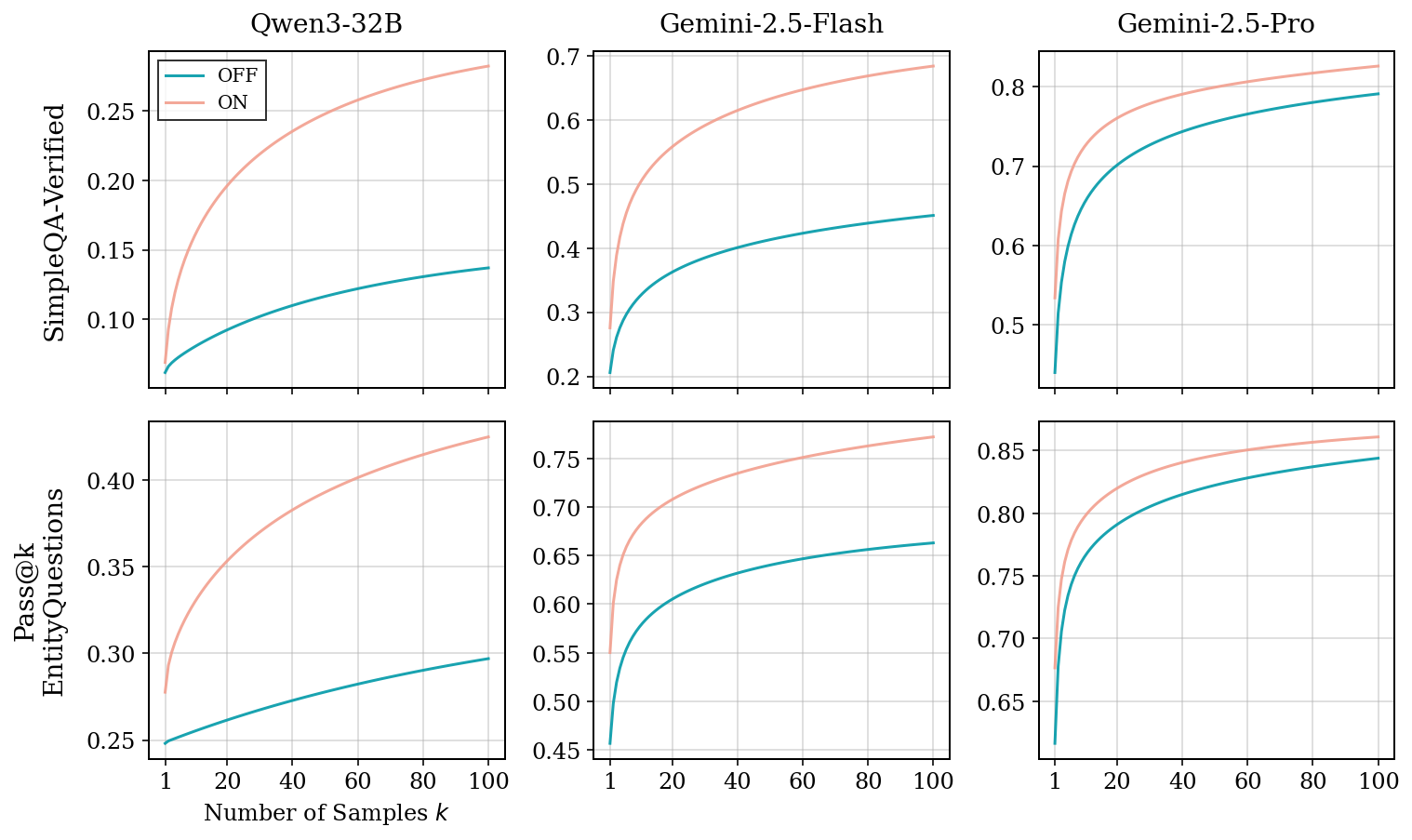
Researchers demonstrate that reasoning processes enable large language models to effectively recall and utilize parametric knowledge stored in their weights, challenging previous assumptions about knowledge retrieval mechanisms. This finding has significant implications for understanding how LLMs access information and suggests that explicit reasoning may be essential for optimal knowledge extraction.
Recent research into large language model architecture reveals a critical insight: reasoning doesn't just help LLMs solve complex problems—it fundamentally unlocks their ability to access stored parametric knowledge. This distinction matters because it suggests that knowledge retrieval in neural networks isn't purely about pattern matching or direct memory access, but rather requires deliberate cognitive processes. The discovery emerged from systematic testing showing that models performing explicit reasoning steps demonstrate markedly improved accuracy when recalling specific information compared to direct retrieval attempts.
This builds on years of investigation into how transformers store and retrieve knowledge. Previous work focused on identifying where information resides within model weights, but this research shifts attention to the mechanisms that activate that knowledge. The connection between reasoning capacity and knowledge accessibility explains why chain-of-thought prompting techniques have proven so effective in practice—they don't merely improve reasoning for reasoning's sake, but actually enhance the model's ability to tap into its internal knowledge repositories.
For developers and organizations deploying LLMs, these findings suggest practical optimization strategies. Architectures and prompting techniques that encourage explicit reasoning pathways may yield better performance on knowledge-intensive tasks without requiring additional training or fine-tuning. This has downstream implications for applications spanning question-answering systems, knowledge retrieval tools, and reasoning-dependent AI agents.
Looking forward, this understanding opens new research directions into neural knowledge encoding and retrieval. Future work may focus on identifying optimal reasoning structures for specific knowledge domains or developing training methods that strengthen the reasoning-knowledge connection from the ground up.
- →Reasoning processes enable LLMs to effectively access parametric knowledge stored in model weights.
- →Explicit reasoning outperforms direct knowledge retrieval, explaining why chain-of-thought techniques work well.
- →The finding suggests knowledge isn't uniformly accessible but requires cognitive activation mechanisms.
- →Developers can optimize LLM performance on knowledge tasks through reasoning-focused prompting without additional training.
- →Future research may focus on training methods that strengthen the connection between reasoning and knowledge encoding.