
Trump signs executive order for voluntary AI safety testing amid criticism it changes nothing
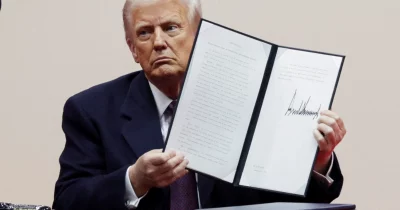
President Trump signed an executive order establishing a voluntary AI safety testing framework, drawing criticism for lacking enforcement mechanisms and potentially prioritizing industry growth over regulatory oversight. The initiative may boost investor confidence in AI development but raises concerns about adequate safety standards and meaningful regulatory impact.
Trump's executive order on voluntary AI safety testing represents a regulatory approach that emphasizes market-driven solutions over mandatory compliance frameworks. Rather than imposing strict safety requirements, the order allows AI companies to self-regulate their testing protocols, reflecting a broader deregulatory stance that prioritizes innovation velocity and competitive advantage in the AI sector.
This move contrasts sharply with international approaches, particularly the EU's AI Act, which mandates comprehensive safety assessments and compliance standards. The voluntary nature of Trump's framework follows his administration's historical preference for light-touch regulation, allowing companies to balance safety concerns with development speed. However, critics argue this approach lacks teeth—without enforcement mechanisms or penalties for non-compliance, companies face minimal incentive to implement rigorous safety protocols beyond what competitive pressures demand.
For investors and the AI industry, the executive order signals a favorable regulatory environment that could accelerate AI commercialization and reduce compliance costs. This may boost investor confidence in AI-native companies and existing players expanding their AI capabilities. However, the lack of standardized safety requirements creates information asymmetries, where investors cannot easily assess true risk profiles across different AI systems.
The longer-term implications remain uncertain. A voluntary framework may prove sufficient if market competition naturally incentivizes safety improvements, or it could create a race-to-the-bottom dynamic where companies minimize safety investments to reduce costs. Stakeholders should monitor whether companies voluntarily adopt robust safety testing and whether gaps in the voluntary system eventually prompt legislative action. The coming months will reveal whether industry self-regulation proves effective or necessitates more stringent government intervention.
- →Voluntary AI safety testing prioritizes innovation over mandatory compliance, potentially reducing regulatory friction for companies.
- →The framework lacks enforcement mechanisms or penalties, limiting its practical impact on actual safety standards.
- →Investor confidence in AI development may increase due to lighter regulatory burden and faster commercialization timelines.
- →Contrasts sharply with international standards like the EU AI Act, creating regulatory arbitrage opportunities.
- →Effectiveness depends entirely on whether companies voluntarily adopt rigorous safety protocols without legal obligation.