
US personal savings rate drops sharply in 2026, approaching historic lows
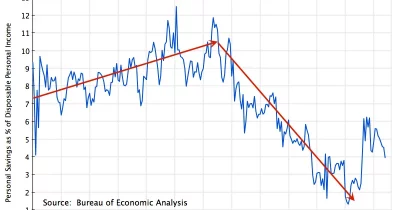
The US personal savings rate has declined sharply in 2026 and is approaching historic lows, signaling potential economic vulnerability. This trend threatens consumer spending capacity, investment behaviors, and overall financial stability, with ripple effects across markets including cryptocurrency and digital assets.
The declining US personal savings rate reflects a structural shift in consumer financial behavior that carries significant macroeconomic implications. When households save less, they have reduced cushions for economic shocks and face constraints on discretionary spending, which historically drives economic growth. This trend suggests consumers are either spending more relative to income or facing wage pressures that limit savings capacity—both concerning signals for sustained economic health.
The broader context reveals decades of declining savings rates punctuated by pandemic-era spikes when fiscal stimulus enabled elevated savings. The current decline suggests those temporary gains have eroded as inflation, higher debt servicing costs, and housing affordability challenges strain household finances. Wage growth has not kept pace with cost-of-living increases, forcing consumers to choose between maintaining consumption and building reserves.
For cryptocurrency and digital asset markets, this development carries mixed implications. A financially stressed consumer base typically reduces discretionary purchases, which could dampen retail crypto investment demand. However, deteriorating savings metrics often precede monetary policy shifts, potentially triggering inflation concerns that historically support alternative assets like Bitcoin. Institutional investors monitoring macro indicators may view declining savings as a catalyst for alternative asset allocation.
Looking ahead, traders should monitor whether the Federal Reserve responds with policy accommodation, which could strengthen the case for non-correlated assets. Watch consumer spending data and credit growth—if households are maintaining consumption through debt rather than savings depletion, credit stress indicators will clarify economic trajectory. The sustainability of this savings decline through 2026 will determine whether crypto markets view macro conditions as deflationary pressure or inflation-hedging opportunity.
- →US personal savings rate approaching historic lows in 2026 signals weakening household financial resilience
- →Consumers facing inflation and high debt costs may have limited capacity for discretionary or investment spending
- →Declining savings could reduce retail crypto participation but may trigger monetary policy responses favoring alternative assets
- →Macro-sensitive investors should monitor Federal Reserve policy shifts and credit growth as leading indicators
- →Economic vulnerability at consumer level may create volatility across risk assets including cryptocurrencies