
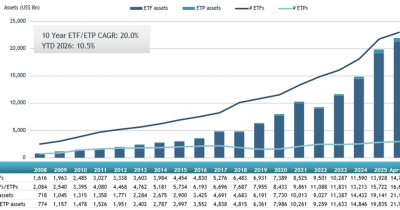
Vanguard's VOO ETF is poised to become the first exchange-traded fund to surpass $1 trillion in assets under management, underscoring the massive shift toward low-cost passive investing. This milestone reflects the decades-long structural transition away from active management and highlights how index-tracking strategies have fundamentally reshaped global capital markets.
VOO's imminent $1 trillion milestone represents a watershed moment for the ETF industry and passive investing broadly. The fund's achievement demonstrates that a single, low-cost index tracker has accumulated more assets than entire investment ecosystems of previous generations, signaling a decisive victory for the passive management model over traditional active strategies. This concentration of capital in one product raises important questions about market structure and systemic risk while validating the thesis that lower fees and transparent tracking substantially outcompete alternatives.
The rise of VOO and similar ETFs stems from decades of active managers failing to consistently beat market benchmarks after fees. The 2008 financial crisis accelerated this trend as retail and institutional investors lost faith in expensive active strategies. Vanguard's pioneering low-cost structure created a competitive race to the bottom on fees, eventually making index investing the default choice for most capital allocators.
This consolidation reshapes market dynamics in consequential ways. Massive passive flows into broad-market ETFs can amplify momentum and reduce price discovery efficiency in underlying securities. Index composition changes now move markets more predictably, and the concentration of voting power among passive providers creates governance concerns. For retail investors, the democratization of low-cost diversification is genuinely beneficial, though it masks structural risks.
Going forward, regulators may scrutinize the concentration risk posed by mega-ETFs, while competition could fragment assets across newer competitors. The financial industry must address whether passive dominance compromises market efficiency and whether systemic safeguards adequately account for this new architecture.
- →VOO's $1T milestone exemplifies passive investing's triumph over active management through superior cost structure and consistent benchmark tracking.
- →Massive ETF consolidation creates potential systemic risks and reduces natural price discovery mechanisms in financial markets.
- →The shift enables retail investors to access diversified portfolios at minimal cost, democratizing previously expensive strategies.
- →Index providers now wield significant market influence through their composition decisions and voting power.
- →Regulators and market participants must address structural implications of trillion-dollar passive fund concentration.