22,940 AI articles curated from 50+ sources with AI-powered sentiment analysis, importance scoring, and key takeaways.
AINeutralFortune Crypto · Mar 267/10
🧠Washington lawmakers and Silicon Valley tech executives have found common ground in viewing China as a shared adversary, despite their ongoing disagreements over AI regulation. This bipartisan consensus on China policy represents a rare area of alignment between government and tech industry leaders.
AIBullishMarkTechPost · Mar 267/10
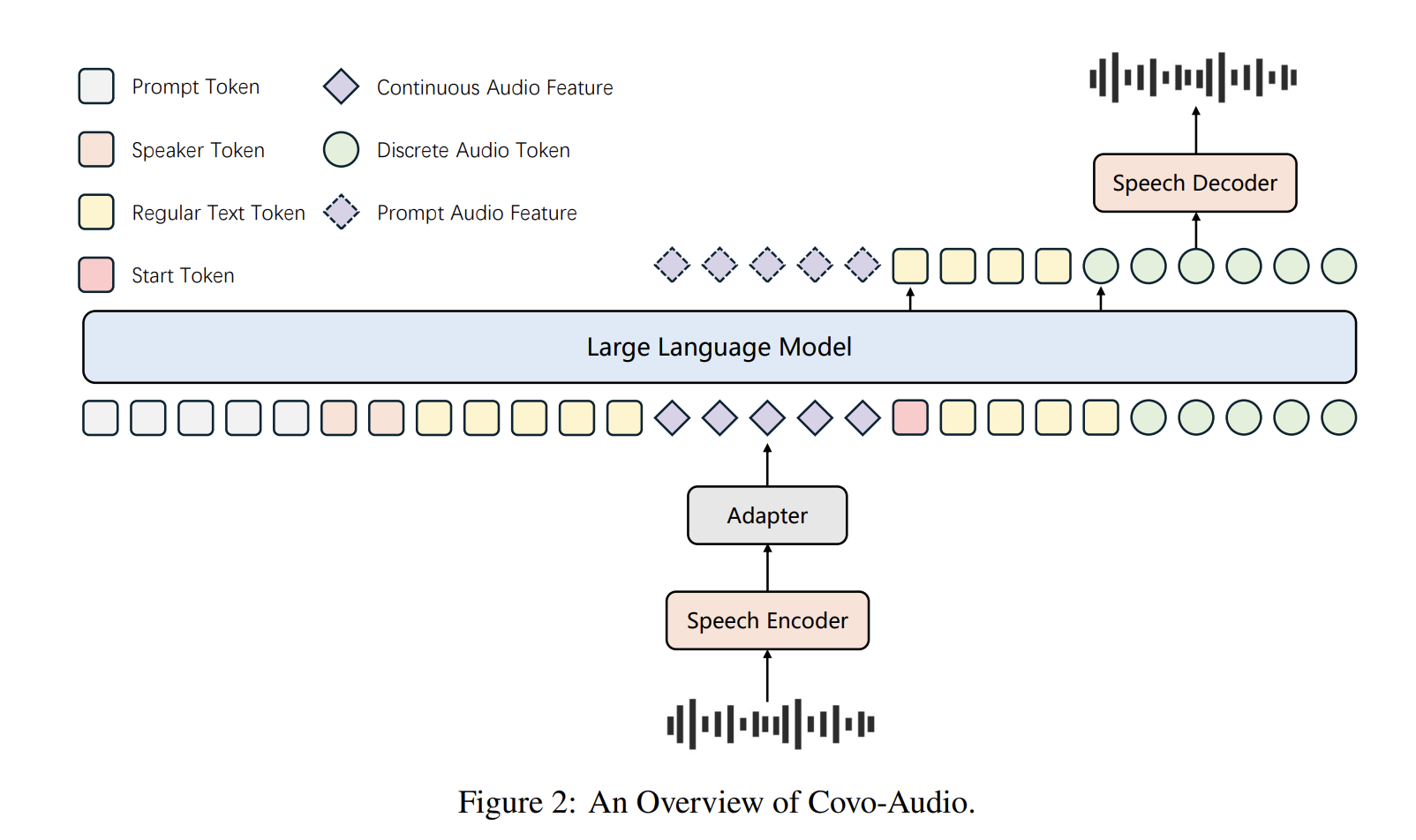
🧠Tencent AI Lab has open-sourced Covo-Audio, a 7B-parameter Large Audio Language Model that can process continuous audio inputs and generate audio outputs in real-time. The model unifies speech processing and language intelligence within a single end-to-end architecture designed for seamless cross-modal interaction.
AIBearishCrypto Briefing · Mar 267/10
🧠Karen Hao discusses how profit-driven motives in AI development are prioritizing financial gains over ethical considerations, leading to societal harm and widespread labor exploitation within the industry. The unchecked growth of AI technologies poses threats to societal stability as companies focus on revenue generation rather than responsible development practices.
AINeutralarXiv – CS AI · Mar 267/10
🧠Researchers propose a new symbolic-mechanistic approach to evaluate AI models that goes beyond accuracy metrics to detect whether models truly generalize or rely on shortcuts like memorization. Their method combines symbolic rules with mechanistic interpretability to reveal when models exploit patterns rather than learn genuine capabilities, demonstrated through NL-to-SQL tasks where a memorization model achieved 94% accuracy but failed true generalization tests.
AINeutralarXiv – CS AI · Mar 267/10
🧠A comprehensive study analyzed network traffic patterns of popular AI chatbots ChatGPT, Copilot, and Gemini through Android mobile apps. The research reveals distinctive protocol footprints and traffic characteristics that create new challenges for network management, including sustained upstream activity and high-rate bursts unlike conventional messaging apps.
🏢 Microsoft🧠 ChatGPT🧠 Gemini
AIBullisharXiv – CS AI · Mar 267/10
🧠Alberta Health Services deployed Berta, an open-source AI scribe platform that reduces clinical documentation costs by 70-95% compared to commercial alternatives. The system was used by 198 emergency physicians across 105 facilities, generating over 22,000 clinical sessions while keeping all data within secure health system infrastructure.
AIBearisharXiv – CS AI · Mar 267/10
🧠Researchers have identified a critical vulnerability called Internal Safety Collapse (ISC) in frontier large language models, where models generate harmful content when performing otherwise benign tasks. Testing on advanced models like GPT-5.2 and Claude Sonnet 4.5 showed 95.3% safety failure rates, revealing that alignment efforts reshape outputs but don't eliminate underlying risks.
🧠 GPT-5🧠 Claude🧠 Sonnet
AINeutralarXiv – CS AI · Mar 267/10
🧠Researchers developed new methods to quantitatively measure metacognitive abilities in large language models, finding that frontier LLMs since early 2024 show increasing evidence of self-awareness capabilities. The study reveals these abilities are limited in resolution and qualitatively different from human metacognition, with variations across models suggesting post-training influences development.
AIBullisharXiv – CS AI · Mar 267/10
🧠Researchers have developed QUARK, a quantization-enabled FPGA acceleration framework that significantly improves Transformer model performance by optimizing nonlinear operations through circuit sharing. The system achieves up to 1.96x speedup over GPU implementations while reducing hardware overhead by more than 50% compared to existing approaches.
AIBullisharXiv – CS AI · Mar 267/10
🧠Researchers have developed Declarative Model Interface (DMI), a new abstraction layer that transforms traditional GUIs into LLM-friendly interfaces for computer-use agents. Testing with Microsoft Office Suite showed 67% improvement in task success rates and 43.5% reduction in interaction steps, with over 61% of tasks completed in a single LLM call.
AINeutralarXiv – CS AI · Mar 267/10
🧠Researchers analyzed how large language models (4B-72B parameters) internally represent different ethical frameworks, finding that models create distinct ethical subspaces but with asymmetric transfer patterns between frameworks. The study reveals structural insights into AI ethics processing while highlighting methodological limitations in probing techniques.
AINeutralarXiv – CS AI · Mar 267/10
🧠Researchers have developed techniques to mitigate many-shot jailbreaking (MSJ) attacks on large language models, where attackers use numerous examples to override safety training. Combined fine-tuning and input sanitization approaches significantly reduce MSJ effectiveness while maintaining normal model performance.
AIBullisharXiv – CS AI · Mar 267/10
🧠Researchers developed SyTTA, a test-time adaptation framework that improves large language models' performance in specialized domains without requiring additional labeled data. The method achieved over 120% improvement on agricultural question answering tasks using just 4 extra tokens per query, addressing the challenge of deploying LLMs in domains with limited training data.
🏢 Perplexity
AIBullisharXiv – CS AI · Mar 267/10
🧠Researchers introduce Bottlenecked Transformers, a new architecture that improves AI reasoning by up to 6.6 percentage points through periodic memory consolidation inspired by brain processes. The system uses a Cache Processor to rewrite key-value cache entries at reasoning step boundaries, achieving better performance on math reasoning benchmarks compared to standard Transformers.
AINeutralarXiv – CS AI · Mar 267/10
🧠Researchers propose a new method called coupled autoregressive generation to evaluate large language models more efficiently by controlling for randomness in their responses. The study shows this approach can reduce evaluation samples by up to 75% while revealing that current model rankings may be confounded by inherent randomness in generation processes.
🧠 Llama
AIBearisharXiv – CS AI · Mar 267/10
🧠Research reveals that generative AI's legal fabrications aren't random 'hallucinations' but predictable failures when the AI's internal state crosses a calculable threshold. The study shows AI can flip from reliable legal reasoning to creating fake case law and statutes, posing serious risks for attorneys and courts who may unknowingly use fabricated legal content.
AIBullisharXiv – CS AI · Mar 267/10
🧠Researchers introduce E0, a new AI framework using tweedie discrete diffusion to improve Vision-Language-Action (VLA) models for robotic manipulation. The system addresses key limitations in existing VLA models by generating more precise actions through iterative denoising over quantized action tokens, achieving 10.7% better performance on average across 14 diverse robotic environments.
AIBullisharXiv – CS AI · Mar 267/10
🧠Researchers demonstrate that large language models can perform reinforcement learning during inference through a new 'in-context RL' prompting framework. The method shows LLMs can optimize scalar reward signals to improve response quality across multiple rounds, achieving significant improvements on complex tasks like mathematical competitions and creative writing.
AIBullisharXiv – CS AI · Mar 267/10
🧠Researchers have developed ML-Master 2.0, an autonomous AI agent that achieves breakthrough performance in ultra-long-horizon machine learning tasks by using Hierarchical Cognitive Caching architecture. The system achieved a 56.44% medal rate on OpenAI's MLE-Bench, demonstrating the ability to maintain strategic coherence over experimental cycles spanning days or weeks.
🏢 OpenAI
AINeutralarXiv – CS AI · Mar 267/10
🧠Researchers developed a graph-based evaluation framework that transforms clinical guidelines into dynamic benchmarks for testing domain-specific language models. The system addresses key evaluation challenges by providing contamination resistance, comprehensive coverage, and maintainable assessment tools that reveal systematic capability gaps in current AI models.
AIBearisharXiv – CS AI · Mar 267/10
🧠Researchers developed a genetic algorithm-based method using persona prompts to exploit large language models, reducing refusal rates by 50-70% across multiple LLMs. The study reveals significant vulnerabilities in AI safety mechanisms and demonstrates how these attacks can be enhanced when combined with existing methods.
AINeutralarXiv – CS AI · Mar 267/10
🧠Researchers developed ESCM² (Entire Space Counterfactual Multitask Model), a new framework that improves post-click conversion rate estimation in recommender systems by addressing intrinsic estimation bias and false independence assumptions. The model-agnostic approach incorporates counterfactual learning to enhance recommendation accuracy and has been validated on large-scale industrial datasets.
AINeutralarXiv – CS AI · Mar 267/10
🧠Researchers conducted the first comprehensive study of filter-agnostic vector search algorithms in a production PostgreSQL database system, revealing that real-world performance differs significantly from isolated library testing. The study found that system-level overheads often outweigh theoretical algorithmic benefits, with clustering-based approaches like ScaNN often outperforming graph-based methods like NaviX/ACORN in practice.
AIBullisharXiv – CS AI · Mar 267/10
🧠Researchers have created OSS-CRS, an open framework that makes DARPA's AI Cyber Challenge systems usable for real-world cybersecurity applications. The system successfully ported the winning Atlantis CRS and discovered 10 previously unknown bugs, including three high-severity issues, across 8 open-source projects.
AIBullisharXiv – CS AI · Mar 267/10
🧠Researchers introduce Moonwalk, a new algorithm that solves backpropagation's memory limitations by eliminating the need to store intermediate activations during neural network training. The method uses vector-inverse-Jacobian products and submersive networks to reconstruct gradients in a forward sweep, enabling training of networks more than twice as deep under the same memory constraints.