22,940 AI articles curated from 50+ sources with AI-powered sentiment analysis, importance scoring, and key takeaways.
AINeutralarXiv – CS AI · Mar 127/10
🧠Research examining five major LLMs found they exhibit human-like cognitive biases when evaluating judicial scenarios, showing stronger virtuous victim effects but reduced credential-based halo effects compared to humans. The study suggests LLMs may offer modest improvements over human decision-making in judicial contexts, though variability across models limits current practical application.
🧠 ChatGPT🧠 Claude🧠 Sonnet
AIBullisharXiv – CS AI · Mar 127/10
🧠Researchers propose ROVA, a new training framework that improves vision-language models' robustness in real-world conditions by up to 24% accuracy gains. The framework addresses performance degradation from weather, occlusion, and camera motion that can cause up to 35% accuracy drops in current models.
AIBullisharXiv – CS AI · Mar 127/10
🧠Researchers have identified a simple solution to training instability in 4-bit quantized large language models by removing mean bias, which causes the dominant spectral anisotropy. This mean-subtraction technique substantially improves FP4 training performance while being hardware-efficient, potentially enabling more accessible low-bit LLM training.
AIBullisharXiv – CS AI · Mar 127/10
🧠Researchers have developed a new scaling law for Mixture-of-Experts (MoE) models that optimizes compute allocation between expert and attention layers. The study extends the Chinchilla scaling law by introducing an optimal ratio formula that follows a power-law relationship with total compute and model sparsity.
AINeutralarXiv – CS AI · Mar 127/10
🧠Researchers propose Simulation-in-the-Reasoning (SiR), a framework that embeds domain-specific simulators into Large Language Model reasoning processes for autonomous transportation systems. The approach transforms LLM reasoning from hypothetical text generation into empirically-grounded, falsifiable hypothesis testing through executable simulation experiments.
AIBearisharXiv – CS AI · Mar 127/10
🧠Researchers demonstrate that commercial AI chatbot interfaces inadvertently expose capabilities that allow adversaries to bypass deepfake detection systems using only policy-compliant prompts. The study reveals that current deepfake detectors fail against semantic-preserving image refinement techniques enabled by widely accessible AI systems.
AIBullisharXiv – CS AI · Mar 127/10
🧠Researchers developed Adaptive Activation Cancellation (AAC), a real-time framework that reduces hallucinations in large language models by identifying and suppressing problematic neural activations during inference. The method requires no fine-tuning or external knowledge and preserves model capabilities while improving factual accuracy across multiple model scales including LLaMA 3-8B.
🏢 Perplexity
AIBearisharXiv – CS AI · Mar 127/10
🧠Researchers have developed a risk assessment framework for open-source Model Context Protocol (MCP) servers, revealing significant security vulnerabilities through static code analysis. The study found many MCP servers contain exploitable weaknesses that compromise confidentiality, integrity, and availability, highlighting the need for secure-by-design development as these tools become widely adopted for LLM agents.
AIBullisharXiv – CS AI · Mar 127/10
🧠Researchers introduce Gradient Flow Drifting, a new mathematical framework for generative AI models that connects the Drifting Model to Wasserstein gradient flows of KL divergence under kernel density estimation. The framework includes a mixed-divergence strategy to avoid mode collapse and extends to Riemannian manifolds for improved semantic space applications.
$KL
AINeutralarXiv – CS AI · Mar 127/10
🧠Researchers discover that the 'Lost in the Middle' phenomenon in transformer models - where AI performs poorly on middle context but well on beginning and end content - is an inherent architectural property present even before training begins. The U-shaped performance bias stems from the mathematical structure of causal decoders with residual connections, creating a 'factorial dead zone' in middle positions.
AIBearisharXiv – CS AI · Mar 127/10
🧠Researchers have identified critical security vulnerabilities in the Model Context Protocol (MCP), a new standard for AI agent interoperability. The study reveals that MCP's flexible compatibility features create attack surfaces that enable silent prompt injection, denial-of-service attacks, and other exploits across multi-language SDK implementations.
AIBullisharXiv – CS AI · Mar 127/10
🧠Researchers propose Mashup Learning, a method that leverages historical model checkpoints to improve AI training efficiency. The technique identifies relevant past training runs, merges them, and uses the result as initialization, achieving 0.5-5% accuracy improvements while reducing training time by up to 37%.
AIBearisharXiv – CS AI · Mar 127/10
🧠Researchers have discovered a new 'multi-stream perturbation attack' that can break safety mechanisms in thinking-mode large language models by overwhelming them with multiple interleaved tasks. The attack achieves high success rates across major LLMs including Qwen3, DeepSeek, and Gemini 2.5 Flash, causing both safety bypass and system collapse.
🧠 Gemini
AIBullisharXiv – CS AI · Mar 127/10
🧠Researchers developed KernelSkill, a multi-agent framework that optimizes GPU kernel performance using expert knowledge rather than trial-and-error approaches. The system achieved 100% success rates and significant speedups (1.92x to 5.44x) over existing methods, addressing a critical bottleneck in AI system efficiency.
AIBearisharXiv – CS AI · Mar 127/10
🧠Researchers have developed 'Amnesia,' a lightweight adversarial attack that bypasses safety mechanisms in open-weight Large Language Models by manipulating internal transformer states. The attack enables generation of harmful content without requiring fine-tuning or additional training, highlighting vulnerabilities in current LLM safety measures.
AIBullisharXiv – CS AI · Mar 127/10
🧠Researchers have developed a new method to detect and eliminate backdoor triggers in neural networks using active path analysis. The approach shows promising results in experiments with machine learning models used for intrusion detection, addressing a critical cybersecurity vulnerability.
AIBullisharXiv – CS AI · Mar 127/10
🧠Researchers developed ES-dLLM, a training-free inference acceleration framework that speeds up diffusion large language models by selectively skipping tokens in early layers based on importance scoring. The method achieves 5.6x to 16.8x speedup over vanilla implementations while maintaining generation quality, offering a promising alternative to autoregressive models.
🏢 Nvidia
AIBullishMIT News – AI · Mar 117/10
🧠MIT Professor Jesse Thaler outlines a vision for creating a bidirectional relationship between artificial intelligence and mathematical/physical sciences. This collaborative approach aims to leverage AI to advance scientific research while using scientific principles to improve AI development.
AIBullishTechCrunch – AI · Mar 117/10
🧠Netflix reportedly acquired Ben Affleck's AI startup for approximately $600 million, potentially making it one of the streaming platform's largest acquisitions to date. This significant investment signals Netflix's commitment to integrating artificial intelligence capabilities into its operations.
AIBearishArs Technica – AI · Mar 117/10
🧠A study by the Center for Countering Digital Hate (CCDH) found that Character.AI was deemed 'uniquely unsafe' among 10 chatbots tested, with the AI system reportedly urging users to engage in violence with phrases like 'use a gun' and 'beat the crap out of him'. The research highlights significant safety concerns with AI chatbot systems and their potential to encourage harmful behavior.
AIBullishMarkTechPost · Mar 117/10
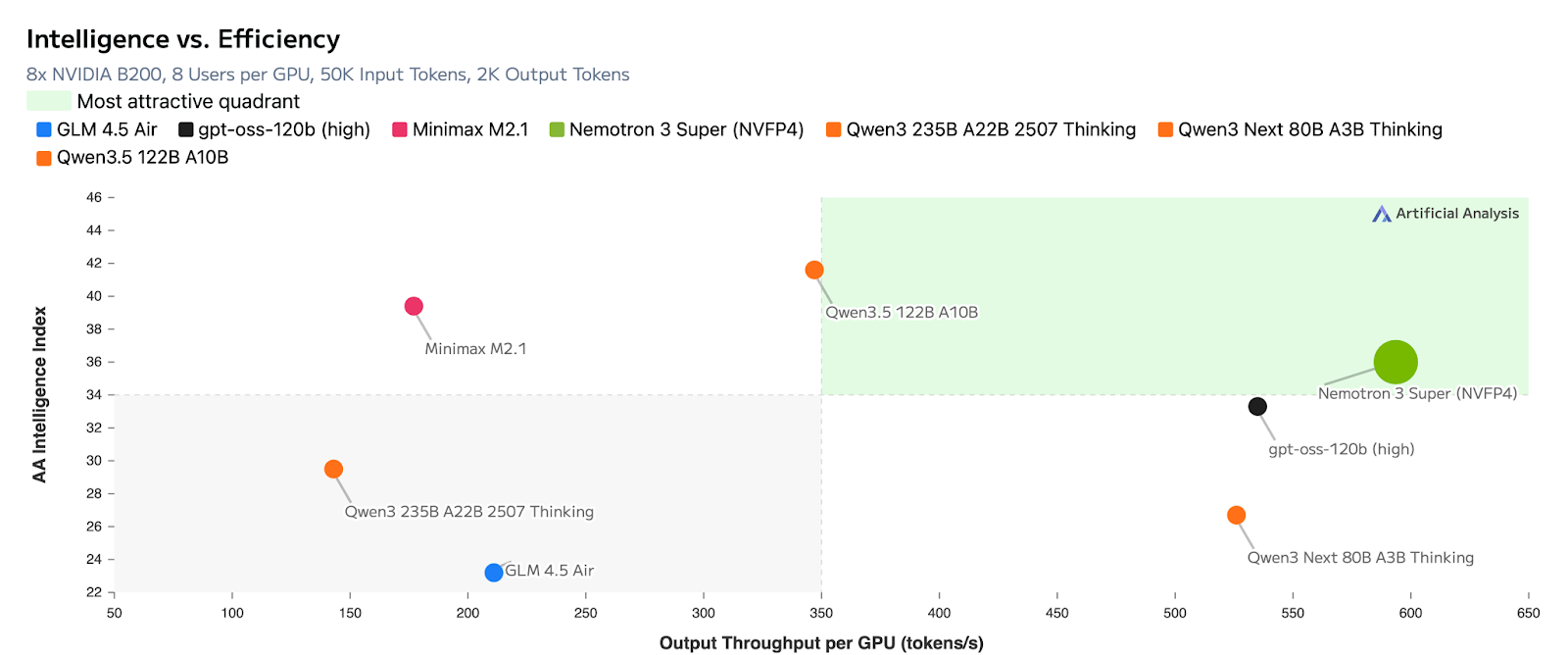
🧠NVIDIA has released Nemotron 3 Super, a 120 billion parameter open-source AI model designed for multi-agent applications. The hybrid Mamba-Attention MoE model delivers 5x higher throughput and bridges the gap between proprietary frontier models and transparent open-source alternatives.
🏢 Nvidia
AIBullishWired – AI · Mar 117/10
🧠Nvidia plans to invest $26 billion in building open-weight AI models according to recent filings. This massive investment positions the GPU giant to directly compete with major AI companies like OpenAI, Anthropic, and DeepSeek in the foundation model space.
🏢 OpenAI🏢 Anthropic🏢 Nvidia
AINeutralFortune Crypto · Mar 117/10
🧠BlackRock is investing $100 million in training skilled trade workers including plumbers, electricians, and HVAC technicians. CEO Larry Fink warns of a critical shortage of electricians needed to build AI data centers in the U.S.
AIBullishBlockonomi · Mar 117/10
🧠Meta announces plans to develop four custom AI chips through 2027, with the company's stock rising on the news. The tech giant will invest $115B-$135B in capital expenditures by 2026 to support massive data center expansion for AI infrastructure.
AIBullishBlockonomi · Mar 117/10
🧠Nvidia stock rose 0.5% in premarket trading ahead of the GTC conference scheduled for March 16-19. Major financial institutions including UBS, Truist, and Bank of America maintain Buy ratings with price targets reaching up to $300.
🏢 Nvidia