22,940 AI articles curated from 50+ sources with AI-powered sentiment analysis, importance scoring, and key takeaways.
AIBullisharXiv – CS AI · Jun 97/10
🧠Researchers introduce BCG-FM, a foundation model trained on 2.75 million hours of ballistocardiography data from nearly 146,000 individuals, enabling non-invasive cardiac health monitoring through piezoelectric bed sensors. The model achieves state-of-the-art biological age estimation and demonstrates clinical relevance across multiple health conditions without requiring deliberate user action.
AINeutralarXiv – CS AI · Jun 97/10
🧠Researchers introduce SWE-Marathon, a benchmark testing AI agents on 20 ultra-long-horizon software engineering tasks requiring millions of tokens and hours of sustained work. Current frontier coding agents solve fewer than 30% of tasks, revealing critical gaps in planning, self-verification, and memory management that limit real-world deployment.
AIBullisharXiv – CS AI · Jun 97/10
🧠Researchers introduce STAR, a novel Mixture-of-Experts routing mechanism that leverages subspace learning to improve how AI models distribute computational tasks across specialized expert networks. By incorporating structure-aware routing via the Generalized Hebbian Algorithm, STAR demonstrates more stable and efficient expert specialization compared to traditional shallow linear routing approaches.
AIBullisharXiv – CS AI · Jun 97/10
🧠Researchers propose Inference-Time Conformal Reasoning (ITCR), a framework that integrates conformal prediction directly into LLM reasoning generation to provide mathematically valid factuality guarantees. The method addresses the structural nature of uncertainty in multi-step reasoning by calibrating when to stop generation based on graph-level factuality signals, delivering more accurate outputs than post-hoc correction approaches.
AIBullisharXiv – CS AI · Jun 97/10
🧠AgentTrust v2 introduces a self-improving trust layer for AI agents that distinguishes between lexical (rule-detectable) and semantic (intent-dependent) threats. Using an LLM judge combined with a dual-store system, it achieves 83.6-85.2% accuracy on semantic threats while progressively distilling deterministic rules for lexical threats, demonstrating zero false-blocks across 45,000 test actions.
AIBullisharXiv – CS AI · Jun 97/10
🧠MatMind is a generative foundation model designed for crystal materials science that unifies structure prediction, property forecasting, and material design within a single LLM-based framework. The model surpasses specialized graph neural networks on benchmark tasks while achieving 65.3% success on crystal generation, demonstrating that unified AI architectures can compete with purpose-built narrow specialists.
AINeutralarXiv – CS AI · Jun 97/10
🧠Researchers present an open-source system for overseeing LLM agents taking real-world actions, revealing that human reviewers have only moderate agreement on what constitutes risky behavior and that human fatigue creates an inverted-U safety curve where excessive oversight can paradoxically reduce system safety. The framework reframes agent guardrails as a resource-allocation problem rather than a pure classification challenge.
AIBullisharXiv – CS AI · Jun 97/10
🧠Researchers introduce Collaboration Policy Tree (Co-pi-tree), a method that distills large language model reasoning into interpretable, executable policy trees for human-AI collaboration. The approach achieves 35% performance improvement while reducing LLM queries by 78% and latency by 97%, addressing key limitations of black-box reinforcement learning and costly real-time LLM querying.
AIBullisharXiv – CS AI · Jun 97/10
🧠Researchers present a Mathematics of Arrays framework that optimizes transformer attention mechanisms to achieve near-theoretical minimum memory requirements, reducing data movement from O(n²) to O(n) complexity. The approach delivers formal mathematical proofs of memory optimality and projects 2-100x speedup improvements, addressing a critical computational bottleneck in AI systems.
AIBullisharXiv – CS AI · Jun 97/10
🧠Researchers introduce AlloSpatial, an agentic framework that enhances multimodal foundation models' spatial reasoning by converting egocentric observations into allocentric (world-centered) representations. The system uses structured spatial priors and a reasoning harness to improve model performance by 5-18% on spatial benchmarks without additional training, suggesting a pathway toward more spatially capable AI systems.
AIBullisharXiv – CS AI · Jun 97/10
🧠Researchers present vla.cpp, a C++ inference runtime that enables Vision-Language-Action AI models to run efficiently on robot hardware rather than requiring high-end GPUs. The system achieves comparable accuracy to state-of-the-art models while reducing memory footprint to 1.3 GB and demonstrating 4.5x latency improvements through optimized inference techniques.
AIBearisharXiv – CS AI · Jun 97/10
🧠A research paper identifies fundamental architectural flaws in Retrieval-Augmented Generation (RAG) systems for legal AI, showing that probabilistic similarity-based retrieval cannot adequately capture the hierarchical, temporal, and causal structure inherent in legal knowledge. The authors propose a deterministic-by-design framework addressing mereological blindness, diachronic blindness, and causal opacity to prevent persistent failures like fabricated citations and anachronistic legal content.
AIBullisharXiv – CS AI · Jun 97/10
🧠INFUSER is a novel self-evolution framework that enables language models to improve their reasoning capabilities through an iterative co-training process between a Generator and Solver, using an influence-aware scoring mechanism rather than difficulty heuristics. The method achieves 20% relative improvement on mathematical and coding benchmarks, demonstrating that adaptive curriculum learning can outperform larger frozen models.
AIBullisharXiv – CS AI · Jun 97/10
🧠AgentCompile is an LLM-guided CUDA inference compiler that uses large language models to optimize transformer model execution on GPUs. The system achieves 4-5.66x speedup over PyTorch across popular models like Qwen and Llama through intelligent specialization decisions and empirical validation.
🧠 Llama
AIBearisharXiv – CS AI · Jun 97/10
🧠Researchers introduce VESTA, an automated safety evaluation framework for LLM agents that generates 1,072 diverse evaluation scenarios across five risk dimensions. Testing 12 LLM agents reveals significant behavioral safety vulnerabilities, with average attack success rates of 47.1% and some models exceeding 70%, highlighting critical gaps in agent safety assurance.
AIBearishCrypto Briefing · Jun 97/10
🧠OpenRouter data reveals American AI startups are increasingly routing traffic to Chinese large language models, signaling a strategic shift driven by cost efficiency and performance considerations. This trend raises concerns about technological dependence on foreign competitors and potential geopolitical vulnerabilities in the AI supply chain.
AIBullishCrypto Briefing · Jun 97/10
🧠JPMorgan has hired Tahir Zafar, Nomura's AI strategy chief, starting in July, signaling the bank's commitment to strengthening its artificial intelligence capabilities. The move reflects intensifying competition among major financial institutions to secure top AI talent and leverage advanced technologies for competitive advantage in financial innovation.
AIBearishCrypto Briefing · Jun 97/10
🧠South Korean stocks experienced a sharp 9% decline, with major semiconductor companies Samsung and SK Hynix leading losses. The selloff reflects growing concerns about AI-driven market valuations and signals potential repricing across global asset classes.
AIBullishcrypto.news · Jun 87/10
🧠Nvidia CEO Jensen Huang announced multiple strategic partnerships with major South Korean conglomerates including SK Hynix, Naver, SK Telecom, Doosan Group, LG Group, and Hyundai Motor Group, spanning chip manufacturing, cloud infrastructure, and robotics. The partnerships signal Nvidia's deepening commitment to the Asian market and South Korea's emergence as a critical hub for AI infrastructure development.
🏢 Nvidia
AIBullishCrypto Briefing · Jun 87/10
🧠Nvidia and SK Hynix have announced a multi-year partnership to develop next-generation AI memory chips, signaling intensified collaboration between semiconductor leaders to address growing AI infrastructure demands. The deal is expected to accelerate AI chip development and reshape competitive dynamics in the semiconductor market.
🏢 Nvidia
AIBearishcrypto.news · Jun 87/10
🧠Nvidia CEO Jensen Huang declined Senator Elizabeth Warren's invitation to testify before the Senate Banking Committee regarding the company's AI chip business in China. The refusal highlights ongoing tensions between U.S. semiconductor companies and Congress over national security concerns surrounding advanced chip exports to China.
🏢 Nvidia
AIBullishCrypto Briefing · Jun 87/10
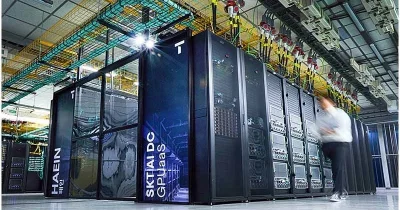
🧠SK Telecom is deploying Nvidia Blackwell GPUs to establish itself as an AI infrastructure provider, marking a strategic pivot away from traditional telecommunications. This move reflects broader industry trends where telcos leverage existing infrastructure and capital to compete in AI services, while also advancing South Korea's technological sovereignty goals.
🏢 Nvidia
AIBullishCrypto Briefing · Jun 87/10
🧠Naver Corporation is building AI data centers using Nvidia's DSX platform to strengthen its position in South Korea's artificial intelligence infrastructure market. This strategic partnership aims to enhance the country's technological autonomy while potentially influencing global AI infrastructure dynamics.
🏢 Nvidia
AIBullishcrypto.news · Jun 87/10
🧠Applied Digital has secured a 15-year lease agreement with a major U.S. hyperscaler for its Delta Forge 2 data center campus, potentially generating $5.2 billion in revenue over the base term. The deal reflects surging demand for AI infrastructure and drove Applied Digital's stock up 8.7% in after-hours trading.
AINeutralDecrypt · Jun 87/10
🧠OpenAI is pivoting from its ChatGPT chatbot model toward building a comprehensive superapp platform similar to WeChat, signaling a fundamental shift in the company's product strategy. This move reflects OpenAI's ambition to capture more user engagement and monetization opportunities beyond conversational AI.
🏢 OpenAI🧠 ChatGPT