AIBullisharXiv – CS AI · Jun 87/10
🧠Native3D introduces an end-to-end 3D scene generation framework that eliminates the need for 2D intermediate representations, using a unified mesh-texture modeling approach with semantic alignment to improve geometric and textural fidelity compared to traditional diffusion model-based methods.
AIBullisharXiv – CS AI · Jun 27/10
🧠Researchers propose a render-free framework for 3D-aware video diffusion models that uses compressed mesh tokens instead of 2D rendered guidance to control human motion in generated videos. By processing 3D geometric information directly alongside video tokens, the approach demonstrates improved performance on motion control tasks while reducing artifacts associated with traditional 2D guidance methods.
AIBullisharXiv – CS AI · Jun 27/10
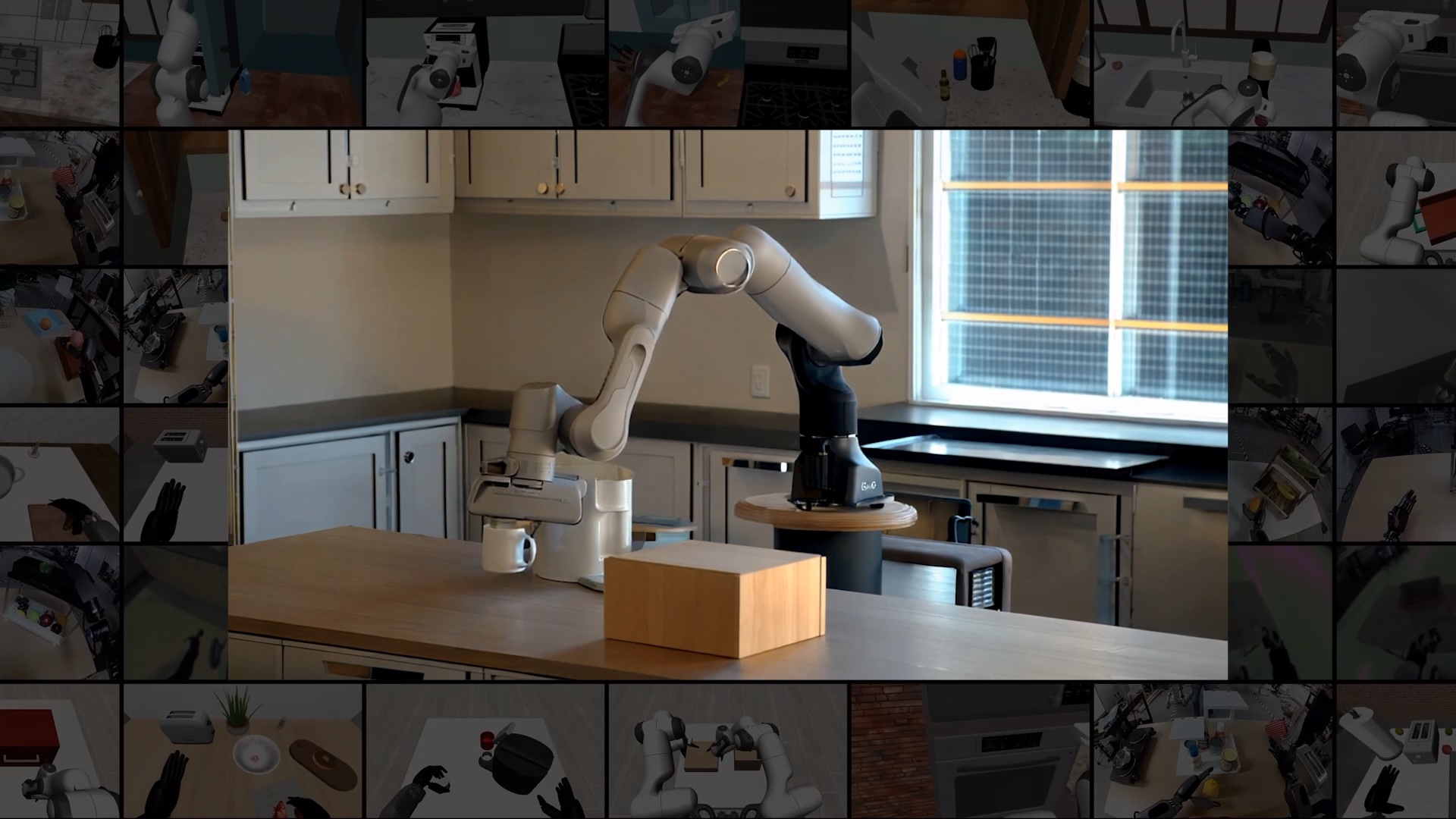
🧠SceneSmith is a new AI framework that generates realistic, physics-accurate indoor environments from natural language descriptions for robot simulation and training. The system produces 3-6x more objects than existing methods with minimal collisions, achieving 92% realism in user evaluations and enabling automated robot policy testing.
AIBullisharXiv – CS AI · May 17/10
🧠Researchers introduce SpatialGrammar, a domain-specific language designed to improve LLM-based 3D indoor scene generation by representing layouts as bird's-eye-view grid placements with compiler validation. The approach, paired with SG-Agent (an iterative refinement system) and SG-Mini (a 104M-parameter model), significantly reduces spatial errors and collision issues that plague existing natural language-to-3D scene generation methods.
AIBullishNVIDIA AI Blog · Aug 117/102
🧠NVIDIA Research has achieved breakthroughs in neural rendering, 3D generation, and world simulation technologies that are advancing physical AI applications. These developments are enabling progress in robotics, autonomous vehicles, and content creation by providing more sophisticated AI-driven visual and simulation capabilities.
AINeutralarXiv – CS AI · Jun 116/10
🧠Researchers introduce TextHOI-3D, a framework that generates realistic 3D hand-object interactions from text descriptions by leveraging multi-view visual generation as an intermediate representation. The staged approach significantly improves geometric accuracy and physical plausibility compared to single-view methods, with penetration volume reduced by 96% and object distance error by 71%.
AIBullishHugging Face Blog · Jun 96/10
🧠An AI agent successfully created a 3D virtual Paris gallery by chaining two Hugging Face Spaces together, demonstrating practical applications of multi-model AI orchestration. This development showcases how developers can leverage existing AI infrastructure to build complex, creative projects without building everything from scratch.
🏢 Hugging Face
AINeutralarXiv – CS AI · Jun 46/10
🧠SymTRELLIS introduces a method to enforce geometric symmetries in 3D generative models without retraining underlying systems, using learned linear operators on voxel latents and velocity symmetrization during generation. The technique substantially reduces symmetry violations across rotational, reflectional, and polyhedral symmetries compared to existing models like TRELLIS.2 and Hunyuan3D-2.1.
AINeutralarXiv – CS AI · Jun 26/10
🧠Researchers introduce WorldCoder-Bench, a comprehensive benchmark for evaluating how well AI language models can generate interactive 3D web environments built with Three.js. The benchmark reveals that current frontier models achieve only 19.9-27.8% verification coverage, with failures primarily stemming from state management issues rather than missing visual elements.
AINeutralarXiv – CS AI · May 286/10
🧠Researchers introduce MUSE, a new benchmark for evaluating text-to-CAD generation that moves beyond simple geometry matching to assess manufacturability, functionality, and assemblability of complex 3D assemblies. Current LLM-based CAD generation systems fail significantly when evaluated against practical engineering requirements, revealing a critical gap between geometric generation and production-ready design.
AINeutralarXiv – CS AI · May 286/10
🧠CubePart introduces a generative framework that creates 3D meshes with user-defined semantic parts controllable through text prompts, enabling game developers and simulation creators to produce production-ready assets without manual post-processing. The system combines a scalable data pipeline for part-labeled 3D datasets with a two-stage architecture that separates global shape synthesis from part-level generation.
AINeutralarXiv – CS AI · May 275/10
🧠BrickAnything is a new AI framework that generates physically buildable brick structures from 3D shapes by combining geometric reconstruction with structural constraints. The method uses structure-aware tokenization to model how bricks attach to each other, improving the feasibility and stability of generated designs compared to existing heuristic approaches.
AIBullisharXiv – CS AI · May 276/10
🧠AssetGen is a new 3D asset generation system that produces deployment-ready 3D models from a single image in 30 seconds (or 14 seconds for preview quality), complete with optimized geometry, textures, and polygon budgets suitable for real-time and mobile rendering. The system prioritizes practical usability and speed over maximum resolution, addressing a gap in current 3D generation tools that often overlook real-world deployment constraints.
$MATIC
AINeutralarXiv – CS AI · May 46/10
🧠Researchers present InpaintSLat, a training-free method for 3D inpainting that optimizes initial noise in structured 3D latent diffusion models. The approach leverages backpropagation approximation and spectral parameterization to improve geometric stability and contextual consistency, outperforming existing training-free baselines without requiring model retraining.
AINeutralarXiv – CS AI · Mar 174/10
🧠Researchers conducted the first empirical study of commercial text-to-3D AI platforms, finding that users can convey semantic themes but struggle with spatial structure specification. The study reveals interaction barriers including poor discoverability and high iteration costs that limit the effectiveness of current text-to-3D systems.
AIBullisharXiv – CS AI · Feb 274/107
🧠Researchers introduce SeeThrough3D, a new AI model that improves 3D layout-conditioned image generation by explicitly modeling object occlusions. The model uses an occlusion-aware 3D scene representation with translucent boxes to better understand depth relationships and generate more realistic partially occluded objects in synthetic scenes.
AIBullisharXiv – CS AI · Mar 34/103
🧠Researchers have developed DHVAE (Disentangled Hierarchical Variational Autoencoder), a new AI model for generating realistic 3D human-human interactions. The system uses hierarchical latent diffusion and contrastive learning to create physically plausible interactions while maintaining computational efficiency.
AINeutralOpenAI News · Dec 161/107
🧠The article appears to reference Point-E, a system for generating 3D point clouds from complex text prompts, but the article body is empty or missing. Without content to analyze, no meaningful assessment of the technology's capabilities, implications, or market impact can be made.