AI × CryptoNeutralcrypto.news · Jun 257/10
🤖Proof of personhood has emerged as a critical infrastructure challenge in cryptocurrency as AI-generated content becomes increasingly sophisticated. The article examines how blockchain networks and crypto platforms are developing solutions to verify authentic human users while maintaining privacy, addressing a problem that affects governance, token distribution, and spam prevention across the industry.
AIBearishThe Verge – AI · May 307/10
🧠AI-generated fake influencers impersonating Black women are being used to sell mass-produced dropshipped products on TikTok, Facebook, and Instagram. This deceptive practice exploits both AI technology and racial identity to circumvent platform safeguards and manipulate consumer trust for low-quality merchandise.
AINeutralThe Verge – AI · May 287/10
🧠An AI-generated feature film titled Dreams of Violets will premiere at the Tribeca Festival next month, marking the first full-length live-action film created entirely by AI to be accepted by a major film festival. The 75-minute film cost just $2,000 to produce and dramatizes Iran's January mass killing of protestors using entirely AI-generated imagery and characters.
AIBearisharXiv – CS AI · May 47/10
🧠Researchers introduce DeGenTWeb, a systematic methodology for identifying websites dominated by LLM-generated content with minimal human input. The study reveals that LLM-dominant sites are significantly more prevalent across the web than previously understood, with detection accuracy declining as LLM capabilities improve, raising questions about content authenticity and search quality.
AINeutralarXiv – CS AI · May 17/10
🧠A comprehensive study using Internet Archive data reveals that approximately 35% of newly published websites by mid-2025 contain AI-generated or AI-assisted text, up from zero before ChatGPT's launch in late 2022. While the research finds statistical support for concerns about reduced semantic diversity and increased positive sentiment bias, it contradicts public fears about declining factual accuracy and stylistic diversity, highlighting a significant gap between perceived and measured impacts of AI-generated content.
🧠 ChatGPT
AI × CryptoBearishCoinDesk · Apr 217/10
🤖AI-generated content flooding search engines creates discoverability challenges for cryptocurrency platforms, exchanges, and decentralized applications. Without strategic content practices and responsible AI tool usage, crypto companies risk losing visibility to search algorithms overwhelmed by low-quality AI-generated material, threatening their user acquisition and market reach.
AIBearishWired – AI · Apr 117/10
🧠The proliferation of AI-generated content and restricted information sources has degraded the internet's ability to verify authenticity, creating systemic challenges for truth verification. This breakdown in verification infrastructure has broad implications for trust in digital information across sectors including finance, media, and technology.
AINeutralCrypto Briefing · Jun 236/10
🧠Superhuman has acquired GPTZero, an AI detection startup, to integrate content authenticity verification into its platform. The acquisition underscores the industry's growing focus on identifying AI-generated content while raising important questions about data privacy and trust mechanisms in an increasingly AI-driven ecosystem.
AINeutralThe Verge – AI · Jun 116/10
🧠Deezer has launched a free AI music detector tool that scans playlists across competing streaming platforms to identify AI-generated content. This move comes after Deezer's own detection technology failed to gain adoption among major competitors like Spotify and Apple Music, which have instead implemented voluntary tagging systems.
AINeutralarXiv – CS AI · Jun 105/10
🧠CANVAS is an automated AI system that generates rich, multi-sensory art descriptions and synchronized audio narration for museum collections and digital art, addressing accessibility gaps for blind and low-vision audiences. The system processes images through large language models and text-to-speech services via Zapier, producing detailed captions faster and cheaper than human alternatives while demonstrating superior lexical diversity compared to baseline alt-text.
AIBearishThe Verge – AI · Jun 66/10
🧠Meta has launched a "For You" section in its standalone AI app that generates clickbait-style news articles entirely through AI, complete with AI-generated images and text. The move represents Meta's pivot toward AI-generated content feeds, though the quality and accuracy of such content remains questionable.
🏢 Meta🧠 ChatGPT
AINeutralarXiv – CS AI · Jun 26/10
🧠Researchers have developed FLAME, an AI-powered framework that detects forgeries in images created by generative AI models by identifying statistical energy anomalies left by diffusion processes. The breakthrough addresses a critical gap in digital forensics where traditional methods fail on synthetic images, introducing both a novel detection technique and an automated pipeline for continuously updating training datasets against evolving generative models.
AIBearishWired – AI · May 296/10
🧠A book about AI's impact on truth and reality was criticized for using AI-generated quotes without disclosure, raising questions about the author's credibility and the broader issue of AI-generated content misrepresenting itself as authentic. The incident highlights the irony and risks when AI tools are deployed without transparency, particularly in works examining AI's societal implications.
AINeutralarXiv – CS AI · May 286/10
🧠A study of 20 Italian readers found that AI-generated short stories created with ChatGPT-4o received slightly higher average ratings than stories by renowned author Alberto Moravia in blind evaluation. The modest preference for AI texts challenges assumptions about reader preference for human-authored fiction and raises questions about editorial necessity for synthetic literary content.
🧠 ChatGPT
AINeutralarXiv – CS AI · May 276/10
🧠A legal research paper examines intellectual property challenges arising from autonomous AI-generated creative and inventive works, comparing regulatory frameworks across Iran, the EU, UK, and US. The analysis reveals significant gaps in current Iranian IP law and recommends establishing new legal mechanisms to address ownership and protection of AI-generated outputs while balancing innovation with human creativity preservation.
GeneralBearishArs Technica – AI · May 186/10
📰Bug bounty platforms are being overwhelmed by low-quality AI-generated submissions that waste time and resources, straining corporate vulnerability disclosure programs. This surge reflects broader challenges in maintaining security reward schemes as AI tools democratize report generation without improving actual security research quality.
GeneralNeutralGoogle DeepMind Blog · May 175/10
📰A platform is expanding tools to help users understand how content was created and edited across the web. This initiative addresses growing concerns about content authenticity and transparency in the digital information ecosystem.
AIBearishArs Technica – AI · May 156/10
🧠arXiv, the preprint repository for scientific papers, has implemented a policy banning AI-generated content submissions, with violators facing year-long submission bans. A moderator announced the enforcement on social media, signaling the platform's effort to maintain research integrity amid growing concerns about low-quality AI-generated submissions flooding academic repositories.
AINeutralarXiv – CS AI · May 126/10
🧠Researchers propose a framework that automatically attaches structured metadata to AI-generated content at creation time, including prompts, model information, and confidence scores, enabling verification of reliability and license compliance. This addresses critical risks of chained hallucinations and compliance violations as AI agents increasingly dominate web content generation.
AINeutralTechCrunch – AI · May 76/10
🧠Spotify is expanding into AI-generated audio content, allowing users to create podcasts using AI tools like Codex or Claude Code and import them directly to the platform. This move positions Spotify as a hosting destination for AI-generated personal audio content, reflecting the streaming platform's strategy to capture emerging creator trends.
🧠 Claude
AINeutralarXiv – CS AI · Apr 206/10
🧠A study of 70 university students reveals that visible effort cues—particularly process videos and time documentation—significantly influence how audiences perceive and value creative work, with 72.9% of participants willing to pay more for human-made content. Notably, applying effort transparency to AI-generated works also improved their perceived authenticity, suggesting that process disclosure can partially bridge the authenticity gap between human and algorithmic creativity.
AIBearishWired – AI · Apr 156/10
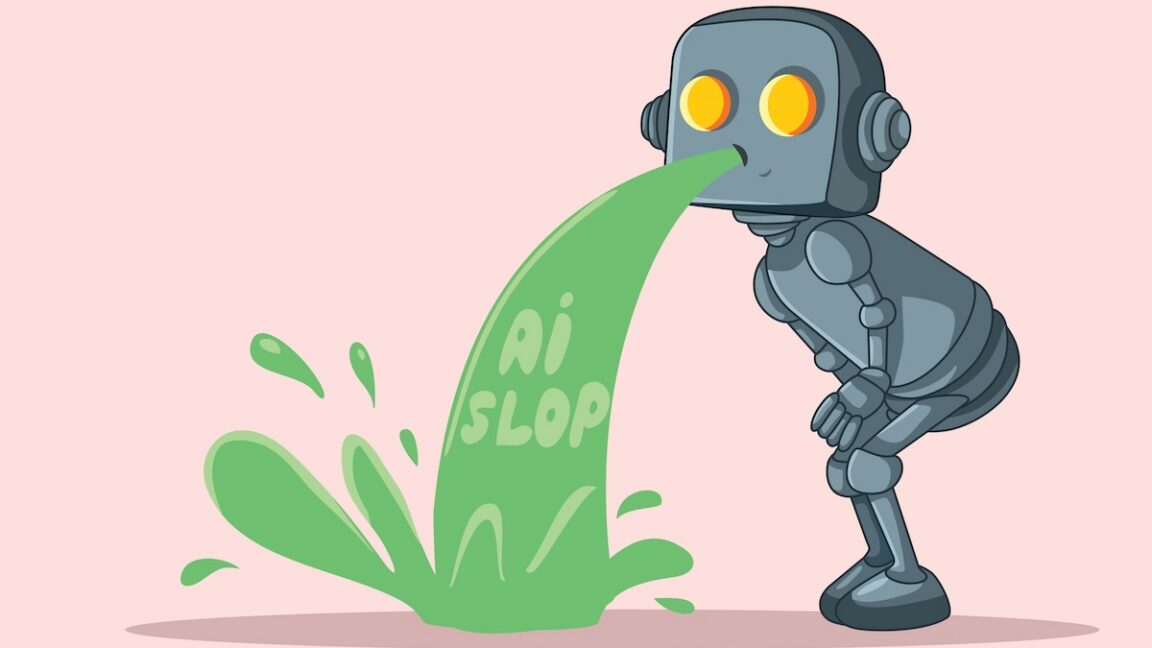
🧠A new study reveals that AI-generated content is proliferating across the internet, creating networks of low-quality websites that artificially inflate positive sentiment and engagement metrics. This trend, termed 'AI slop,' undermines content authenticity and distorts the digital information ecosystem.
AINeutralarXiv – CS AI · Apr 146/10
🧠Researchers propose a steganography-based attribution framework that embeds cryptographic identifiers into AI-generated images to combat harmful misuse on social platforms. The system combines watermarking techniques with CLIP-based multimodal detection to achieve 0.99 AUC-ROC performance, enabling reliable forensic tracing of synthetic media used in misinformation campaigns.
AINeutralThe Verge – AI · Mar 55/10
🧠Apple Music has introduced optional 'Transparency Tags' for artists and record labels to voluntarily identify AI-generated content in songs and visuals. The new metadata system covers four categories: tracks, compositions, artwork, and music videos, with specific criteria for when AI usage should be disclosed.
AINeutralTechCrunch – AI · Mar 45/101
🧠Apple Music is reportedly planning to add transparency tags to distinguish AI-generated music on its platform. The effectiveness of this initiative remains questionable since labels and distributors must voluntarily opt-in to tag their music as AI-generated.