#ai-optimization News & Analysis
Recent coverage of #ai-optimization spans 11 articles in the past month, with research predominantly sourced from arXiv's computer science and AI sections. Discussion has centered on methods for improving model efficiency and performance, with entities like ChatGPT, Nvidia, and Hugging Face appearing frequently in related coverage. The tag clusters closely with discussions of machine learning, large language models, and computational efficiency.
Sentiment around the topic has softened notably, with bullish coverage at 63.6% in the past 30 days—a significant decline from earlier trends—while neutral coverage stands at 27.3% and bearish perspectives account for 9.1%. Scan the article list below to explore the latest developments in this space.
sentiment · last 30d (11 articles) · -25.9pp bullish vs prior 90dTop sources:arXiv – CS AI · 54Fortune Crypto · 1MarkTechPost · 1crypto.news · 1
Most-discussed entities:Hugging Face · 1ChatGPT · 1Nvidia · 1Meta · 1
AINeutralarXiv – CS AI · May 286/10
🧠Researchers propose SelfJudge, a new method for accelerating large language model inference through self-supervised judge verification that eliminates the need for human annotations. The approach trains verifiers to assess whether token substitutions preserve semantic meaning, enabling faster inference without sacrificing accuracy across diverse NLP tasks.
AINeutralarXiv – CS AI · May 286/10
🧠Researchers propose a unified framework for understanding Tree-of-Thoughts (ToT) as a classical heuristic search problem, mapping LLM reasoning to established search algorithms. The work synthesizes fragmented research across NLP and planning communities, identifying design patterns where Best-First Search suits shallow tasks while deeper reasoning benefits from lookahead-heavy strategies like DFS and MCTS.
AINeutralarXiv – CS AI · May 286/10
🧠Researchers introduce AlphaTransit, an AI framework combining Monte Carlo Tree Search with neural networks to optimize city-scale bus network design. The system achieves 9.9-11.4% performance improvements over reinforcement learning alone by coupling learned guidance with tree search, demonstrating that hybrid approaches outperform single-method solutions for complex infrastructure planning problems.
AINeutralarXiv – CS AI · May 276/10
🧠Researchers introduce DIANOIA, a diagnostic framework for multi-agent LLM systems that decomposes reasoning performance into three measurable channels: coverage, fidelity, and synthesis. The method enables practitioners to identify performance bottlenecks and allocate computational resources more efficiently, achieving significant improvements on multiple benchmarks.
🧠 Claude
AIBullisharXiv – CS AI · May 276/10
🧠Researchers propose RulePlanner, a deep reinforcement learning framework that unifies the handling of complex hardware design rules in 3D integrated circuit floorplanning. The approach addresses a critical bottleneck in chip design by automating compliance with multiple design rules simultaneously, reducing manual post-processing and accelerating the path from design to manufacturing.
AINeutralarXiv – CS AI · May 276/10
🧠UnityMAS-O is a new reinforcement learning optimization framework that enables LLM-based multi-agent systems to be trained end-to-end rather than manually orchestrated. The framework treats entire agent workflows as optimization units and demonstrates performance improvements across QA, search, and code generation tasks, particularly benefiting smaller models.
AINeutralarXiv – CS AI · May 126/10
🧠Researchers demonstrate that overlaying coordinate grids on chart images significantly improves multimodal LLM accuracy for data extraction tasks, reducing error rates from 25.5% to 19.5%. This spatial priming approach outperforms semantic methods like Chain-of-Thought prompting, suggesting that explicit spatial context is more effective than high-level semantic guidance for current-generation vision-language models.
AINeutralarXiv – CS AI · May 126/10
🧠PLACO presents a multi-stage framework for optimizing human-AI team performance in classification tasks by combining human and model outputs through Bayesian probability methods. The research addresses how to effectively leverage both human judgment and AI predictions when neither alone achieves desired performance levels.
AINeutralarXiv – CS AI · May 126/10
🧠Researchers present CaTR, a reinforcement learning framework that optimizes real-time taxiway routing and conflict avoidance for multiple aircraft at airports. The system uses hierarchical traffic representation and value-decomposed learning to balance safety and efficiency, demonstrating superior performance compared to traditional planning and optimization methods while maintaining practical computational speed.
AIBullisharXiv – CS AI · May 126/10
🧠Researchers have optimized Alpamayo 1, a reasoning-based autonomous driving system, by redesigning it from multi-reasoning to single-reasoning architecture while accelerating diffusion-based action generation. The optimization achieves a 69.23% latency reduction while maintaining trajectory diversity and prediction quality, demonstrating that system-level efficiency improvements are critical for practical autonomous driving deployment.
AIBullisharXiv – CS AI · May 126/10
🧠Researchers introduce EAPO, an exploration-aware reinforcement learning framework that enables LLM agents to selectively explore uncertain scenarios before acting. The method uses fine-grained reward functions and adaptive exploration mechanisms to improve decision-making across text and GUI-based agent benchmarks.
🏢 Hugging Face
AINeutralarXiv – CS AI · May 126/10
🧠Researchers propose Information Density as a quantitative framework for optimizing IoT sensor networks by enabling virtual sensing through AI. Using spatial, temporal, and cross-modal correlations, the system can replace physical sensors with computational models while maintaining sub-4% error margins, demonstrated via Madrid's smart city infrastructure.
AINeutralarXiv – CS AI · May 126/10
🧠This theoretical computer science paper establishes formal conditions for efficient personalized alignment in large language models, proving that user diversity—specifically whether user-specific parameters span latent reward directions—is both necessary and sufficient for optimal statistical efficiency. The research provides rigorous mathematical foundations for adapting AI systems to heterogeneous user preferences.
AIBullisharXiv – CS AI · May 116/10
🧠Researchers propose a query-efficient method for evaluating new AI models using cached responses from previously-evaluated models, leveraging the Data Kernel Perspective Space (DKPS) framework to reduce computational costs while maintaining evaluation accuracy. The approach demonstrates that by intelligently reusing existing model outputs, organizations can achieve equivalent benchmarking results with substantially fewer new queries.
AINeutralarXiv – CS AI · May 96/10
🧠Researchers demonstrate that stacking more components into LLM agent systems doesn't improve performance and often degrades it due to cross-component interference. A comprehensive factorial study across 32 configurations shows optimal agent design is task-dependent and model-scale dependent, with the fully-equipped system consistently underperforming smaller, curated subsets by up to 79%.
🧠 Llama
AIBullisharXiv – CS AI · May 96/10
🧠Researchers propose BADIT, a novel approach to improve large language model training by decomposing shared parameters into orthogonal basic abilities, mitigating the cross-task interference problem that degrades performance in multi-task instruction-tuning. The method outperforms existing solutions on the SuperNI benchmark across 6 LLMs by maintaining parameter orthogonality through spherical clustering during training.
AIBearisharXiv – CS AI · May 96/10
🧠Researchers demonstrate that self-consistency—a technique where LLMs sample multiple reasoning paths to improve accuracy—delivers diminishing returns on modern models. Testing with Gemini 2.5 shows minimal accuracy gains (0.4-1.6%) while token costs scale linearly, suggesting the technique has become inefficient as model reliability improves.
🧠 Gemini
GeneralBullishFortune Crypto · May 16/10
📰Record global temperatures and rising energy costs are driving demand for advanced climate control solutions, with companies like Trane Technologies capitalizing on this trend. AI-powered building management systems are reshaping how organizations optimize HVAC efficiency and reduce operational expenses during an era of climate volatility.
AIBearisharXiv – CS AI · May 16/10
🧠Researchers challenge the conventional wisdom that large language models contain significant redundant parameters, demonstrating that small-magnitude weights encode crucial knowledge for difficult downstream tasks. The study reveals that pruning these weights causes irreversible performance degradation that cannot be recovered through continued training, with effects monotonically correlated to task difficulty.
AINeutralarXiv – CS AI · Apr 146/10
🧠ConfigSpec introduces a profiling-based framework for optimizing distributed LLM inference across edge-cloud systems using speculative decoding. The research reveals that no single configuration can simultaneously optimize throughput, cost efficiency, and energy efficiency—requiring dynamic, device-aware configuration selection rather than fixed deployments.
AINeutralarXiv – CS AI · Apr 106/10
🧠Researchers introduce Step-Saliency, a diagnostic tool that reveals how large reasoning models fail during multi-step reasoning tasks by identifying two critical information-flow breakdowns: shallow layers that ignore context and deep layers that lose focus on reasoning. They propose StepFlow, a test-time intervention that repairs these flows and improves model accuracy without retraining.
AIBullishMarkTechPost · Apr 56/10
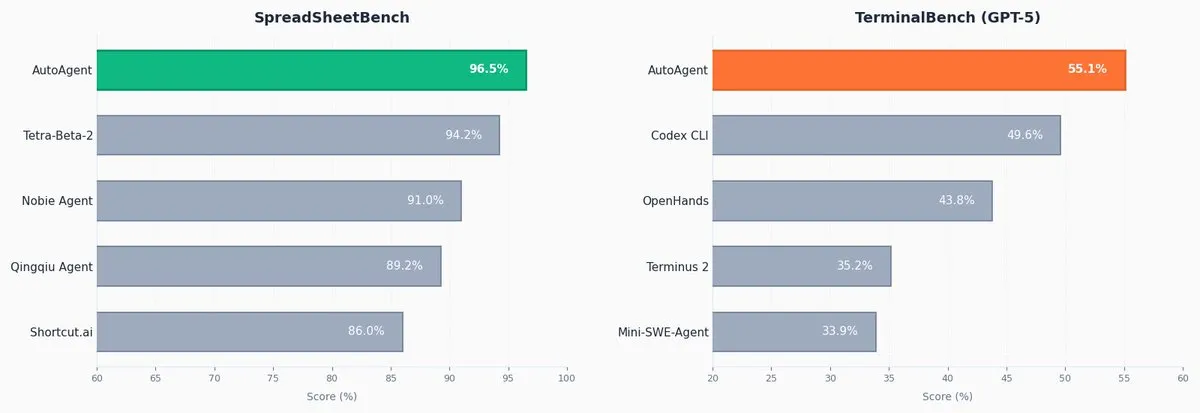
🧠AutoAgent is a new open-source library that automates the tedious process of prompt engineering and agent optimization for AI developers. The tool allows AI systems to engineer and optimize their own agent configurations overnight, potentially eliminating the manual prompt-tuning loop that typically requires dozens of iterations.
AIBullisharXiv – CS AI · Mar 266/10
🧠Researchers introduce AscendOptimizer, an AI agent that optimizes operators for Huawei's Ascend NPUs through evolutionary search and experience-based learning. The system achieved 1.19x geometric-mean speedup over baselines on 127 real operators, with nearly 50% outperforming reference implementations.
AIBullisharXiv – CS AI · Mar 266/10
🧠SafeSieve is a new algorithm for optimizing LLM-based multi-agent systems that reduces token usage by 12.4%-27.8% while maintaining 94.01% accuracy. The progressive pruning method combines semantic evaluation with performance feedback to eliminate redundant communication between AI agents.
AIBullisharXiv – CS AI · Mar 176/10
🧠Researchers introduce GPrune-LLM, a new structured pruning framework that improves compression of large language models by addressing calibration bias and cross-task generalization issues. The method partitions neurons into behavior-consistent modules and uses adaptive metrics based on distribution sensitivity, showing consistent improvements in post-compression performance.