#ai-research News & Analysis
The #ai-research tag covers 1,021 articles examining developments across artificial intelligence research, with 91 pieces published in the last 30 days. Coverage draws primarily from arXiv's computer science AI section, supplemented by reporting from Apple's machine learning team and industry analyst Jack Clark. Recent discussion has centered on large language models including Llama, GPT-4, and Claude, while frequently intersecting with broader conversations on machine learning, reinforcement learning, and related arxiv findings.
Sentiment around #ai-research has shifted notably, with bullish coverage declining 20.9 percentage points over the past month to 29.7%, while neutral analysis now dominates at 65.9%. This softening reflects a more measured tone in recent research discussions compared to the prior quarter. Explore the articles below to track the current landscape of AI research developments.
sentiment · last 30d (91 articles) · -20.9pp bullish vs prior 90dTop sources:arXiv – CS AI · 831Apple Machine Learning · 9Import AI (Jack Clark) · 6MIT News – AI · 4Fortune Crypto · 3
Most-discussed entities:Llama · 16GPT-4 · 12Claude · 11GPT-5 · 8Gemini · 7
AIBullisharXiv – CS AI · Mar 176/10
🧠Researchers present Centered Reward Distillation (CRD), a new reinforcement learning framework for fine-tuning diffusion models that addresses brittleness issues in existing methods. The approach uses within-prompt centering and drift control techniques to achieve state-of-the-art performance in text-to-image generation while reducing reward hacking and convergence issues.
AINeutralarXiv – CS AI · Mar 176/10
🧠Researchers studied computational resource allocation in AI retrieval systems for long-horizon agents, finding that re-ranking stages benefit more from powerful models and deeper candidate pools than query expansion stages. The study suggests concentrating compute power on re-ranking rather than distributing it uniformly across pipeline stages for better performance.
🧠 Gemini
AIBullisharXiv – CS AI · Mar 176/10
🧠Researchers introduce MVHOI, a new AI framework that significantly improves human-object interaction video generation by handling complex 3D manipulations through a two-stage process using 3D foundation models. The system can create realistic long-duration videos showing intricate object manipulations from multiple viewpoints, addressing limitations of existing approaches that struggle with non-planar movements.
AINeutralarXiv – CS AI · Mar 176/10
🧠Researchers conducted an empirical study on 16 Large Language Models to understand how they process tabular data, revealing a three-phase attention pattern and finding that tabular tasks require deeper neural network layers than math reasoning. The study analyzed attention dynamics, layer depth requirements, expert activation in MoE models, and the impact of different input designs on table understanding performance.
AIBullisharXiv – CS AI · Mar 176/10
🧠Researchers have developed QA-Dragon, a new Query-Aware Dynamic RAG System that significantly improves knowledge-intensive Visual Question Answering by combining text and image retrieval strategies. The system achieved substantial performance improvements of 5-6% across different tasks in the Meta CRAG-MM Challenge at KDD Cup 2025.
AIBullisharXiv – CS AI · Mar 176/10
🧠Researchers developed monitoring strategies to detect when Large Reasoning Models are engaging in unproductive reasoning by identifying early failure signals. The new techniques reduce token usage by 62.7-93.6% while maintaining accuracy, significantly improving AI model efficiency.
AIBullisharXiv – CS AI · Mar 176/10
🧠Researchers developed a novel counterfactual approach to address fairness bugs in machine learning software that maintains competitive performance while improving fairness. The method outperformed existing solutions in 84.6% of cases across extensive testing on 8 real-world datasets using multiple performance and fairness metrics.
🏢 Meta
AIBullisharXiv – CS AI · Mar 176/10
🧠Researchers propose a theoretical framework based on category theory to formalize meta-prompting in large language models. The study demonstrates that meta-prompting (using prompts to generate other prompts) is more effective than basic prompting for generating desirable outputs from LLMs.
AIBullisharXiv – CS AI · Mar 176/10
🧠Researchers introduce SyncSpeech, a new text-to-speech model that combines autoregressive and non-autoregressive approaches using a Temporal Mask Transformer architecture. The model achieves 5.8x lower first-packet latency and 8.8x improved real-time performance while maintaining comparable speech quality to existing models.
AINeutralarXiv – CS AI · Mar 176/10
🧠Research shows that synthetic data designed to enhance in-context learning capabilities in AI models doesn't necessarily improve performance. The study found that while targeted training can increase specific neural mechanisms, it doesn't make them more functionally important compared to natural training approaches.
🏢 Perplexity
AIBullisharXiv – CS AI · Mar 176/10
🧠GlobalRAG is a new reinforcement learning framework that significantly improves multi-hop question answering by decomposing questions into subgoals and coordinating retrieval with reasoning. The system achieves 14.2% average improvements in performance metrics while using only 42% of the training data required by baseline models.
AIBearisharXiv – CS AI · Mar 176/10
🧠Researchers introduce HEARTS, a comprehensive benchmark for evaluating large language models' ability to reason over health time series data across 16 datasets and 12 health domains. The study reveals that current LLMs significantly underperform compared to specialized models and struggle with multi-step temporal reasoning in healthcare applications.
AIBullishImport AI (Jack Clark) · Mar 166/10
🧠ImportAI 449 explores recent developments in AI research including LLMs training other LLMs, a 72B parameter distributed training run, and findings that computer vision tasks remain more challenging than generative text tasks. The newsletter highlights autonomous LLM refinement capabilities and post-training benchmark results showing significant AI capability growth.
AIBullishMarkTechPost · Mar 167/10
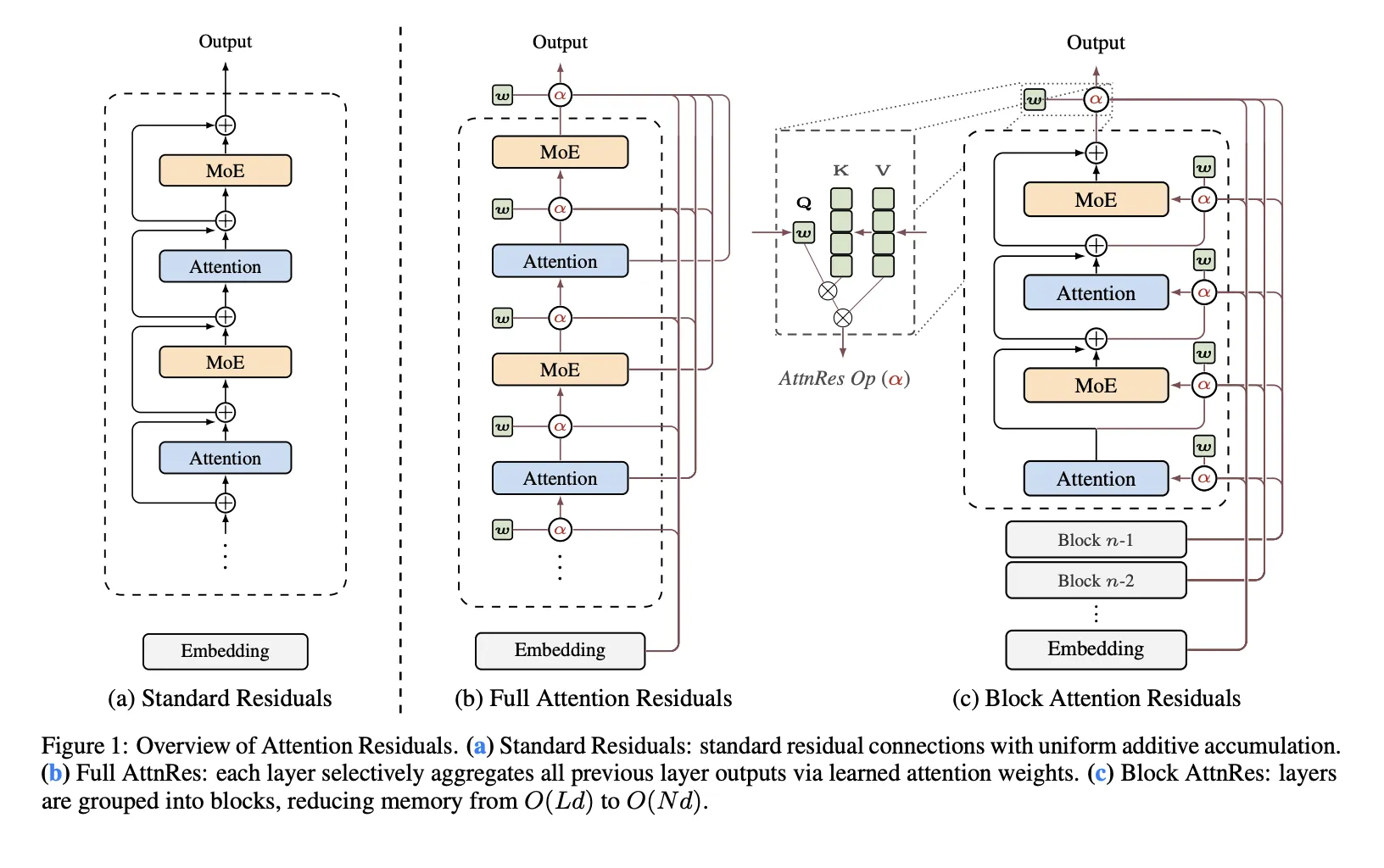
🧠Moonshot AI has released Attention Residuals, a new approach that replaces traditional fixed residual connections in Transformer architectures with depth-wise attention mechanisms. The innovation addresses structural problems in PreNorm architectures where all prior layer outputs are mixed equally, potentially improving model scaling capabilities.
AIBullisharXiv – CS AI · Mar 166/10
🧠Researchers have developed ToolTree, a new Monte Carlo tree search-based planning system for LLM agents that improves tool selection and usage through dual-feedback evaluation and bidirectional pruning. The system achieves approximately 10% performance gains over existing methods while maintaining high efficiency across multiple benchmarks.
AIBullisharXiv – CS AI · Mar 166/10
🧠Researchers propose AMRO-S, a new routing framework for multi-agent LLM systems that uses ant colony optimization to improve efficiency and reduce costs. The system addresses key deployment challenges like high inference costs and latency while maintaining performance quality through semantic-aware routing and interpretable decision-making.
AINeutralarXiv – CS AI · Mar 166/10
🧠Researchers propose Global Evolutionary Refined Steering (GER-steer), a new training-free framework for controlling Large Language Models without fine-tuning costs. The method addresses issues with existing activation engineering approaches by using geometric stability to improve steering vector accuracy and reduce noise.
AINeutralarXiv – CS AI · Mar 166/10
🧠Researchers introduce Budget-Sensitive Discovery Score (BSDS), a formally verified framework for evaluating AI-guided scientific candidate selection under budget constraints. Testing on drug discovery datasets reveals that simple random forest models outperform large language models, with LLMs providing no marginal value over existing trained classifiers.
AINeutralarXiv – CS AI · Mar 166/10
🧠Research reveals that large language models used as judges for scoring responses show misleading performance when evaluated by global correlation metrics versus actual best-of-n selection tasks. A study using 5,000 prompts found that judges with moderate global correlation (r=0.47) only captured 21% of potential improvement, primarily due to poor within-prompt ranking despite decent overall agreement.
AIBullisharXiv – CS AI · Mar 166/10
🧠Researchers have developed Feynman, an AI agent that generates high-quality diagram-caption pairs at scale for training vision-language models. The system created a dataset of 100k+ well-aligned diagrams and introduced Diagramma, a benchmark for evaluating visual reasoning capabilities.
AIBullisharXiv – CS AI · Mar 166/10
🧠Researchers introduce FastDSAC, a new framework that successfully applies Maximum Entropy Reinforcement Learning to high-dimensional humanoid control tasks. The system uses Dimension-wise Entropy Modulation and continuous distributional critics to achieve 180% and 400% performance gains on challenging control tasks compared to deterministic methods.
AINeutralarXiv – CS AI · Mar 166/10
🧠This comprehensive survey examines continual learning methodologies for large language models, focusing on three core training stages and methods to mitigate catastrophic forgetting. The research reveals that while current approaches show promise in specific domains, fundamental challenges remain in achieving seamless knowledge integration across diverse tasks and temporal scales.
AIBullisharXiv – CS AI · Mar 166/10
🧠Researchers propose MetaKE, a new framework for knowledge editing in Large Language Models that addresses the 'Semantic-Execution Disconnect' through bi-level optimization. The method treats edit targets as learnable parameters and uses a Structural Gradient Proxy to align edits with the model's feasible manifold, showing significant improvements over existing approaches.
AIBullisharXiv – CS AI · Mar 166/10
🧠Researchers propose a new "structure-faithful" framework for machine unlearning that preserves semantic relationships in AI models while removing specific data. The method uses semantic anchors to maintain knowledge structure, showing significant performance improvements of 19-33% across image classification, retrieval, and face recognition tasks.
AINeutralarXiv – CS AI · Mar 166/10
🧠SkillsBench introduces a new benchmark to evaluate Agent Skills - structured packages of procedural knowledge that enhance LLM agents. Testing across 86 tasks and 11 domains shows curated Skills improve performance by 16.2 percentage points on average, while self-generated Skills provide no benefit.