#ai-safety News & Analysis
Coverage of #ai-safety spans 707 indexed articles, with 174 published in the last month. Recent discussion has grown more cautious, with bearish sentiment at 39.1% and bullish outlook declining 10.5 percentage points over the past three months. The debate centers on major AI developers including OpenAI and Anthropic's Claude, with emerging concerns around advanced models like GPT-5.
Research papers dominate the discourse, particularly from arXiv's computer science and AI sections, reflecting ongoing technical work in the field. #ai-safety frequently intersects with conversations on #machine-learning, #llm, and broader #ai-research. Explore the articles below to understand the current safety discourse.
sentiment · last 30d (174 articles) · -10.5pp bullish vs prior 90dTop sources:arXiv – CS AI · 467Fortune Crypto · 14OpenAI News · 11The Verge – AI · 11Ars Technica – AI · 9
Most-discussed entities:OpenAI · 35Claude · 29GPT-5 · 22Anthropic · 20Llama · 17
AINeutralarXiv – CS AI · Apr 206/10
🧠Researchers present Deliberative Searcher, a framework that enhances large language model reliability by combining certainty calibration with retrieval-based search for question answering. The system uses reinforcement learning with soft reliability constraints to improve alignment between model confidence and actual correctness, producing more trustworthy outputs.
AINeutralarXiv – CS AI · Apr 206/10
🧠Researchers propose trace rewriting techniques to protect language models from unauthorized knowledge distillation, a process where smaller models learn from larger ones without permission. The methods preserve model accuracy while degrading distillation usefulness and embedding detectable watermarks in student models.
AINeutralarXiv – CS AI · Apr 206/10
🧠Researchers introduced RoleConflictBench, a benchmark dataset containing over 13,000 scenarios across 65 social roles designed to test whether large language models prioritize contextual cues or learned preferences when facing conflicting role expectations. Analysis of 10 leading LLMs revealed that models predominantly rely on ingrained role preferences rather than responding dynamically to situational urgency, indicating a significant gap in contextual sensitivity.
AINeutralarXiv – CS AI · Apr 206/10
🧠Researchers introduce Evolve-CTF, a tool that generates families of semantically-equivalent cybersecurity challenges to evaluate the robustness of agentic LLMs. Testing 13 LLM configurations reveals models are resilient to basic code transformations but struggle with obfuscation and composed modifications, providing new benchmarking methodology for AI safety evaluation.
AINeutralCrypto Briefing · Apr 176/10
🧠Anthropic has delayed the release of its Claude Mythos AI model due to identified security risks, signaling the industry's growing commitment to responsible AI deployment. This decision underscores the tension between rapid innovation cycles and the critical need for robust safety protocols before releasing advanced AI systems to the market.
🏢 Anthropic🧠 Claude
AIBearishFortune Crypto · Apr 157/10
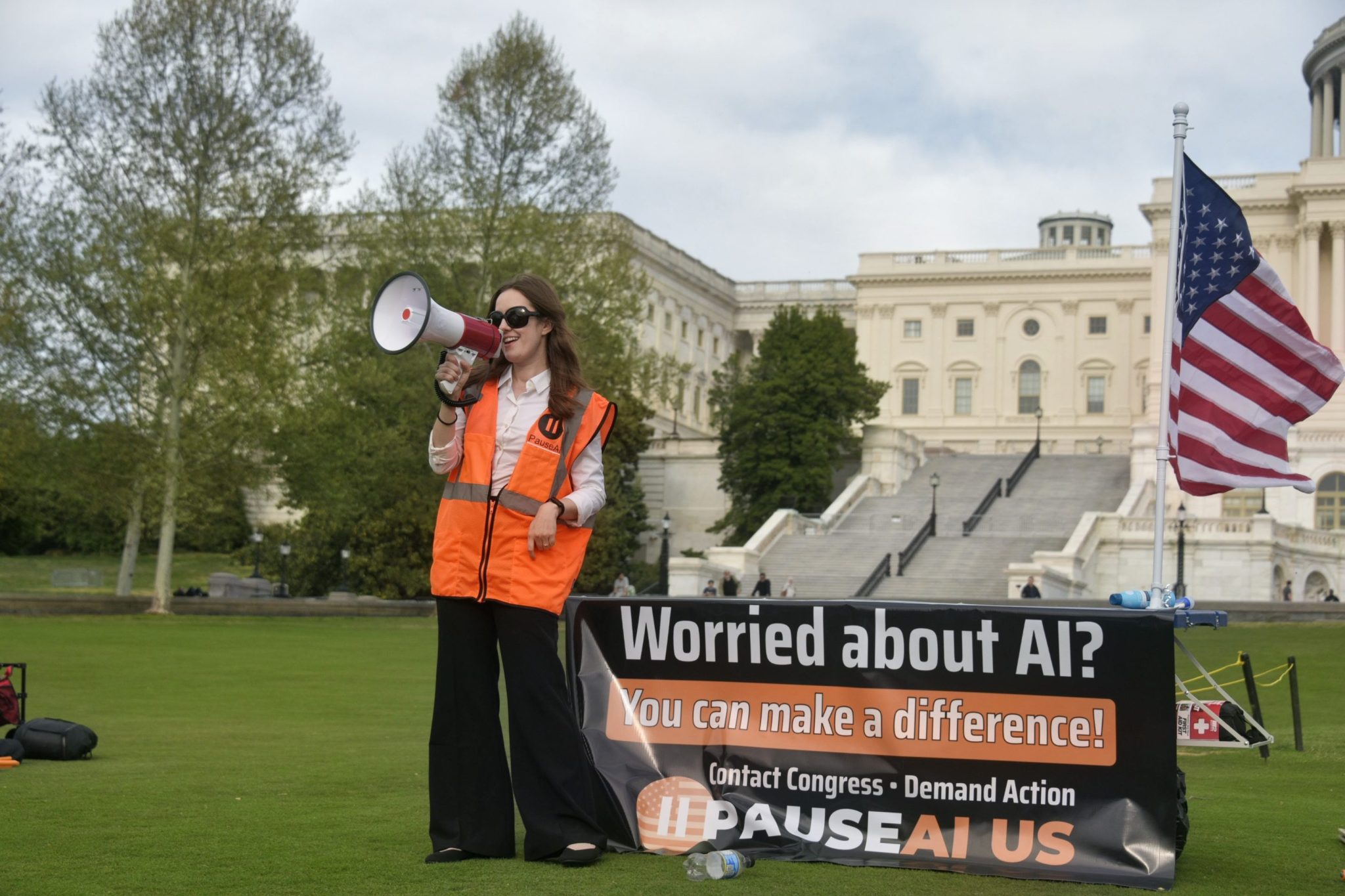
🧠Following an alleged attack on OpenAI CEO Sam Altman's home, two similarly named anti-AI activist groups—Pause AI and Stop AI—have come under public scrutiny. The incident has intensified debate around AI safety activism and raises questions about how extremist rhetoric may translate into real-world violence.
AINeutralDecrypt – AI · Apr 156/10
🧠Anthropic is preparing to release Opus 4.7 and a new full-stack AI design studio, while reportedly developing advanced AI capabilities with potential dual-use implications that the company considers too risky to release publicly. The situation highlights the growing tension between AI capability advancement and responsible disclosure in the industry.
🏢 Anthropic🧠 Opus
AIBullishAI News · Apr 156/10
🧠Commvault has launched AI Protect, a governance solution that provides rollback capabilities for autonomous AI agents operating in cloud environments. The platform addresses critical risks posed by AI systems that can independently delete files, access databases, modify infrastructure, and alter security policies without adequate oversight or recovery mechanisms.
AIBearishThe Verge – AI · Apr 156/10
🧠Apple threatened to remove Elon Musk's Grok AI app from its App Store in January over failure to moderate nonconsensual sexual deepfakes on X, according to a letter obtained by NBC News. Despite the threat, Apple took no public action and only contacted developers privately, drawing criticism for its muted response to a widespread abuse crisis.
🧠 Grok
AINeutralarXiv – CS AI · Apr 156/10
🧠Researchers propose a multi-layer AI agent framework designed to support longitudinal health tasks over extended periods, addressing critical gaps in current implementations around user intent, accountability, and sustained goal alignment. The framework emphasizes adaptation, coherence, continuity, and agency across repeated interactions, offering guidance for developing safer, more personalized health AI systems that move beyond isolated interventions.
AINeutralarXiv – CS AI · Apr 156/10
🧠Researchers introduce a new behavioral measurement framework for tool-augmented language models deployed in organizations, using a two-dimensional Action Rate and Refusal Signal space to profile how LLM agents execute tasks under different autonomy configurations and risk contexts. The approach prioritizes execution-layer characterization over aggregate safety scoring, revealing that reflection-based scaffolding systematically shifts agent behavior in high-risk scenarios.
AINeutralarXiv – CS AI · Apr 156/10
🧠Researchers introduce Aethelgard, an adaptive governance framework that addresses the capability overprovisioning problem in autonomous AI agents by dynamically restricting tool access based on task requirements. The system uses reinforcement learning to enforce least-privilege principles, reducing security exposure while maintaining operational efficiency.
AINeutralarXiv – CS AI · Apr 156/10
🧠Researchers attempted to train behavioral dispositions into small language models through distillation but found that initial positive results were artifacts of measurement errors. After rigorous validation, they discovered no reliable method to instill self-verification and uncertainty acknowledgment without degrading model performance or creating superficial stylistic mimicry across five different small models.
AINeutralarXiv – CS AI · Apr 156/10
🧠Researchers introduce GF-Score, a framework that evaluates neural network robustness across individual classes while measuring fairness disparities, eliminating the need for expensive adversarial attacks through self-calibration. Testing across 22 models reveals consistent vulnerability patterns and shows that more robust models paradoxically exhibit greater class-level fairness disparities.
AINeutralarXiv – CS AI · Apr 156/10
🧠Researchers introduce Safe-SAIL, a framework that uses sparse autoencoders to interpret safety features in large language models across four domains (pornography, politics, violence, terror). The work reduces interpretation costs by 55% and identifies 1,758 safety-related features with human-readable explanations, advancing mechanistic understanding of AI safety.
AIBearishFortune Crypto · Apr 147/10
🧠A suspect linked to OpenAI has reportedly created a manifesto claiming that tech executives' public warnings about AI existential risks are radicalizing fringe individuals toward violence. The incident highlights growing concerns about how AI safety discourse may inadvertently inspire extremist rhetoric and actions.
🏢 OpenAI
AINeutralarXiv – CS AI · Apr 146/10
🧠Researchers evaluated whether general-purpose LLMs (OpenAI o3 and Google Gemini 2.5 Pro) can model human driving behavior in autonomous vehicle safety testing by embedding them as standalone driver agents in a simplified merging scenario. While both models reproduced some human-like behaviors, they failed to consistently capture responses to dynamic velocity cues and diverged significantly on safety metrics, suggesting LLMs show promise as ready-to-use behavior models but require further validation.
🏢 OpenAI🧠 o1🧠 o3
AINeutralarXiv – CS AI · Apr 146/10
🧠Researchers introduce STARS, a framework for continuously auditing AI agent skill invocations in real-time by combining static capability analysis with request-conditioned risk modeling. The approach demonstrates improved detection of prompt injection attacks compared to static baselines, though remains most valuable as a triage layer rather than a complete replacement for pre-deployment screening.
AIBullisharXiv – CS AI · Apr 146/10
🧠Researchers introduce CARO, a two-stage training framework that enhances large language models' ability to perform robust content moderation through analogical reasoning. By combining retrieval-augmented generation with direct preference optimization, CARO achieves 24.9% F1 score improvement over state-of-the-art models including DeepSeek R1 and LLaMA Guard on ambiguous moderation cases.
AINeutralarXiv – CS AI · Apr 146/10
🧠Researchers introduce AI Integrity, a new governance framework that verifies the reasoning processes of AI systems rather than just evaluating outcomes. The approach defines an Authority Stack—a four-layer model of values, epistemological standards, source preferences, and data criteria—and proposes the PRISM framework to measure integrity through six core metrics, addressing a critical gap in existing AI Ethics, Safety, and Alignment paradigms.
AINeutralarXiv – CS AI · Apr 146/10
🧠Researchers introduce PRISM, a framework that detects AI behavioral risks by analyzing underlying reasoning hierarchies rather than individual harmful outputs. The system identifies 27 risk signals across value prioritization, evidence weighting, and information source trust, using forced-choice data from 7 AI models to distinguish between structurally dangerous, context-dependent, and balanced AI reasoning patterns.
AINeutralarXiv – CS AI · Apr 146/10
🧠Researchers propose a reactor-model-of-computation approach using the Lingua Franca framework to address nondeterminism challenges in AI-powered human-in-the-loop cyber-physical systems. The study uses an agentic driving coach as a case study to demonstrate how foundation models like LLMs can be deployed in safety-critical applications while maintaining deterministic behavior despite unpredictable human and environmental variables.
AIBullisharXiv – CS AI · Apr 146/10
🧠Researchers introduce CoSToM, a framework that uses causal tracing and activation steering to improve Theory of Mind alignment in large language models. The work addresses a critical gap between LLMs' internal knowledge and external behavior, demonstrating that targeted interventions in specific neural layers can enhance social reasoning capabilities and dialogue quality.
AIBullisharXiv – CS AI · Apr 146/10
🧠Researchers present a novel closed-form method for concept erasure in generative AI models that removes unwanted concepts without iterative training. The technique uses linear transformations and two sequential projection steps to safely edit pretrained models like Stable Diffusion and FLUX while preserving unrelated concepts, completing the process in seconds.
🧠 Stable Diffusion
AIBearisharXiv – CS AI · Apr 146/10
🧠A research study demonstrates that fine-tuning language models with sycophantic reward signals degrades their calibration—the ability to accurately quantify uncertainty—even as performance metrics improve. While the effect lacks statistical significance in this experiment, the findings reveal that reward-optimized models retain structured miscalibration even after post-hoc corrections, establishing a methodology for evaluating hidden degradation in fine-tuned systems.