
AINeutralarXiv – CS AI · Apr 76/10
#ai News & Analysis
This #ai tag aggregates 3,601 indexed articles, with 1,520 published in the last 30 days. Recent coverage maintains a bullish outlook, with 78% of articles in positive sentiment compared to 19.2% bearish, showing stable momentum from the prior quarter. OpenAI, Anthropic, and Claude dominate the discussion around artificial intelligence developments. The most active sources tracking this topic include arXiv's computer science section, along with crypto-focused outlets Blockonomi and Fortune Crypto, suggesting substantial overlap between AI advancement coverage and digital asset markets. Scan the article list below to explore the latest reporting on this rapidly covered domain.
sentiment · last 30d (1520 articles)
Top sources:arXiv – CS AI · 1325Blockonomi · 393Fortune Crypto · 328Crypto Briefing · 190TechCrunch – AI · 159
Most-discussed entities:OpenAI · 180Anthropic · 165Claude · 143Nvidia · 122ChatGPT · 85
17828 articles
AIBullisharXiv – CS AI · Apr 76/10
🧠
Neuromorphic Computing for Low-Power Artificial Intelligence
Researchers outline how neuromorphic computing could overcome energy efficiency limits in classical CMOS technology for AI applications. The approach requires co-design across materials, circuits, and algorithms to achieve brain-inspired compute-in-memory architectures.
AIBearisharXiv – CS AI · Apr 75/10
AIBullisharXiv – CS AI · Apr 76/10
🧠
Context Engineering: A Practitioner Methodology for Structured Human-AI Collaboration
Researchers introduce Context Engineering, a structured methodology for improving AI output quality through better context assembly rather than just prompting techniques. The study of 200 AI interactions showed that structured context reduced iteration cycles from 3.8 to 2.0 and improved first-pass acceptance rates from 32% to 55%.
🧠 ChatGPT🧠 Claude
AIBullisharXiv – CS AI · Apr 76/10
🧠
VLA-Forget: Vision-Language-Action Unlearning for Embodied Foundation Models
Researchers introduce VLA-Forget, a new unlearning framework for vision-language-action (VLA) models used in robotic manipulation. The hybrid approach addresses the challenge of removing unsafe or unwanted behaviors from embodied AI foundation models while preserving their core perception, language, and action capabilities.
AINeutralarXiv – CS AI · Apr 76/10
🧠
FactReview: Evidence-Grounded Reviews with Literature Positioning and Execution-Based Claim Verification
Researchers introduce FactReview, an AI system that improves academic peer review by combining claim extraction, literature positioning, and code execution to verify research claims. The system addresses weaknesses in current LLM-based reviewing by grounding assessments in external evidence rather than relying solely on manuscript narratives.
$MKR
AIBearishCrypto Briefing · Apr 76/10
🧠
Marik Hazan: Social media is reshaping journalism, AI will disrupt employment more than expected, and the cofounder model is unsustainable for AI startups | TWIST
Marik Hazan discusses how AI will cause more significant job displacement than anticipated, challenging the common belief that humans will primarily use AI as a collaborative tool. He also addresses how social media is transforming journalism and critiques the traditional cofounder model for AI startups.

AIBullishFortune Crypto · Apr 67/10
🧠
JPMorgan CEO Jamie Dimon predicts AI will cut the workweek down to 3.5 days—and tells Gen Z developing EQ is more important than ever
JPMorgan CEO Jamie Dimon predicts AI will reduce the workweek to 3.5 days and create more job opportunities for future generations. He emphasizes that human skills like emotional intelligence, curiosity, and work ethic will become increasingly valuable as AI transforms the workplace.

AIBullishFortune Crypto · Apr 66/10
🧠
The real impact of AI on SaaS isn’t what investors think
The article argues that AI's impact on SaaS will be to enable a surge of new software creation rather than eliminating existing software companies. Lower development costs and simplified coding through AI tools could democratize software development and expand the market.

AIBullisharXiv – CS AI · Apr 66/10
🧠
Unified Thinker: A General Reasoning Modular Core for Image Generation
Researchers introduce Unified Thinker, a new AI architecture that improves image generation by separating reasoning from visual generation. The modular system addresses the gap between closed-source models like Nano Banana and open-source alternatives by enabling better instruction following through executable reasoning and reinforcement learning.
AIBullisharXiv – CS AI · Apr 66/10
🧠
A Survey on AI for 6G: Challenges and Opportunities
This survey paper examines AI's role in developing 6G wireless networks, covering key technologies like deep learning, reinforcement learning, and federated learning. The research addresses how AI will enable 6G's promise of high data rates and low latency for applications like smart cities and autonomous systems, while identifying challenges in scalability, security, and energy efficiency.
AIBullisharXiv – CS AI · Apr 66/10
🧠
Attribution Gradients: Incrementally Unfolding Citations for Critical Examination of Attributed AI Answers
Researchers have developed "attribution gradients," a new technique to improve AI answer engines by making citations more informative and easier to evaluate. The method consolidates evidence amounts, supporting/contradictory excerpts, and contextual explanations in one place, while also allowing users to explore second-degree citations without leaving the interface.
AIBullishMarkTechPost · Apr 56/10
🧠
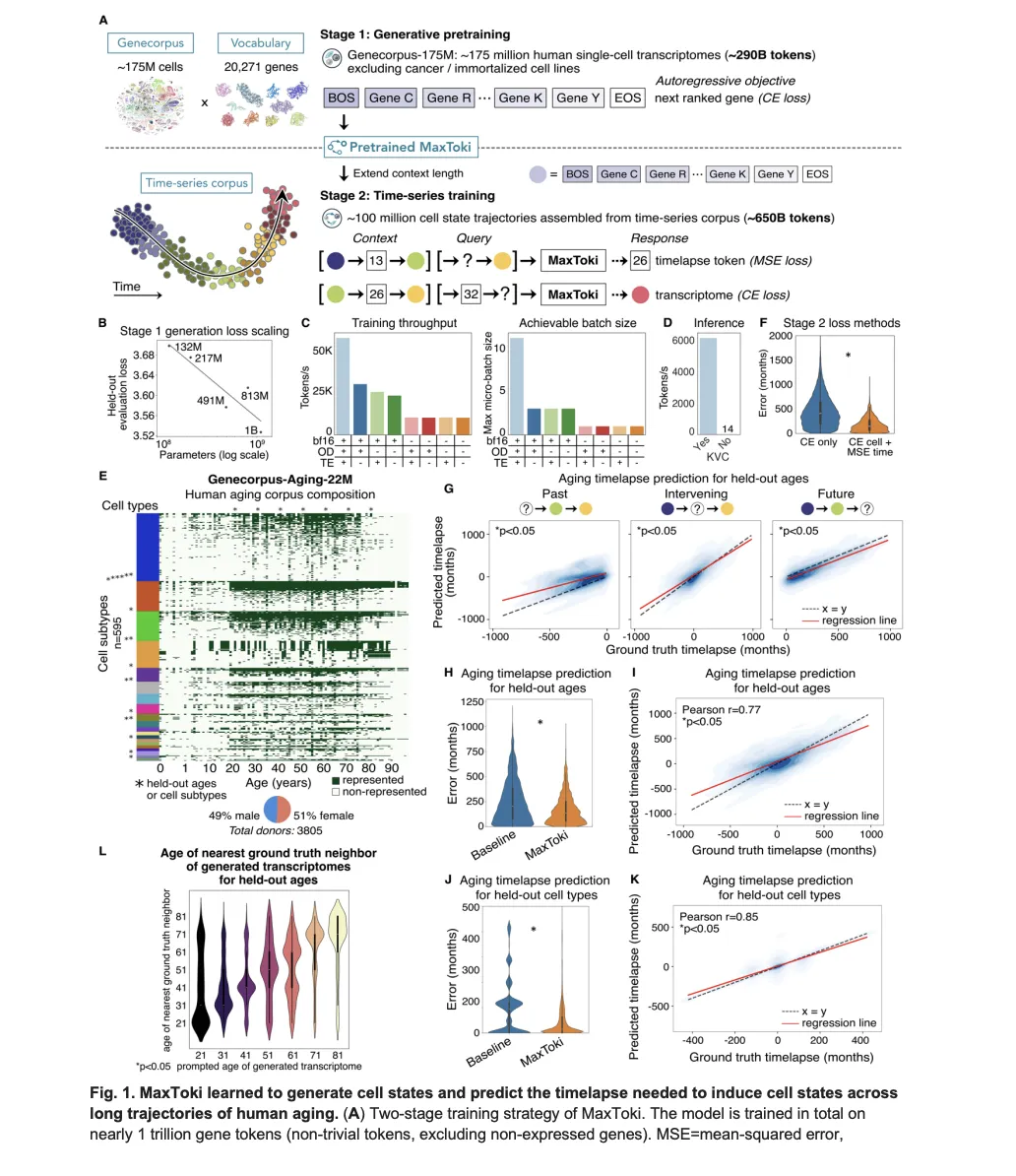
Meet MaxToki: The AI That Predicts How Your Cells Age — and What to Do About It
MaxToki is a new AI foundation model that can predict cellular aging patterns and trajectories, addressing a key limitation in existing biological models that only analyze cells as static snapshots. The technology represents a significant advancement in computational biology by incorporating temporal dynamics into cellular analysis.
AIBullishDecrypt · Apr 46/10

AIBullishcrypto.news · Apr 46/10

AIBearishFortune Crypto · Apr 36/10

AIBearishArs Technica – AI · Apr 36/10

AIBearishTechCrunch – AI · Apr 36/10
AIBullishBlockonomi · Apr 36/10
AIBearishBlockonomi · Apr 36/10
AIBullishcrypto.news · Apr 36/10

AIBearishThe Verge – AI · Apr 36/10

AIBullishFortune Crypto · Apr 36/10

AIBullishcrypto.news · Apr 36/10

AIBullishBlockonomi · Apr 36/10