#artificial-intelligence News & Analysis
Coverage of #artificial-intelligence has accelerated significantly, with 217 articles published in the last 30 days across the aggregator's indexed sources. Bullish sentiment dominates the discourse at 76%, up 8.1 percentage points compared to the prior quarter, while bearish takes represent just 15.2% of recent coverage. Research preprints from arXiv lead source volume, followed by reporting from The Verge and specialized AI publications.
The conversation centers on major players including OpenAI and Anthropic, with ChatGPT remaining a frequent focal point. Related discussions touch on machine learning, research developments, and cryptocurrency assets including Bitcoin and various alternative tokens. Scan the articles below for the latest reporting and analysis.
sentiment · last 30d (217 articles) · +8.1pp bullish vs prior 90dTop sources:arXiv – CS AI · 407The Verge – AI · 76AI News · 56crypto.news · 25Crypto Briefing · 20
Most-discussed entities:OpenAI · 53ChatGPT · 38Anthropic · 33Claude · 23Nvidia · 16
AIBullisharXiv – CS AI · Mar 177/10
🧠An NSF workshop community paper outlines strategic priorities for strengthening the intersection between artificial intelligence and mathematical/physical sciences (AI+MPS). The report proposes three key activities: enabling bidirectional AI+MPS research, building interdisciplinary communities, and fostering education and workforce development in this rapidly evolving field.
AIBearisharXiv – CS AI · Mar 177/10
🧠A comprehensive study of 19 large language models reveals systematic racial bias in automated text annotation, with over 4 million judgments showing LLMs consistently reproduce harmful stereotypes based on names and dialect. The research demonstrates that AI models rate texts with Black-associated names as more aggressive and those written in African American Vernacular English as less professional and more toxic.
AINeutralarXiv – CS AI · Mar 177/10
🧠A research paper argues that the most valuable capabilities of large language models are precisely those that cannot be captured by human-readable rules. The thesis is supported by proof showing that if LLM capabilities could be fully rule-encoded, they would be equivalent to expert systems, which have been proven historically weaker than LLMs.
AIBullisharXiv – CS AI · Mar 177/10
🧠Researchers propose BIGMAS (Brain-Inspired Graph Multi-Agent Systems), a new architecture that organizes specialized LLM agents in dynamic graphs with centralized coordination to improve complex reasoning tasks. The system outperformed existing approaches including ReAct and Tree of Thoughts across multiple reasoning benchmarks, demonstrating that multi-agent design provides gains complementary to model-level improvements.
AIBullishMarkTechPost · Mar 167/10
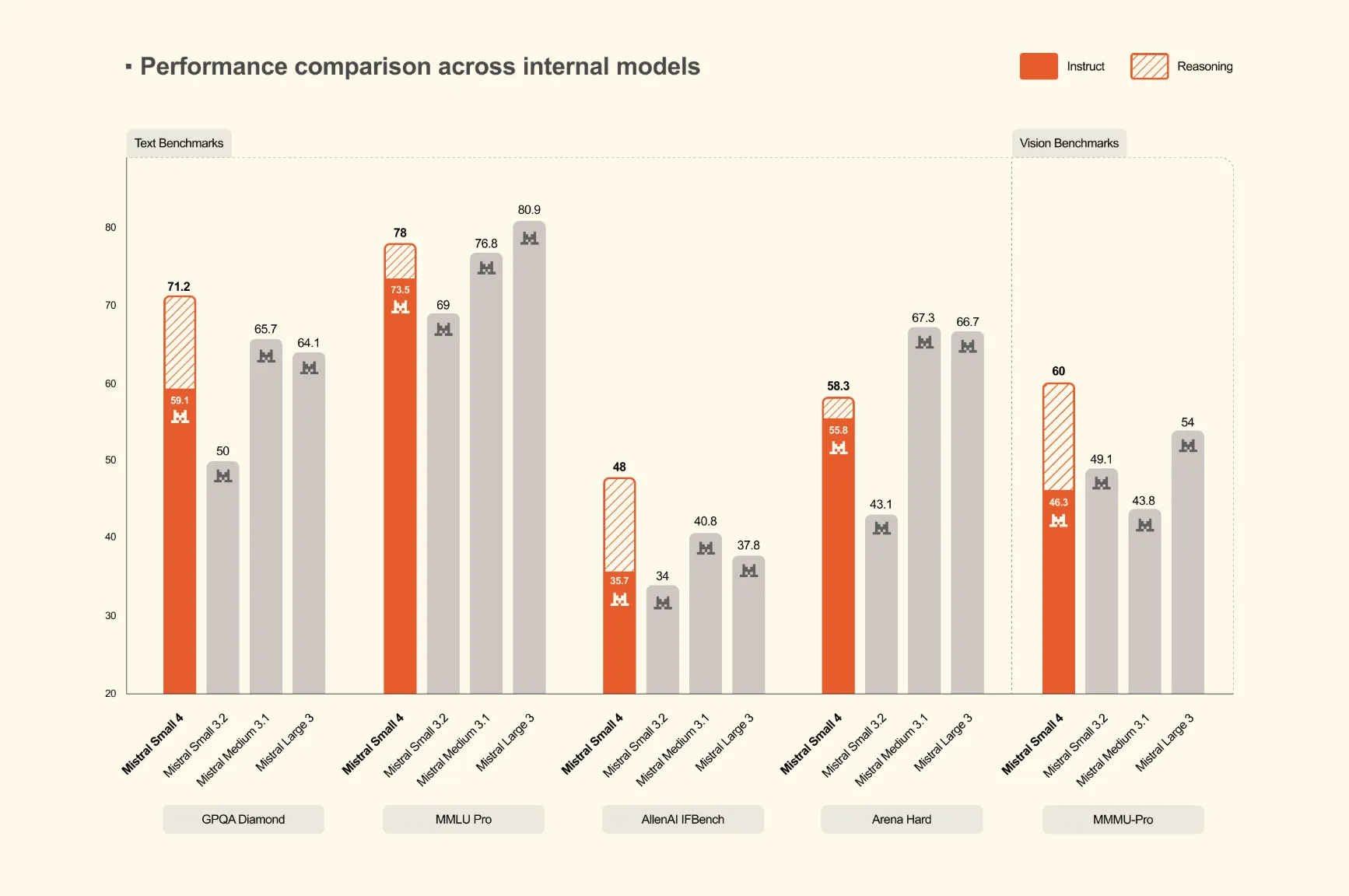
🧠Mistral AI has launched Mistral Small 4, a 119-billion parameter Mixture of Experts (MoE) model that unifies instruction following, reasoning, and multimodal capabilities into a single deployment. This represents the first model from Mistral to consolidate the functions of their previously separate Mistral Small, Magistral, and Pixtral models.
🏢 Mistral
AIBearishFortune Crypto · Mar 167/10
🧠Elon Musk's xAI company is experiencing significant organizational turmoil, with 9 out of 11 original co-founders departing, leaving only 2 remaining besides Musk. Musk has publicly acknowledged that the company 'wasn't built right' as its major AI initiatives appear to be stalling.
🏢 xAI
AIBullisharXiv – CS AI · Mar 167/10
🧠Researchers introduce the Darwin Gödel Machine (DGM), a self-improving AI system that can iteratively modify its own code and validate changes through benchmarks. The system demonstrated significant performance improvements, increasing coding capabilities from 20.0% to 50.0% on SWE-bench and from 14.2% to 30.7% on Polyglot benchmarks.
AIBullisharXiv – CS AI · Mar 167/10
🧠Researchers introduce the AI Search Paradigm, a comprehensive framework for next-generation search systems using four LLM-powered agents (Master, Planner, Executor, Writer) that collaborate to handle everything from simple queries to complex reasoning tasks. The system employs modular architecture with dynamic workflows for task planning, tool integration, and content synthesis to create more adaptive and scalable AI search capabilities.
AIBullisharXiv – CS AI · Mar 167/10
🧠Researchers propose Active Causal Structure Learning with Latent Variables (ACSLWL) as a necessary component for building AGI agents and robots. The paper demonstrates how this approach enables simulated robots to learn complex detour behaviors when encountering unexpected obstacles, allowing them to adapt to new environments by constructing internal causal models.
AIBullisharXiv – CS AI · Mar 167/10
🧠Researchers introduced QMatSuite, an open-source platform that enables AI agents to accumulate and apply knowledge across computational materials science experiments. The system demonstrated significant improvements, reducing reasoning overhead by 67% and improving accuracy from 47% to 3% deviation from literature benchmarks.
AINeutralarXiv – CS AI · Mar 167/10
🧠Researchers introduce HCP-DCNet, a new AI framework that combines physical dynamics with symbolic causal reasoning to enable AI systems to understand cause-and-effect relationships. The system uses hierarchical causal primitives and can self-improve through interventions, potentially addressing current limitations in AI's ability to handle distribution shifts and counterfactual reasoning.
AINeutralBlockonomi · Mar 157/10
🧠Elon Musk predicts AI will make traditional jobs optional in coming decades as AI systems become capable of performing most tasks efficiently. He proposes Universal High Income as a solution, where automation reduces costs to basic material and electricity prices, creating abundance while requiring new mechanisms to distribute AI-generated wealth.
AIBearishBlockonomi · Mar 147/10
🧠Meta's stock fell 3.83% following reports that the company may cut 20% of its workforce to fund a massive $600 billion AI infrastructure investment through 2028. The layoffs represent a significant restructuring effort to finance the tech giant's ambitious artificial intelligence expansion plans.
AI × CryptoBearishCoinTelegraph · Mar 127/10
🤖Crypto ATM losses increased by 33% in 2025, with AI technology being used to enhance and superpower scamming operations. CertiK identifies crypto ATMs as the most accessible extraction method for scammers to convert stolen funds.
AIBullishBlockonomi · Mar 117/10
🧠KALA BIO (KALA) stock surged 70% in pre-market trading after announcing plans to launch its first commercial AI agent within 14 days through the Researgency.ai platform. The company is positioning itself as a 'Palantir for Biotech' with its AI-driven strategy.
AIBullisharXiv – CS AI · Mar 117/10
🧠Researchers developed EyExIn, a new AI framework that addresses critical gaps in large vision language models for medical diagnosis by anchoring them with domain-specific expert knowledge. The system uses dual-stream encoding and deep expert injection to improve accuracy in ophthalmic diagnosis, outperforming existing proprietary systems across four benchmarks.
AINeutralarXiv – CS AI · Mar 117/10
🧠Researchers have identified a phenomenon called 'merging collapse' where combining independently fine-tuned large language models leads to catastrophic performance degradation. The study reveals that representational incompatibility between tasks, rather than parameter conflicts, is the primary cause of merging failures.
AIBullishTechCrunch – AI · Mar 107/10
🧠Legora, an AI platform for lawyers, has reached a $5.55 billion valuation after raising $550 million in Series D funding led by Accel. The funding round highlights the continued growth and investor confidence in AI-powered legal technology solutions.
AINeutralarXiv – CS AI · Mar 97/10
🧠New research reveals that generative AI creates a paradox where it equalizes individual task performance but may increase aggregate inequality by concentrating economic value in complementary assets. The study presents a formal model showing two inequality regimes dependent on AI's technology structure and labor market institutions.
AIBullisharXiv – CS AI · Mar 97/10
🧠Researchers developed AIRT, an AI-powered radiation therapy planning system that generates complete prostate cancer treatment plans in under one second using deep learning. The system processes CT scans and anatomical data to produce clinically-viable radiation treatment plans 100x faster than current methods, demonstrating non-inferiority to existing commercial solutions.
🏢 Nvidia
AIBullisharXiv – CS AI · Mar 97/10
🧠Google DeepMind introduces Aletheia, an AI research agent powered by Gemini Deep Think that can autonomously conduct mathematical research from problem-solving to generating complete research papers. The system has successfully produced research papers without human intervention and solved four open mathematical problems from established databases.
🏢 Google🧠 Gemini
AI × CryptoNeutralarXiv – CS AI · Mar 67/10
🤖Researchers propose S5-SHB Agent, a blockchain framework for smart homes that combines adaptive consensus mechanisms with multi-agent AI coordination. The system uses ten specialized AI agents and a four-tier governance model to manage safety, security, comfort, and energy while allowing resident control over automation.
AINeutralarXiv – CS AI · Mar 67/10
🧠Researchers introduce BioLLMAgent, a hybrid framework combining reinforcement learning models with large language models to simulate human decision-making in computational psychiatry. The framework demonstrates strong interpretability while accurately reproducing human behavioral patterns and successfully simulating cognitive behavioral therapy principles.
AIBullishCrypto Briefing · Mar 57/10
🧠OpenAI has released GPT-5.4, featuring enhanced reasoning, coding, and computer use capabilities across ChatGPT, API, and Codex platforms. This represents a significant advancement in AI technology that could impact various industries and development workflows.
🏢 OpenAI🧠 GPT-5🧠 ChatGPT
AIBullishThe Verge – AI · Mar 57/10
🧠OpenAI has launched GPT-5.4, a new AI model with native computer use capabilities that can operate computers and complete tasks across different applications. The model represents a significant step toward autonomous AI agents that can work in the background to complete complex jobs, combining improvements in reasoning, coding, and professional work.
🏢 OpenAI🧠 GPT-5🧠 ChatGPT