AIBullishMIT Technology Review · Jun 17/10
🧠China has approved an invasive brain-computer interface (BCI) chip, marking a regulatory milestone in neurotechnology. The device enabled a paralyzed patient to regain motor control, demonstrating practical medical applications for BCIs in treating spinal cord injuries.
AIBullishMIT News – AI · Mar 267/10
🧠MIT engineers have developed an AI model that generates novel proteins based on their vibrational motion and dynamics rather than just static structure. This breakthrough approach opens new possibilities for creating dynamic biomaterials and adaptive therapeutics that leverage protein movement.
AIBullisharXiv – CS AI · Mar 57/10
🧠Researchers introduce MMAI Gym for Science, a training framework for molecular foundation models in drug discovery. Their Liquid Foundation Model (LFM) outperforms larger general-purpose models on drug discovery tasks while being more efficient and specialized for molecular applications.
AINeutralarXiv – CS AI · Mar 57/10
🧠Researchers developed Logit Diff Amplification (LDA) as an inference-time safety mechanism for protein language models to prevent toxic protein generation. The method reduces predicted toxicity rates while maintaining biological plausibility and structural viability, addressing dual-use safety concerns in AI-driven protein design.
AIBullisharXiv – CS AI · Mar 46/102
🧠Researchers introduce RigidSSL, a new geometric pretraining framework for protein design that improves designability by up to 43% and enhances success rates in protein generation tasks. The two-phase approach combines geometric learning from 432K protein structures with molecular dynamics refinement to better capture protein conformational dynamics.
AIBullisharXiv – CS AI · Mar 37/103
🧠Researchers developed mCLM, a 3-billion parameter modular Chemical Language Model that generates functional molecules compatible with automated synthesis by tokenizing at the building block level rather than individual atoms. The AI system outperformed larger models including GPT-5 in creating synthesizable drug candidates and can iteratively improve failed clinical trial compounds.
AIBullishOpenAI News · Feb 57/105
🧠An autonomous laboratory system combining OpenAI's GPT-5 with Ginkgo Bioworks' cloud automation platform achieved a 40% reduction in cell-free protein synthesis costs through closed-loop experimentation. This breakthrough demonstrates AI's potential to significantly optimize biotechnology processes and reduce manufacturing expenses.
AIBullishGoogle DeepMind Blog · Nov 257/102
🧠AlphaFold has significantly accelerated scientific research and biological discovery over the past five years. The AI system has enabled breakthroughs in protein structure prediction, fueling innovation across the global scientific community.
AIBullishGoogle Research Blog · Sep 117/107
🧠The article introduces NucleoBench and AdaBeam, new tools for advancing nucleic acid design in biotechnology. These AI-powered platforms aim to improve the precision and efficiency of genetic engineering and therapeutic applications.
AIBullishOpenAI News · Aug 227/106
🧠OpenAI and Retro Bio collaborated using a specialized AI model called GPT-4b micro to engineer more effective proteins for stem cell therapy and longevity research. This represents a significant application of AI technology in advancing life sciences and medical research capabilities.
AIBullishGoogle DeepMind Blog · Oct 97/105
🧠Demis Hassabis and John Jumper have been awarded the Nobel Prize in Chemistry for developing AlphaFold, an AI system that predicts 3D protein structures from amino acid sequences. This recognition highlights the transformative impact of AI in scientific research and drug discovery.
AINeutralMIT Technology Review · May 275/10
🧠MIT Technology Review's newsletter discusses the accelerating pace of AI developments during summer 2024 and explores emerging applications in biotechnology, specifically IVF. The article underscores the challenge of keeping informed amid relentless technological advancement across multiple sectors.
AINeutralarXiv – CS AI · May 276/10
🧠Researchers introduce SILO, a self-improvement imitation framework for protein design that optimizes protein sequences under limited evaluation budgets. The method combines hierarchical editing, stochastic beam search, and active learning to outperform existing reinforcement learning and generative approaches across multiple protein fitness landscapes.
AIBullishMarkTechPost · Apr 56/10
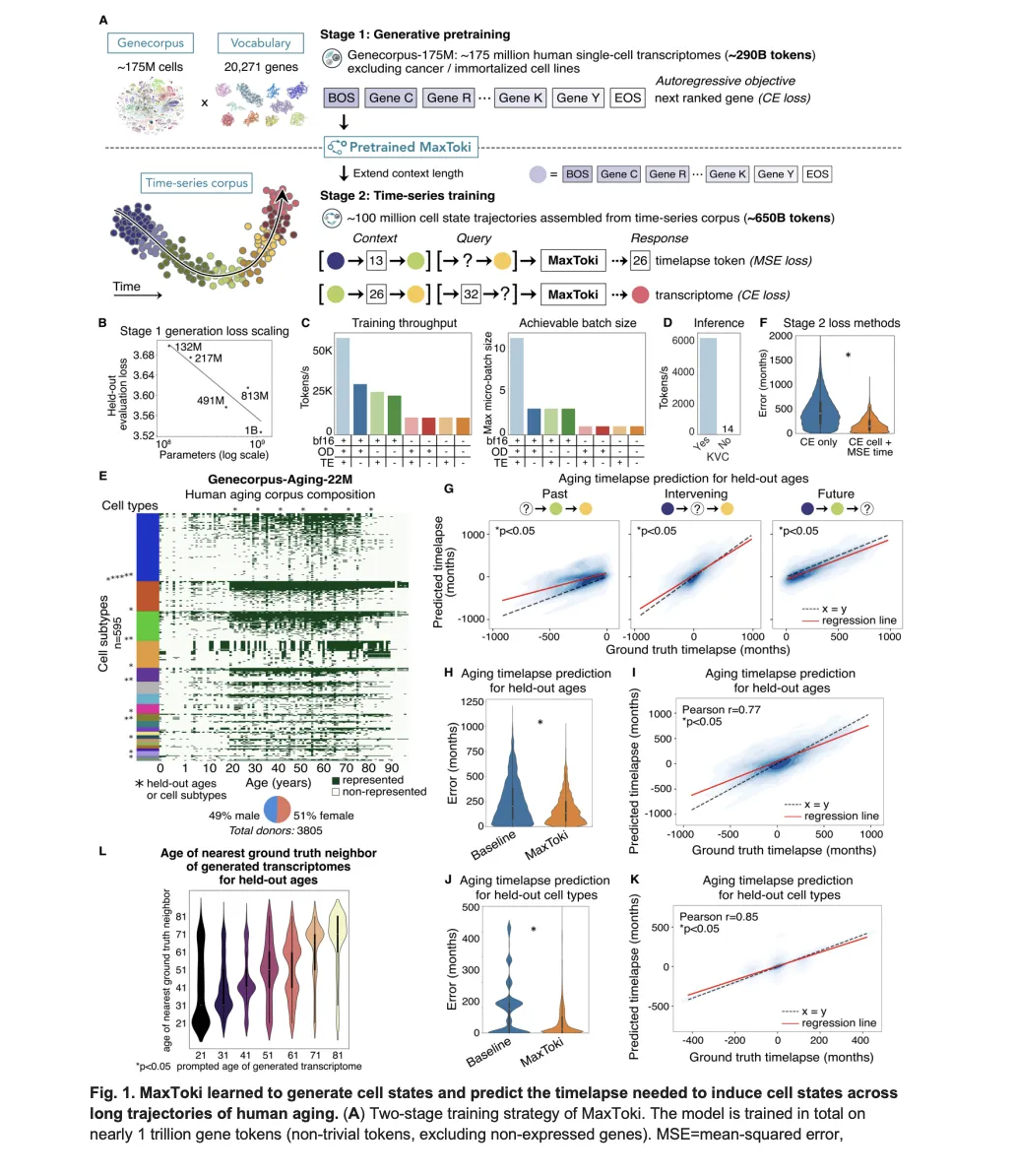
🧠MaxToki is a new AI foundation model that can predict cellular aging patterns and trajectories, addressing a key limitation in existing biological models that only analyze cells as static snapshots. The technology represents a significant advancement in computational biology by incorporating temporal dynamics into cellular analysis.
AIBullisharXiv – CS AI · Mar 36/103
🧠Researchers have developed GeoBPE, a new protein structure tokenization method that converts protein backbone structures into discrete geometric tokens, achieving over 10x compression and data efficiency improvements. The approach uses geometry-grounded byte-pair encoding to create hierarchical vocabularies of protein structural primitives that align with functional families and enable better multimodal protein modeling.
AIBullishDecrypt · Mar 37/107
🧠Cortical Labs successfully trained living human neurons to play the video game Doom, marking a significant advancement in biological computing. This experiment demonstrates the potential for using biological neural networks in computing applications, extending traditional engineering benchmarks into the realm of living tissue.
AIBullisharXiv – CS AI · Mar 26/1014
🧠Researchers have developed GenAI-Net, a generative AI framework that automates the design of chemical reaction networks (CRNs) for synthetic biology applications. The system can automatically generate biomolecular circuits for various functions including logic gates, oscillators, and classifiers, potentially accelerating the development of biomanufacturing and therapeutic technologies.
AIBullisharXiv – CS AI · Feb 276/107
🧠CryoNet.Refine introduces a deep learning framework that uses one-step diffusion models to rapidly refine molecular structures in cryo-electron microscopy. The AI system automates and accelerates the traditionally manual and computationally expensive process of fitting atomic models into experimental density maps.
AIBullishIEEE Spectrum – AI · Feb 46/104
🧠Google DeepMind has launched AlphaGenome, an AI tool that analyzes the 98% of human DNA that doesn't code for proteins but regulates gene expression. The deep-learning platform can predict 11 types of biological signals and is already being used by thousands of scientists worldwide for cancer research, drug discovery, and synthetic DNA design.
$LINK$NEAR
AIBullishGoogle DeepMind Blog · Dec 46/105
🧠Scientists are leveraging Google's AlphaFold AI system to engineer more resilient crops that can withstand rising temperatures. The research focuses on strengthening photosynthesis enzymes to create heat-tolerant agricultural varieties for climate adaptation.
AIBullishGoogle DeepMind Blog · Jun 256/105
🧠AlphaGenome introduces a new unified DNA sequence model designed to improve regulatory variant-effect prediction and enhance understanding of genome function. The AI-powered genomics tool is now accessible through an API for researchers and developers.
AIBullishNVIDIA AI Blog · Feb 76/102
🧠Researchers are using artificial intelligence to design proteins that could serve as life-saving treatments for deadly snake venom. This AI-driven approach in medicine could potentially provide crucial snakebite treatments to vulnerable populations worldwide.
AIBullishOpenAI News · Oct 315/107
🧠Promega, a biotechnology company, has implemented ChatGPT across its organization in a top-down approach to enhance operations in manufacturing, sales, and marketing. The adoption demonstrates how AI tools can be systematically integrated into enterprise workflows to improve efficiency and productivity.
AIBullishOpenAI News · Sep 195/103
🧠Genmab has launched an 'AI Everywhere' initiative, adopting ChatGPT Enterprise across its operations. The biotechnology company is leveraging OpenAI's enterprise solution with enhanced security and privacy commitments for organizational implementation.
AINeutralMIT News – AI · Feb 114/106
🧠Drug-resistant infections are increasing due to antibiotic overuse and misuse, while development of new antibacterial treatments has slowed. Synthetic biology and AI are being explored as potential solutions to address the growing global antimicrobial resistance threat.