#computational-efficiency News & Analysis
Recent coverage of #computational-efficiency has drawn sustained attention from the research community, with 36 articles published in the last month across 147 indexed pieces. The conversation maintains solidly bullish sentiment at 80.6%, with minimal variation from earlier periods. Academic sources dominate the discourse, led by arXiv's computer science and AI sections, reflecting the tag's close ties to machine learning research and broader AI development discussions.
The topic frequently intersects with conversations about specific models like GPT-4 and Gemini, as well as platform work at organizations like Perplexity. Scan the articles below for the latest developments in this area.
sentiment · last 30d (36 articles)Top sources:arXiv – CS AI · 134Hugging Face Blog · 1
Most-discussed entities:Perplexity · 2GPT-4 · 1Gemini · 1
AIBullisharXiv – CS AI · Jun 27/10
🧠Researchers present Heterogeneous Decentralized Diffusion Models (HDDM), a framework that reduces computational requirements for training diffusion models by 16× while enabling diverse training objectives across distributed experts. The approach eliminates synchronization requirements and allows individual contributors with single GPUs to participate in decentralized generative model training.
AIBullisharXiv – CS AI · Jun 27/10
🧠Researchers introduce JAMEL, a framework that trains AI agents to explore open-ended environments more effectively by jointly developing memory systems and exploration policies through novelty-driven learning. The approach uses natural supervisory signals like code coverage to train compressed memory representations, achieving exploration capabilities that rival closed-source models while reducing computational token consumption.
AIBullishArs Technica – AI · Jun 17/10
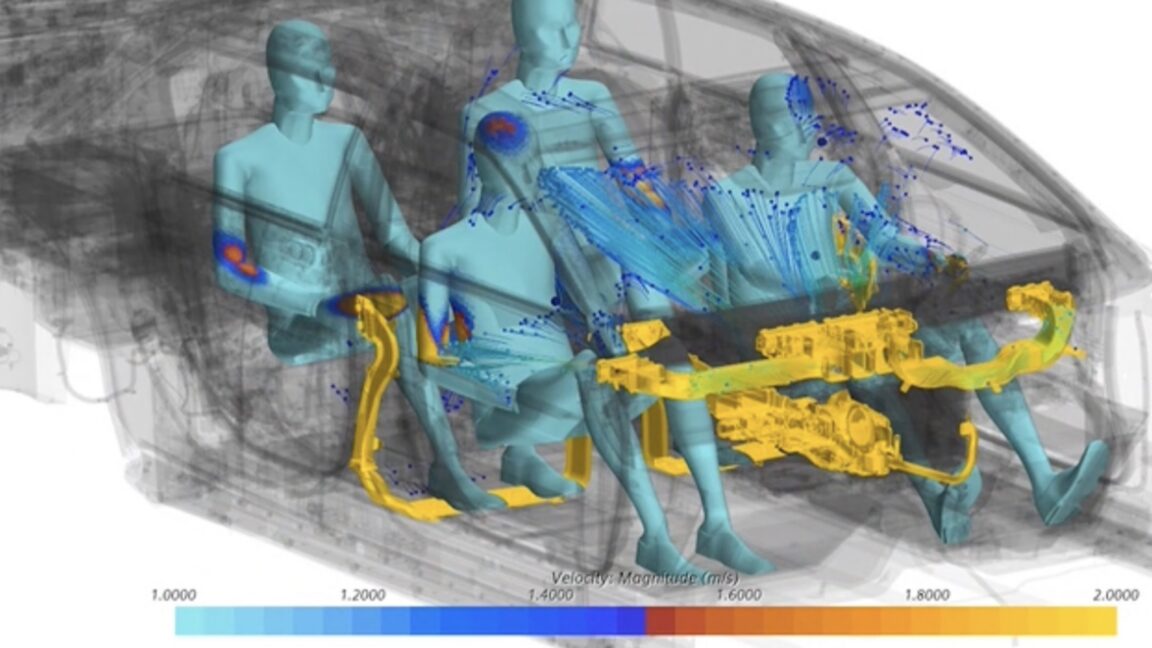
🧠General Motors is leveraging AI and machine learning to dramatically accelerate vehicle development cycles, reducing computational simulation time from 15 hours to one minute through advanced virtualization techniques including CFD, FEA, and digital twins. This technological shift demonstrates how AI adoption in traditional manufacturing can create substantial efficiency gains and competitive advantages in automotive design and production.
AIBullisharXiv – CS AI · Jun 17/10
🧠Researchers propose DeMix, a framework that uses model merging to efficiently determine optimal data mixtures for large language model pre-training without expensive repeated training cycles. The approach decouples the search process from training costs, enabling evaluation of multiple data combinations while also releasing a 22-token dataset to support open research.
AIBullisharXiv – CS AI · Jun 17/10
🧠Researchers introduce SLAT, a reinforcement learning framework that reduces chain-of-thought reasoning in large language models by 50% while maintaining accuracy. The approach identifies and suppresses redundant, low-utility reasoning segments rather than applying uniform length penalties, addressing computational inefficiency in advanced AI reasoning systems.
AIBullisharXiv – CS AI · Jun 17/10
🧠Researchers propose Rank-Factorized Implicit Neural Bias (RIB), a novel positional encoding method that replaces relative positional bias in Super-Resolution Transformers, enabling compatibility with FlashAttention hardware acceleration. This breakthrough achieves significant performance gains (35.63 dB PSNR on Urban100×2) while reducing training and inference time by 2.1× and 2.9× respectively, addressing a critical scalability bottleneck in SR model development.
AIBullisharXiv – CS AI · Jun 17/10
🧠Researchers demonstrate that efficient LLM benchmarking can be substantially improved by treating it as a multiple regression problem with kernel ridge regression and applying minimum redundancy maximum relevance (mRMR) feature selection. The approach achieves lower prediction errors and faster computation than existing methods while maintaining consistency across different data splits.
AIBullisharXiv – CS AI · Jun 17/10
🧠Researchers introduce PRISM, a training-free framework for efficiently selecting visual instruction data for multimodal language models that reduces computational costs to 30% of conventional pipelines while improving performance across multiple benchmarks. The method addresses global semantic drift caused by anisotropic visual feature distributions, enabling more efficient model fine-tuning without sacrificing quality.
AIBullisharXiv – CS AI · Jun 17/10
🧠Researchers have proven that Shapley values, a key framework for attribution in machine learning, depend exclusively on the odd component of set functions. This theoretical breakthrough justifies the effectiveness of paired sampling and enables OddSHAP, a new estimator that achieves state-of-the-art accuracy by performing regression solely on the odd subspace using Fourier basis decomposition.
AIBullisharXiv – CS AI · Jun 17/10
🧠Researchers propose DARTS, a novel approach to accelerate large language model reinforcement learning by reshaping the rollout distribution toward conciseness and certainty, reducing computational inefficiencies caused by long-tail response lengths. The method achieves up to 1.77x speedup through distribution-aware trajectory sampling without sacrificing model performance.
AIBullisharXiv – CS AI · Jun 17/10
🧠Researchers propose replacing the outdated point neuron model in artificial neural networks with a more biologically realistic cortical cell model, demonstrating improvements in expressivity, robustness, learning speed, and reduced memorization without increasing parameters. This fundamental advancement in neural architecture design could enhance AI system efficiency and performance across applications.
AIBullisharXiv – CS AI · May 297/10
🧠Researchers introduce LoRe, a training-free optimization method that dynamically routes computational resources to high-priority interactions in iterative graph solvers, achieving 8× speedup and 12× memory reduction on combinatorial optimization problems while maintaining solution quality.
AIBullisharXiv – CS AI · May 297/10
🧠ParaTool is a new framework that shifts tool representations from context to parameters in large language models, enabling efficient tool calling without relying on lengthy in-context documentation. The approach uses parametric tool pre-training, soft tool selection, and fine-tuning to reduce inference overhead and hallucination risks while maintaining superior performance on benchmark tests.
AIBullisharXiv – CS AI · May 297/10
🧠Researchers introduce e-valuator, a method that applies sequential hypothesis testing to convert AI verifier scores into statistically reliable decision rules for evaluating agent trajectories. The framework provides provable false alarm rate control and enables early termination of problematic sequences, offering a model-agnostic approach to improving the reliability of agentic AI systems.
AIBullisharXiv – CS AI · May 297/10
🧠Researchers introduce CORE-RAG, a novel framework that compresses context in Retrieval-Augmented Generation systems using performance-driven learning rather than predefined heuristics. The approach achieves a 97% compression ratio while improving accuracy by 3.3 points on exact match scores, addressing a critical bottleneck in LLM efficiency.
AIBullisharXiv – CS AI · May 287/10
🧠Researchers introduce TSVD, a framework for training Large Language Models more efficiently by maintaining low-rank representations and strict weight orthonormality throughout pretraining. The method uses adaptive rank selection and caching mechanisms to reduce computational overhead while matching or exceeding the performance of standard full-parameter models.
AIBullisharXiv – CS AI · May 287/10
🧠Researchers introduce EAGer, a training-free method that optimizes inference-time computation for reasoning language models by dynamically allocating compute budgets based on token-level entropy. The approach reduces computational waste while improving performance, achieving up to 37% gains in Pass@k metrics with 59% fewer tokens in supervised settings.
AIBullisharXiv – CS AI · May 277/10
🧠Researchers introduce Qrita, an efficient algorithm for Top-k and Top-p sampling in large language models that uses pivot-based truncation instead of sorting. The method achieves 1.4x throughput improvements with 50% less memory usage while maintaining identical output to traditional sorting approaches, and has been adopted as the default sampler in vLLM.
AIBullisharXiv – CS AI · May 277/10
🧠Researchers propose VLA-Pruner, a novel token pruning method that accelerates Vision-Language-Action models for embodied AI by addressing the mismatch between semantic and action-critical visual processing. The method achieves up to 1.99x speedup while maintaining manipulation performance by considering both semantic context and temporal action relevance, unlike existing VLM pruning approaches.
AIBullisharXiv – CS AI · May 277/10
🧠Researchers conducted an extensive empirical study evaluating FP8, INT8, and INT4 quantization formats across the Llama-3.1 model family, finding that FP8 is effectively lossless while INT4 weight-only quantization performs surprisingly well. The findings provide practical deployment guidelines for optimizing the accuracy-performance trade-off in large language model inference at scale.
🧠 Llama
AIBullisharXiv – CS AI · May 277/10
🧠Researchers present Inverse Learning (IL), a neuro-inspired framework for embodied AI planning that outperforms offline reinforcement learning and diffusion-based planners on D4RL benchmarks by an average of 24.2% while requiring 1-2 orders of magnitude less inference compute. The approach optimizes entire action sequences through forward models rather than step-by-step decisions, enabling faster, smoother control policies applicable to robotics and quantum gate synthesis.
AIBullisharXiv – CS AI · May 127/10
🧠Researchers introduce MARLaaS, a system enabling cost-effective concurrent reinforcement learning fine-tuning for large language models across multiple users through shared base models and asynchronous architecture. The approach achieves 4.3x better accelerator utilization and 85% reduction in training time while maintaining single-task performance quality.
AIBullisharXiv – CS AI · May 127/10
🧠Researchers introduce Entropy-informed Decoding (EDEN), a novel framework that optimizes how large language models generate text by dynamically adjusting computational effort based on output uncertainty. The method matches or exceeds the performance of traditional beam search while using fewer computational expansions, particularly improving results on complex tasks like mathematical reasoning and code generation.
AIBullisharXiv – CS AI · May 127/10
🧠Researchers demonstrate that Mixture of Experts (MoE) models contain substantial underutilized sparsity within individual experts that can be exploited without modifying model parameters. By implementing intra-expert activation sparsity in vLLM, they achieve up to 2.5x speedup in MoE layer execution, offering a practical optimization path for efficient large language model deployment.
AIBullisharXiv – CS AI · May 127/10
🧠Researchers propose LEAD, a new method that makes large reasoning AI models more efficient by dynamically balancing accuracy and output length during training. Unlike existing approaches using static constraints, LEAD adapts per-problem length targets and reward calibration in real-time, achieving better accuracy and shorter outputs across mathematical reasoning benchmarks.
🏢 OpenAI🧠 o1