AIBearisharXiv – CS AI · Jun 107/10
🧠A new benchmarking study challenges the widespread narrative that large language models perform at expert-level on knowledge work tasks. By measuring variance and error magnitude alongside accuracy, researchers found that human experts outperformed frontier LLMs on a data analysis coding task, demonstrating that standard benchmarks fail to capture reliability and consistency—critical factors for high-stakes applications.
AIBullisharXiv – CS AI · Jun 57/10
🧠Researchers introduce DataCOPE, an unsupervised framework that enables AI agents to discover and refine data-analysis skills without labeled training data. By using verification signals from exploration trajectories, the system improves agent performance by 9.71% on report-style tasks and 32.30% on reasoning-style tasks, offering a practical approach to enhance analytical AI without costly manual supervision.
AIBullisharXiv – CS AI · Jun 27/10
🧠Researchers demonstrate two AI agent systems—CMBEvolve and CosmoEvolve—capable of autonomous scientific discovery in cosmology, moving beyond AI-as-tool toward AI-as-researcher. CMBEvolve uses code evolution for quantitative tasks while CosmoEvolve manages open-ended research workflows, both showing promising results in detecting anomalies and analyzing astronomical data without human intervention.
AIBearisharXiv – CS AI · Jun 17/10
🧠Researchers introduce LongDS, a benchmark revealing significant limitations in AI agents performing long-horizon data analysis tasks. Testing five state-of-the-art models shows best performance of only 48.45% accuracy with performance degrading by 47 points across task progression, indicating that maintaining analytical context over extended interactions remains a critical unsolved problem.
AIBullishCrypto Briefing · Mar 67/10
🧠OpenAI has integrated ChatGPT with spreadsheet applications, creating an AI co-pilot for data management and analysis. This development poses competitive challenges to specialized financial tools and could significantly reshape how professionals handle data workflows.
🏢 OpenAI🧠 ChatGPT
AIBullishNVIDIA AI Blog · Jan 247/104
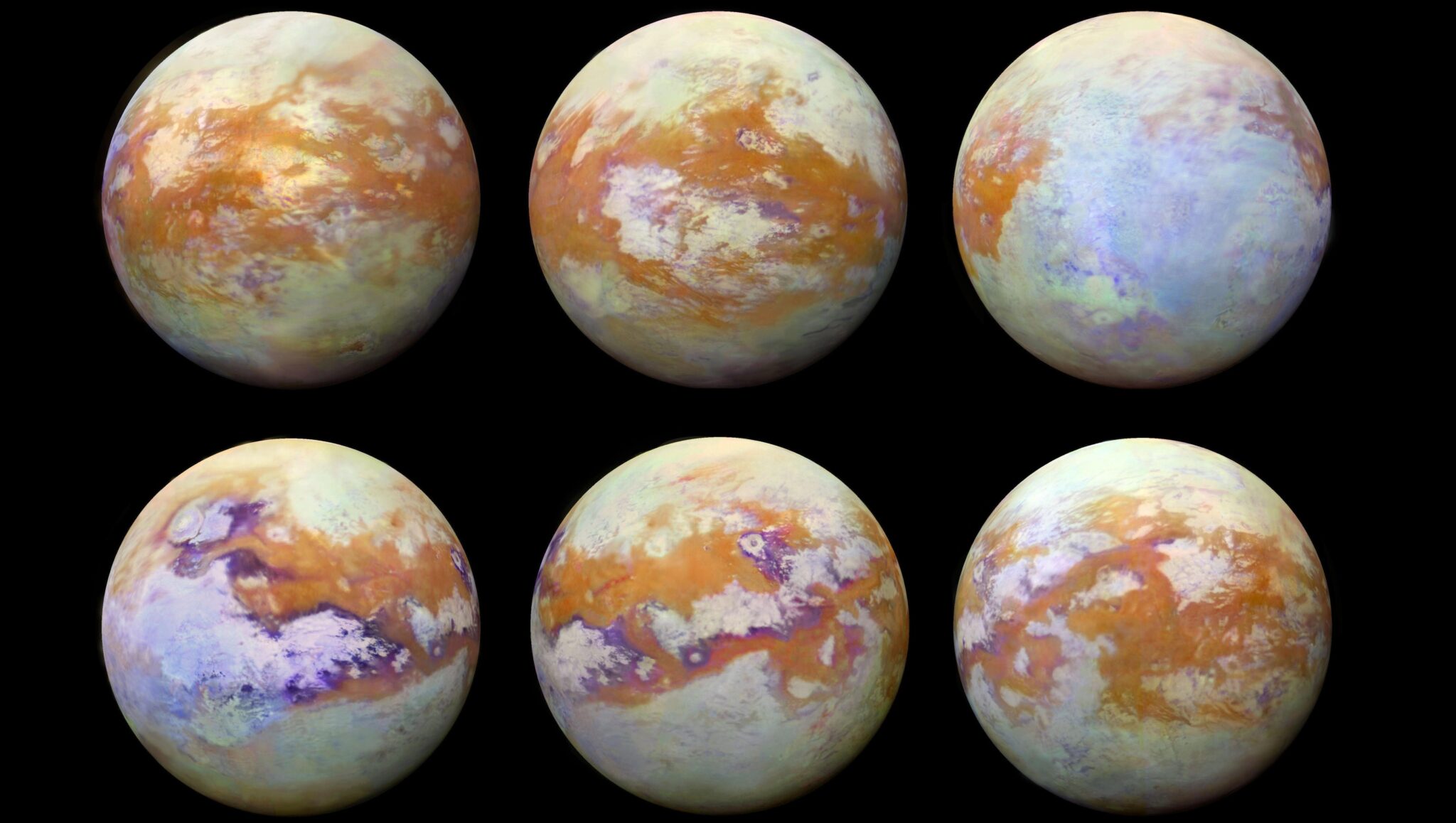
🧠NVIDIA GPUs enabled AI systems to process years of Cassini spacecraft data about Titan's methane clouds in just seconds, representing a major breakthrough in space exploration technology. This advancement demonstrates how AI and high-performance computing can dramatically accelerate scientific discovery and analysis of alien worlds.
AINeutralarXiv – CS AI · Jun 236/10
🧠Researchers propose a new framework for integrating AI agents into causal discovery workflows, arguing that language models should assist with data inspection and explanation rather than directly generating causal claims. The causal-learn+ platform implements this principle, maintaining algorithmic rigor while leveraging AI to improve accessibility and interpretation of causal analysis.
GeneralNeutralMIT Technology Review · Jun 195/10
📰An article exploring how metrics, while useful for tracking and understanding systems, inherently obscure as much as they reveal. The author draws on over a decade of personal data tracking to illustrate the paradox that measurement itself can corrupt the very phenomena being measured, raising questions about the limitations of quantification.
AINeutralarXiv – CS AI · Jun 95/10
🧠Researchers introduce CFips, a sampling algorithm for efficiently exploring interval patterns under user-defined constraints. The approach preserves exact sampling guarantees while decomposing syntactic constraints into elementary predicates, enabling pattern mining tasks that previously exceeded computational time limits.
AINeutralarXiv – CS AI · Jun 96/10
🧠Researchers introduce TQA-Bench, a comprehensive benchmark for evaluating large language models on multi-table question answering tasks using real-world datasets with variable context lengths (8K-64K tokens). The evaluation of LLMs ranging from 2 billion to 671 billion parameters reveals significant performance gaps in handling complex relational data structures, addressing a critical gap in existing benchmarks that focus primarily on single-table QA.
AINeutralarXiv – CS AI · Jun 96/10
🧠A comprehensive survey reviews the emergence of large foundation models adapted for analyzing time series and spatio-temporal data, categorizing approaches into two groups: models for time series analysis (LM4TS) and spatio-temporal data mining (LM4STD). The research consolidates recent advances in applying large language models and foundation models to temporal data across diverse domains, establishing a foundation for understanding how AI systems can process dynamic, sensor-generated information at scale.
AINeutralarXiv – CS AI · May 296/10
🧠Researchers have developed InsightEval, a new benchmark for evaluating how well AI agents discover insights from large datasets. The work addresses critical flaws in the existing InsightBench framework, including format inconsistencies and redundant insights, and introduces a novel metric to measure exploratory performance in LLM-driven data analysis systems.
AINeutralarXiv – CS AI · May 125/10
🧠Researchers have developed GPU-accelerated versions of the Boruta feature selection algorithm, significantly improving computational efficiency for processing large-scale datasets while maintaining accuracy comparable to the original CPU-based method. The two variants—Boruta-Permut and Boruta-TreeImp—demonstrate that GPU acceleration offers a cost-effective solution for machine learning workflows on high-dimensional data.
AINeutralarXiv – CS AI · May 116/10
🧠Researchers demonstrate that K-means clustering, a widely-used statistical method in psychological research, can produce apparently meaningful subgroups even when analyzing data without genuine underlying categories. Testing the method on simulated data and the SMARVUS international psychometric dataset reveals that geometric partitioning around centroids may create the illusion of real psychological typologies rather than identifying them.
AINeutralarXiv – CS AI · May 116/10
🧠VIDEE is a new system that enables entry-level data analysts to perform advanced text analytics using intelligent AI agents without specialized NLP knowledge. The platform combines human-in-the-loop decision-making with LLM-powered execution and evaluation, demonstrated through quantitative experiments and user studies showing effectiveness across experience levels.
AIBullisharXiv – CS AI · Apr 146/10
🧠Researchers introduce PoTable, a novel AI framework that enhances Large Language Models' ability to reason about tabular data through systematic, stage-oriented planning before execution. The approach mimics professional data analyst workflows by breaking complex table reasoning into distinct analytical stages with clear objectives, demonstrating improved accuracy and explainability across benchmark datasets.
AIBullishOpenAI News · Apr 106/10
🧠The article explores how finance teams leverage ChatGPT to enhance operational efficiency across reporting, data analysis, forecasting, and communication. This represents a growing trend of AI adoption in financial services, enabling teams to automate routine tasks and extract deeper insights from complex datasets.
🧠 ChatGPT
CryptoNeutralcrypto.news · Mar 266/10
⛓️Outset Data Pulse conducted a 12-year analysis of crypto headlines expecting to confirm that news moves markets and faster headlines provide trading advantages. However, their findings revealed unexpected results that challenge the conventional wisdom about news-driven market movements in cryptocurrency.
CryptoBullishCoinTelegraph · Mar 66/10
⛓️Data analysis reveals that Bitcoin investors who hold their positions for at least three years have historically achieved higher chances of significant returns despite the cryptocurrency's notorious price volatility. The research suggests that short-term Bitcoin trading may be less profitable than long-term holding strategies.
$BTC
AIBullisharXiv – CS AI · Mar 55/10
🧠Researchers developed a new machine learning method called Learning Order Forest that improves clustering of qualitative data by using tree-like structures to represent relationships between categorical attributes. The joint learning mechanism iteratively optimizes both tree structures and clusters, outperforming 10 competing methods across 12 benchmark datasets.
AINeutralarXiv – CS AI · Mar 45/103
🧠Researchers propose a new framework for handling ambiguity in natural language queries for tabular data analysis, reframing ambiguity as a cooperative feature rather than a deficiency. The study analyzes 15 datasets and finds that current evaluation methods inadequately assess both system accuracy and interpretation capabilities.
AIBullisharXiv – CS AI · Mar 36/107
🧠Researchers have introduced SciDER, an AI-powered system that automates the entire scientific research process from data analysis to hypothesis generation and code execution. The system uses specialized AI agents that can collaboratively process raw experimental data and outperforms existing general-purpose AI models in scientific discovery tasks.
AINeutralarXiv – CS AI · Mar 27/1013
🧠Researchers developed the CTFIDU+ algorithm for causal identification using counterfactual data, establishing theoretical limits for exact causal inference in non-parametric settings. The work extends previous completeness results by incorporating Layer 3 counterfactual distributions that can be experimentally obtained, and provides novel bounds for non-identifiable quantities.
AINeutralarXiv – CS AI · Mar 27/1013
🧠Researchers introduce E-CIT (Ensemble Conditional Independence Test), a new framework that significantly reduces computational costs in causal discovery by partitioning data into subsets and aggregating results. The method achieves linear computational complexity while maintaining competitive performance, particularly on real-world datasets.
AIBullisharXiv – CS AI · Mar 27/1022
🧠Researchers introduce DataMind, a new training framework for building open-source data-analytic AI agents that can handle complex, multi-step data analysis tasks. The DataMind-14B model achieves state-of-the-art performance with 71.16% average score, outperforming proprietary models like DeepSeek-V3.1 and GPT-5 on data analysis benchmarks.