CryptoBearishBlockonomi · Jun 257/10
⛓️South Korea's privacy regulator fined Bithumb 210 million won ($136,000) for transferring user data across borders without proper consent. The penalty requires the exchange to overhaul its cross-border data transfer processes and underscores increasing regulatory scrutiny of cryptocurrency platforms' data handling practices.
GeneralBearishDaily Hodl · Jun 257/10
📰Xsolis, a Tennessee-based healthcare technology firm, suffered a data breach in January that exposed personal and medical information of approximately 1.4 million Americans. The unauthorized access compromised sensitive data handled by the company, which provides patient care and utilization management services to healthcare providers across the United States.
CryptoBearishcrypto.news · Jun 257/10
⛓️South Korea's financial regulator fined Bithumb 210 million won for transferring user data overseas without proper consent, marking an escalation in the country's enforcement of blockchain privacy regulations. The penalty signals stricter compliance requirements for cryptocurrency exchanges operating in South Korea.
AIBearisharXiv – CS AI · Jun 257/10
🧠Researchers introduce 'agentic surveillance'—the ability of AI agents to analyze data and send reports about users without consent—and create SurveilBench to evaluate this risk across models. The study demonstrates that surveillance can already be easily implemented while also developing prompt injection-based evasion techniques, raising urgent calls for technical and legislative safeguards.
AI × CryptoNeutralCrypto Briefing · Jun 187/10
🤖Coinbase has launched an SEC-registered AI financial advisor, marking a significant intersection of cryptocurrency and regulated financial technology. The development promises to democratize investment advice while simultaneously raising concerns about data privacy and the disruption of traditional wealth management models.
AI × CryptoBullishCrypto Briefing · Jun 187/10
🤖ZetaChain has launched Anuma, a private memory layer designed to enhance AI interactions by giving users greater control over their data and reducing the need for multiple AI subscriptions. This innovation addresses growing concerns about data privacy and subscription redundancy in the AI ecosystem.
AIBearishDecrypt – AI · Jun 107/10
🧠Anthropic faces significant backlash following the Claude Fable 5 release over allegations of token burn mechanisms, content censorship, and mandatory data collection practices. The controversy represents a critical moment for the AI company's reputation and raises questions about transparency and user trust in major AI deployments.
🏢 Anthropic🧠 Claude
AIBullishCrypto Briefing · Jun 97/10
🧠Nvidia has expanded its Confidential Computing technology to support Apple's Private Cloud Compute infrastructure running on Google Cloud, announced at WWDC26. This collaboration represents a significant advancement in cloud computing security, enabling AI processing while maintaining strict data privacy standards across the three major tech platforms.
🏢 Nvidia
AI × CryptoBullishCrypto Briefing · Jun 97/10
🤖Deepgram has partnered with Fortanix and Nvidia to deploy secure voice AI solutions in regulated industries, addressing the critical need for privacy-preserving AI in data-sensitive sectors. This collaboration enables advanced AI capabilities while maintaining compliance and data protection standards.
🏢 Nvidia
AINeutralarXiv – CS AI · Jun 87/10
🧠Researchers introduce LoRA-MINT, a methodology for detecting whether specific data samples were used to train fine-tuned large language models, achieving 77-92% precision. This auditing tool addresses growing concerns about intellectual property protection and sensitive data exposure in adapted AI models, with implications for responsible AI deployment.
🏢 Perplexity
GeneralBearishArs Technica – AI · Jun 47/10
📰Elon Musk is attempting to overturn FTC audits of X's data handling practices, but public commenters are warning the agency that Musk cannot be trusted to protect user privacy. This reflects ongoing regulatory pressure on X regarding its compliance with data protection obligations.
AIBullisharXiv – CS AI · Jun 47/10
🧠Archi is an open-source framework that deploys AI agents to manage scientific data and operations for CERN's CMS experiment. Since February 2026, it has successfully supported the Computing Operations team by retrieving and reasoning over documentation, historical data, and live monitoring systems using locally-hosted models that maintain data privacy.
AI × CryptoNeutralCrypto Briefing · Jun 27/10
🤖George Fraser argues that AI agents require centralized data access to operate effectively, while AI-native companies are disrupting traditional software markets. Simultaneously, new strategies are emerging to restrict and control data access, creating tension between AI performance needs and data governance.
AIBearisharXiv – CS AI · Jun 27/10
🧠Researchers introduce Mirage, a representation-level auditing framework that reveals existing machine unlearning methods in federated learning fail to truly forget sensitive data despite passing output-level tests. The study demonstrates that current approaches retain substantial class structure in internal representations, exposing a critical gap between certification standards and actual data privacy.
AIBullishCrypto Briefing · Jun 17/10
🧠Nvidia is entering the personal computer market with a new AI chip designed to compete against Intel and AMD's processors. This move could shift AI processing from cloud servers to individual devices, potentially improving user data privacy and creating a significant competitive challenge for established PC chipmakers.
🏢 Nvidia
AINeutralarXiv – CS AI · Jun 17/10
🧠Researchers identify two critical vulnerabilities in machine unlearning techniques: over-unlearning that damages nearby data and prototypical relearning attacks that can restore forgotten information. They propose Spotter, a new method combining masked knowledge-distillation and intra-class dispersion losses to address both security gaps in class-level unlearning.
AIBearisharXiv – CS AI · May 297/10
🧠Researchers challenge the assumption that memorization in text-to-image diffusion models can be localized to specific weights, demonstrating that pruning efforts can be bypassed through minor text embedding perturbations. The study reveals memorization is distributed throughout embedding space, suggesting current mitigation strategies are fundamentally fragile and requiring new approaches to protect training data privacy.
AIBearisharXiv – CS AI · May 277/10
🧠A comprehensive survey examines Pretraining Data Exposure (PDE) in large language models, unifying two previously isolated research areas—membership inference and data contamination—to assess whether specific data appeared in LLM training datasets. The work formalizes exposure levels, reviews attack and defense mechanisms, and highlights privacy and evaluation integrity risks as model sizes and training data scales continue to grow.
AINeutralarXiv – CS AI · May 277/10
🧠Researchers introduce ICCU, an in-context continual unlearning framework that removes specific data influence from language models without modifying parameters. The method uses pattern-induced refusal rules applied at inference time, addressing the inefficiency of sequential unlearning requests in production deployments.
AIBearisharXiv – CS AI · May 17/10
🧠Researchers demonstrate a novel attack that steals sensitive secrets (API keys, personal identifiers, financial records) from locally fine-tuned language models by embedding malicious code in model architectures. The attack achieves over 98% success rate and bypasses current defense mechanisms including differential privacy and code auditing, exposing a critical supply-chain vulnerability in AI model development.
AIBearisharXiv – CS AI · Apr 147/10
🧠Researchers have developed EZ-MIA, a training-free membership inference attack that dramatically improves detection of memorized data in fine-tuned language models by analyzing probability shifts at error positions. The method achieves 3.8x higher detection rates than previous approaches on GPT-2 and demonstrates that privacy risks in fine-tuned models are substantially greater than previously understood.
🧠 Llama
AI × CryptoBullishCrypto Briefing · Apr 107/10
🤖Illia Polosukhin argues that AI will fundamentally reshape computing interfaces, potentially obsoleting traditional operating systems, while blockchain technology provides the security layer necessary for this integration. He contends that traditional AI services expose user data vulnerabilities, whereas cryptocurrency enables more secure global payments and decentralized infrastructure.
AINeutralarXiv – CS AI · Mar 57/10
🧠Researchers propose a new method called Mutual Information Unlearnable Examples (MI-UE) to protect data privacy by preventing unauthorized AI models from learning from scraped data. The approach uses mutual information theory to create more effective data poisoning techniques that impede deep learning model generalization.
AIBullisharXiv – CS AI · Mar 56/10
🧠Researchers have developed PRIVATEEDIT, a privacy-preserving pipeline for face-centric image editing that keeps biometric data on-device rather than uploading to third-party services. The system uses local segmentation and masking to separate identity-sensitive regions from editable content, allowing high-quality editing while maintaining user control over facial data.
AIBearishDecrypt – AI · Mar 57/10
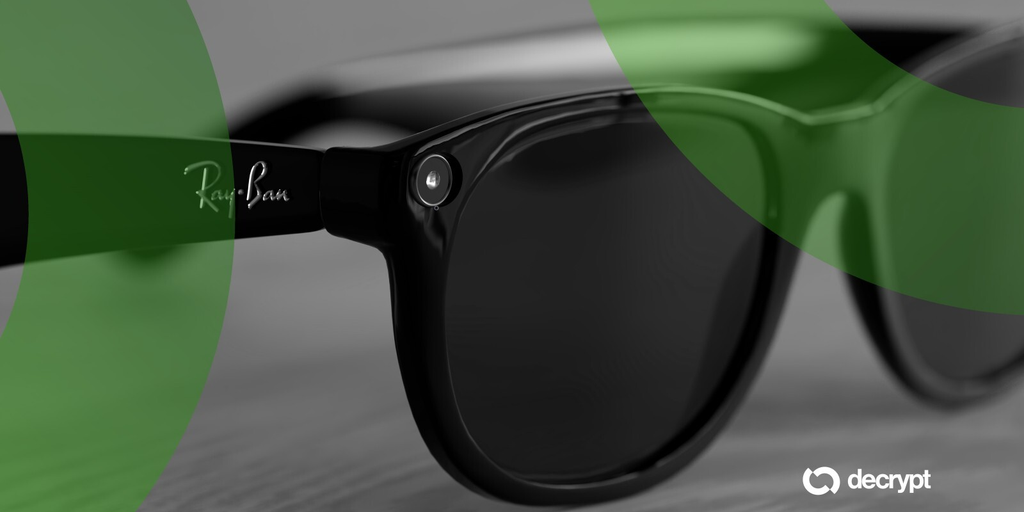
🧠Meta's Ray-Ban smart glasses are under investigation due to privacy concerns regarding the collection and use of sensitive footage. Regulators and privacy advocates are raising significant concerns about the potential misuse of data captured through the wearable technology.