AINeutralarXiv – CS AI · Jun 106/10
🧠Researchers have developed MSI-Net, a deep learning model for detecting building damage in post-earthquake satellite imagery, and introduced the TUE-CD dataset based on the Turkey earthquake. The solution addresses the challenge of analyzing remote sensing images with short time intervals and varying imaging angles to support emergency response operations.
AINeutralarXiv – CS AI · Jun 106/10
🧠Researchers introduce Architect-Ant, an AI system that automatically furnishes architectural floor plans using a fine-tuned vision-language model and a new dataset of 270 professionally designed floor plans. The framework generates furniture layouts as editable symbolic code that can be rendered into realistic images while maintaining spatial validity and functional plausibility.
AINeutralarXiv – CS AI · Jun 96/10
🧠Researchers introduce CIFAR, a synthetic evidence corpus dataset designed to detect AI-generated fraudulent documents in legal proceedings. The dataset addresses a critical gap by providing training data for systems that can identify subtle, localized document alterations that preserve plausibility while changing legal meaning—a challenge existing detection tools cannot adequately handle.
AINeutralarXiv – CS AI · Jun 96/10
🧠Researchers introduce a new cross-view urban traffic dataset combining synchronized drone and bicycle-mounted camera footage from real intersections. The benchmark enables two computer vision tasks: matching identical objects across street and aerial views, and predicting bird's-eye-view layouts from ground-level cameras with drone supervision.
AINeutralarXiv – CS AI · Jun 96/10
🧠Researchers have developed RiskNet, a large-scale dataset documenting AI risk incidents from multilingual news sources, organizing hundreds of millions of reports into structured incident records with standardized classifications. The resource bridges the gap between high-level AI governance principles and empirical evidence of real-world AI harms, providing a foundation for data-driven monitoring and computational analysis of AI safety issues.
AINeutralarXiv – CS AI · Jun 96/10
🧠Researchers introduce PhysScene, the first scene graph dataset specifically designed for physics experiments, enabling AI systems to understand complex scientific setups through structured visual reasoning. The dataset prioritizes semantic accuracy and relational density over scale, addressing a gap in domain-specific AI training data for scientific applications.
AINeutralarXiv – CS AI · Jun 86/10
🧠ChemQuests is a new curated dataset containing 952 question-answer pairs extracted from chemistry research papers, designed to advance chemistry-focused natural language processing. The dataset bridges the gap between rapidly expanding chemistry literature and the need for domain-specific training data for AI models and retrieval systems.
🧠 GPT-4
AINeutralarXiv – CS AI · Jun 86/10
🧠Researchers introduce CrowdMath, a dataset of 164 expert-annotated collaborative mathematical problem-solving discussions from MIT PRIMES and Art of Problem Solving (2016-2025). While frontier AI models achieve 83-88% accuracy in predicting next posts, they struggle significantly with understanding the functional roles of contributions in mathematical reasoning, revealing a gap between solving isolated problems and comprehending collaborative research progress.
AINeutralarXiv – CS AI · Jun 56/10
🧠Researchers introduce ALMANAC, a dataset of 2,987 annotated human collaboration actions designed to teach AI agents how to maintain mental models during teamwork. The dataset, built from the Map Task routing exercise, includes theory-informed annotations tracking participants' reasoning, partner intent perception, and shared goals—addressing a critical gap in training collaborative AI systems beyond task completion.
AIBullishMIT News – AI · Jun 36/10
🧠MIT researchers have developed ChartNet, a new training dataset designed to improve vision-language models' ability to interpret charts and visual data. This advancement enhances AI systems used for analyzing business trends and scientific figures, addressing a critical gap in current model capabilities.
AINeutralarXiv – CS AI · Jun 26/10
🧠Researchers introduce CoCoVideo-26K, a new dataset and detection framework for identifying AI-generated videos from commercial systems like those used by major AIGC providers. The work addresses a critical gap in deepfake detection by using high-quality synthetic videos from 13 commercial generators and proposes CoCoDetect, a hybrid approach combining contrastive learning with multimodal AI reasoning to improve detection accuracy.
AINeutralarXiv – CS AI · Jun 26/10
🧠Researchers introduce CAFOSat, a large-scale annotated dataset containing over 45,000 image patches for mapping Concentrated Animal Feeding Operations across the United States using high-resolution satellite imagery. The dataset combines AI-assisted annotation, human verification, and infrastructure-level labeling to address challenges in automated CAFO detection, benchmarking multiple deep learning models for improved agricultural monitoring capabilities.
AINeutralarXiv – CS AI · May 296/10
🧠Researchers introduce TelecomTS, a large-scale observability dataset from 5G telecommunications networks designed to advance time series analysis and anomaly detection. The dataset addresses a critical gap in AI research by providing de-anonymized, scale-preserved metrics that reflect real-world system monitoring challenges, while benchmarking reveals that current foundation models struggle with the noisy, high-variance characteristics of enterprise observability data.
AINeutralarXiv – CS AI · May 296/10
🧠Researchers introduce KOTOX, the first Korean-language dataset for detecting and neutralizing obfuscated toxic content in language models. The dataset addresses a critical gap by providing paired examples of normal, toxic, and obfuscated text, leveraging Korean's unique linguistic properties like agglutination and orthographic variation that enable easy toxicity disguise.
AINeutralarXiv – CS AI · May 286/10
🧠Researchers have developed a new deepfake detection framework called T-AVFD that addresses a critical gap in audio-visual forgery detection by handling singing scenarios, where traditional cross-modal inconsistency methods fail. The study introduces the SHDF dataset and demonstrates improved detection performance across both talking and singing deepfakes through text-guided pattern learning.
AIBullisharXiv – CS AI · May 276/10
🧠Researchers introduce HyperTrack, a large-scale dataset of 16,000+ mobile GUI navigation tasks across 650+ Chinese applications, and GUIEvalKit, an open-source benchmarking toolkit for evaluating Vision-Language Models. The study demonstrates that reinforcement-based finetuning substantially outperforms supervised learning for mobile automation tasks, with implications for developing more capable AI agents.
AINeutralarXiv – CS AI · May 126/10
🧠Researchers introduce NaiAD, a comprehensive dataset of nearly 59,000 ad-embedded LLM responses designed to optimize advertising within AI systems while maintaining user experience. The framework uses mechanistic analysis to identify four semantic strategies for effective ad integration and employs human-calibrated scoring to enable independent control of user and commercial utility objectives.
AINeutralarXiv – CS AI · May 126/10
🧠Researchers introduce VT-Bench, the first comprehensive benchmark for visual-tabular multi-modal learning, aggregating 14 datasets with 756K samples across 9 domains. The benchmark evaluates 23 models and reveals significant gaps in current approaches for combining image and tabular data, particularly in high-stakes sectors like healthcare.
AINeutralarXiv – CS AI · May 126/10
🧠Researchers have created a multilingual text simplification corpus by collecting and aligning sentence-level data from comparable corpora across five languages (Catalan, English, French, Italian, and Spanish). The dataset addresses a critical gap in NLP resources for non-English languages and is publicly available for training and evaluating text simplification models.
AINeutralarXiv – CS AI · May 46/10
🧠Researchers introduce LEGIT, a 24K-instance legal reasoning dataset with hierarchical argument trees that serve as evaluation rubrics for LLM-generated legal reasoning. The study reveals that LLM legal reasoning performance depends critically on both issue coverage and correctness, with RAG and reinforcement learning offering complementary improvements.
AINeutralarXiv – CS AI · May 16/10
🧠Researchers have created Cognitive Digital Shadows (CDS), a 190,000-record synthetic dataset of LLM-generated responses on controversial societal topics, designed to measure how language models shift their outputs based on persona prompting and sociodemographic attributes. The dataset enables systematic auditing of LLM bias, alignment, and social sensitivity across 19 different models.
AIBullisharXiv – CS AI · Mar 276/10
🧠Researchers developed UF-FGTG, a framework that automatically converts novice user prompts into model-preferred prompts for text-to-image AI systems. The system uses a novel Coarse-Fine Granularity Prompts dataset and achieved 5% improvement across quality metrics compared to existing methods.
AIBullisharXiv – CS AI · Mar 276/10
🧠Researchers introduce TimeLens, a family of multimodal large language models optimized for video temporal grounding that outperforms existing open-source models and even surpasses proprietary models like GPT-5 and Gemini-2.5-Flash. The work addresses critical data quality issues in existing benchmarks and introduces improved training datasets and algorithmic design principles.
🧠 GPT-5🧠 Gemini
AIBullishMarkTechPost · Mar 176/10
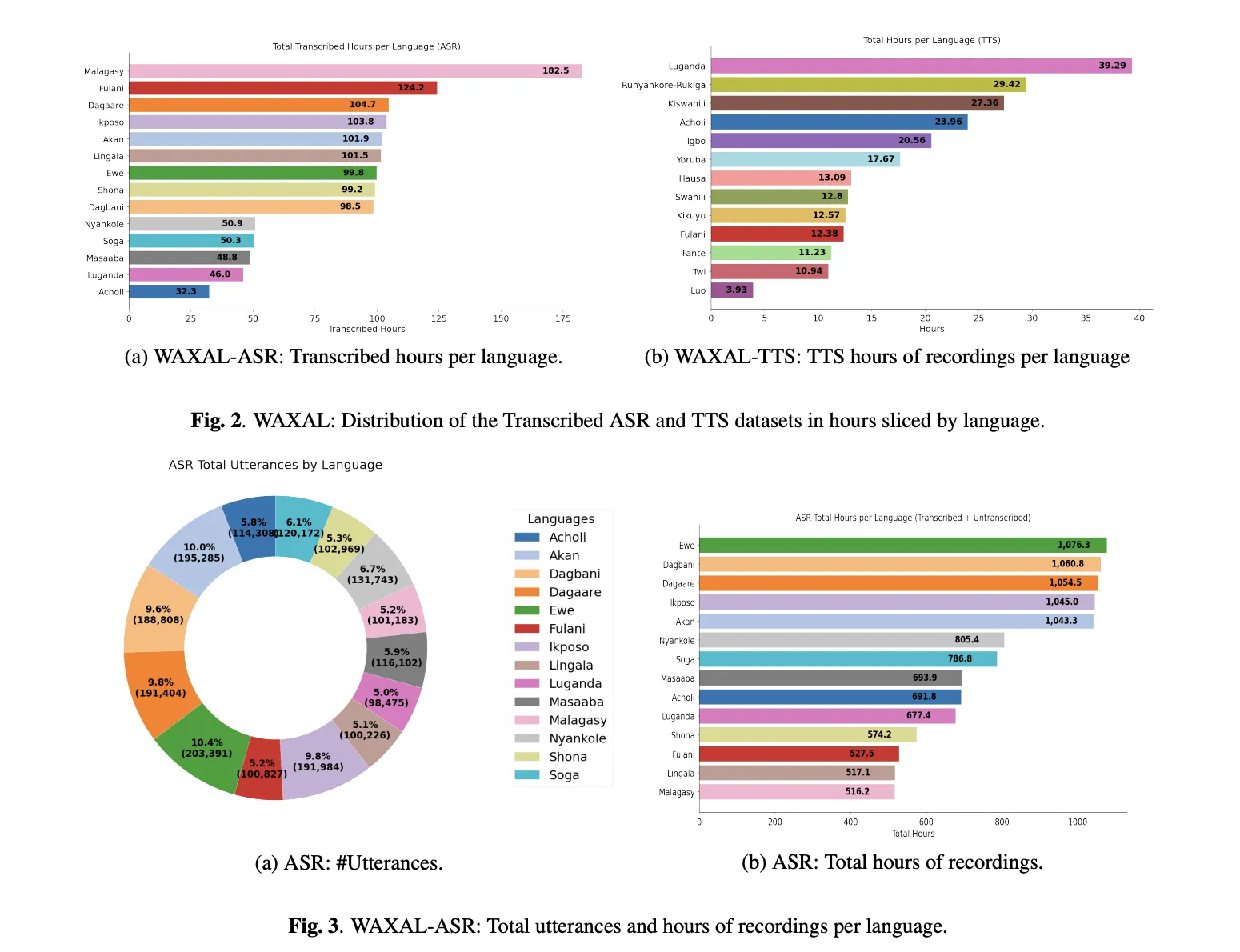
🧠Google AI has released WAXAL, an open multilingual speech dataset covering 24 African languages to improve Automatic Speech Recognition and Text-to-Speech systems. This addresses the significant data distribution problem where African languages remain poorly represented in speech technology training corpora.
🏢 Google
AIBullisharXiv – CS AI · Mar 166/10
🧠Researchers have developed Feynman, an AI agent that generates high-quality diagram-caption pairs at scale for training vision-language models. The system created a dataset of 100k+ well-aligned diagrams and introduced Diagramma, a benchmark for evaluating visual reasoning capabilities.