AIBullisharXiv – CS AI · Jun 97/10
🧠Researchers propose a foundation model approach using adversarial fine-tuning to translate between unpaired spatial transcriptomics and single-cell RNA sequencing data. The method addresses the scarcity of paired datasets by leveraging the abundance of individual modalities, outperforming existing multi-omics translation approaches.
AIBullisharXiv – CS AI · Mar 46/103
🧠Researchers developed a Neuro-Symbolic Agentic Framework combining machine learning with LLM-based reasoning to predict colorectal cancer drug responses. The system achieved significant predictive accuracy (r=0.504) and introduces 'Inverse Reasoning' for simulating genomic edits to predict drug sensitivity changes.
AIBullisharXiv – CS AI · Mar 37/104
🧠GeneZip is a new DNA compression model that achieves 137.6x compression with minimal performance loss by recognizing that genomic information is highly imbalanced. The system enables training of much larger AI models for genomic analysis using single GPU setups instead of expensive multi-GPU configurations.
AIBullishNVIDIA AI Blog · Feb 197/102
🧠NVIDIA has made Evo 2, the largest publicly available AI foundation model for genomic data, accessible through its BioNeMo platform. The model was developed in collaboration with Arc Institute and can understand genetic code across all domains of life, built on NVIDIA's DGX Cloud platform.
AINeutralarXiv – CS AI · Jun 255/10
🧠Stable-Shift introduces a structured machine learning method for predicting how genes respond to perturbations without requiring experimental data from those genes. The approach outperforms existing methods like GEARS on benchmark datasets, achieving 0.592 cosine similarity, and demonstrates the value of integrating biological context through graph neural networks for genomic prediction tasks.
AINeutralarXiv – CS AI · Jun 96/10
🧠Researchers introduce BSTabDiff, a generative framework designed to create synthetic high-dimensional tabular data with limited samples by partitioning features into latent blocks and using diffusion priors. The method addresses challenges in domains like genomics where data is sparse relative to feature count, producing more realistic synthetic data than existing approaches.
AINeutralarXiv – CS AI · Jun 46/10
🧠Researchers introduce YOTO, an end-to-end machine learning framework that simultaneously selects compact gene subsets and performs prediction tasks in single-cell transcriptomic analysis. The differentiable architecture enforces sparsity and uses multi-task learning to improve biomarker discovery while outperforming existing feature selection methods.
AIBullishOpenAI News · Jun 36/10
🧠OpenAI has enhanced GPT-Rosalind with advanced capabilities for biological reasoning, medicinal chemistry, genomics analysis, and experimental workflows. These improvements position the model as a specialized tool for accelerating life sciences research and drug discovery processes.
AIBullisharXiv – CS AI · Jun 26/10
🧠Researchers developed agentic LLM-based systems to democratize the authoring of complex genomics visualizations through natural-language interfaces. By testing six different agent architectures across 159 test cases, they found that agentic iteration substantially improves visualization quality over baseline approaches, though more complex agent configurations provide diminishing returns.
AINeutralarXiv – CS AI · Jun 26/10
🧠Researchers introduce GC-MoE, a machine learning framework that predicts individual cell gene expression from histopathology images and spatial data, addressing limitations of existing methods that only work at the spot level. The approach combines cell-type-specific expert models with genomic guidance to capture cellular expression variability more accurately than current baselines.
AINeutralarXiv – CS AI · May 296/10
🧠Researchers introduce Influence-Guided Symbolic Regression (IGSR), a novel framework combining LLMs with Monte Carlo Tree Search to discover scientific equations more efficiently. The method uses granular influence scores to evaluate which components of equations contribute to accuracy, enabling systematic refinement. The approach demonstrated genuine discovery potential by identifying a novel relationship between DNA methylation and RNA Polymerase II pausing that was subsequently validated experimentally.
AINeutralarXiv – CS AI · May 116/10
🧠Researchers introduce OmicsLM, a multimodal large language model that interprets transcriptomic data by combining quantitative gene expression profiles with natural language processing. Trained on 5.5 million examples across 70 task types, the model outperforms specialized omics tools and general LLMs on language-guided biological reasoning tasks, advancing AI applications in genomic research.
AINeutralarXiv – CS AI · May 115/10
🧠Researchers developed LiT-G2P, a hybrid machine learning model combining linear genetic effects with Transformer-based neural networks to predict plant traits from DNA sequences in grapevines. The approach achieved superior prediction accuracy for leaf and trichome density across multiple years, demonstrating practical applications for genomic selection in agricultural breeding.
AINeutralarXiv – CS AI · May 116/10
🧠Researchers introduce RelAge-GNN, a graph neural network framework that models complex biological relationships among DNA methylation sites to improve aging clock predictions. The method outperforms existing approaches in estimating biological age and shows enhanced sensitivity for detecting age acceleration in disease cohorts, with interpretability analysis revealing which relationships and CpG sites drive predictions.
AIBullishArs Technica – AI · Mar 46/101
🧠A new open-source AI model has been developed specifically for genomics, trained on trillions of DNA bases. The system can identify various genetic elements including genes, regulatory sequences, and splice sites, representing a significant advancement in AI-powered biological analysis.
AIBullishIEEE Spectrum – AI · Feb 46/104
🧠Google DeepMind has launched AlphaGenome, an AI tool that analyzes the 98% of human DNA that doesn't code for proteins but regulates gene expression. The deep-learning platform can predict 11 types of biological signals and is already being used by thousands of scientists worldwide for cancer research, drug discovery, and synthetic DNA design.
$LINK$NEAR
AIBullishGoogle Research Blog · Oct 166/104
🧠DeepSomatic is an AI tool developed to identify genetic variants in tumor samples, advancing cancer research and precision medicine capabilities. This represents a significant application of artificial intelligence in healthcare diagnostics and genomic analysis.
AIBullishGoogle DeepMind Blog · Jun 256/105
🧠AlphaGenome introduces a new unified DNA sequence model designed to improve regulatory variant-effect prediction and enhance understanding of genome function. The AI-powered genomics tool is now accessible through an API for researchers and developers.
AIBullishNVIDIA AI Blog · Jan 146/103
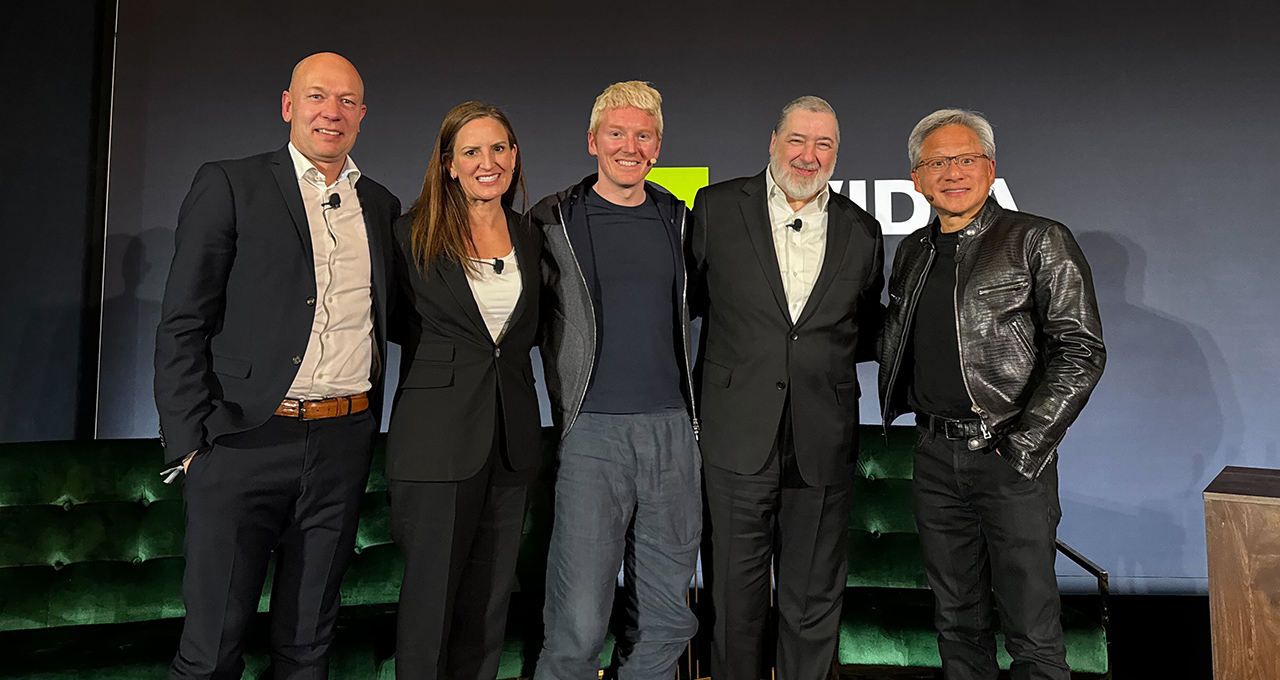
🧠NVIDIA CEO Jensen Huang participated in a fireside chat at the J.P. Morgan Healthcare Conference, discussing AI applications across healthcare sectors including genomic research, drug discovery, clinical trials, and patient care. The discussion highlighted how AI is making significant inroads throughout the entire healthcare industry.
AINeutralarXiv – CS AI · Feb 274/107
🧠Researchers developed UTR-STCNet, a new Transformer-based AI model that can analyze variable-length genetic sequences to predict protein translation efficiency. The model outperformed existing methods and can identify important regulatory elements in mRNA sequences, potentially advancing therapeutic mRNA design.
AINeutralGoogle Research Blog · Aug 64/107
🧠DeepPolisher represents a new AI-driven approach to genome polishing that significantly improves the accuracy of genomic sequencing data. This advancement could enhance the quality and reliability of genomic research foundations across various scientific and medical applications.