AIBullisharXiv – CS AI · Mar 36/108
🧠IdGlow introduces a new AI framework for generating images with multiple subjects that preserves individual identities while creating coherent scenes. The system uses a two-stage approach with Flow Matching diffusion models and addresses the challenge of maintaining identity fidelity during complex transformations like age changes.
AIBullisharXiv – CS AI · Mar 36/109
🧠Researchers introduced ARC (Adaptive Rewarding by self-Confidence), a new framework for improving text-to-image generation models through self-confidence signals rather than external rewards. The method uses internal self-denoising probes to evaluate model accuracy and converts this into scalar rewards for unsupervised optimization, showing improvements in compositional generation and text-image alignment.
AIBullishArs Technica – AI · Feb 266/106
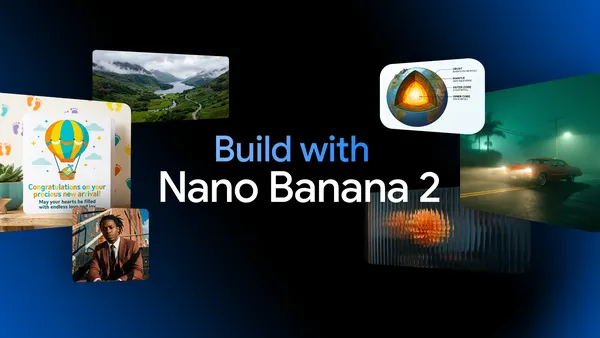
🧠Google has launched Nano Banana 2, a new AI image generation model that replaces previous versions and is now available in Gemini. The model represents Google's latest advancement in AI image generation technology.
AIBullishGoogle DeepMind Blog · Feb 265/107
🧠Nano Banana 2 is a new image generation model that combines advanced capabilities including world knowledge, production-ready specifications, and subject consistency while maintaining Flash-level speed. The model represents an advancement in AI image generation technology by offering professional-grade features without sacrificing performance.
AIBullishThe Verge – AI · Feb 266/106
🧠Google has launched Nano Banana 2 (Gemini 3.1 Flash Image), bringing advanced AI image generation capabilities previously exclusive to Nano Banana Pro to free users. The new model offers faster, cheaper, and easier complex image generation with real-time information and web search integration.
AIBullishTechCrunch – AI · Feb 266/103
🧠Google has launched Nano Banana 2, a new AI model featuring faster image generation capabilities. The model is being integrated as the default in Google's Gemini app and AI mode, representing a significant update to Google's AI infrastructure.
AIBullishGoogle AI Blog · Feb 266/10
🧠Google has released Nano Banana 2 (Gemini 3.1 Flash Image), a new AI image generation and editing model that promises professional-level intelligence and fidelity. The model is positioned as their best offering for image applications and is now available for developers to build with.
🧠 Gemini
AIBullishOpenAI News · May 216/107
🧠The Responses API has introduced new capabilities including Remote MCP, image generation, and Code Interpreter functionality. These updates are designed to enhance AI agent performance using GPT-4o and o-series models while improving reliability and efficiency.
AIBullishOpenAI News · Apr 246/104
🧠ChatGPT for Business introduces new features in April 2025 including the o3 model, image generation capabilities, enhanced memory functionality, and internal knowledge systems. The announcement includes hands-on demonstrations of these business-focused AI tools and capabilities.
AIBullishOpenAI News · Apr 236/106
🧠A new image generation model called 'gpt-image-1' is now available through an API, allowing developers and businesses to integrate professional-grade visual creation capabilities directly into their applications and platforms. This represents an expansion of AI-powered content generation tools for commercial use.
AIBullishOpenAI News · Mar 256/104
🧠OpenAI has released GPT-4o image generation, a new image creation system that significantly surpasses their previous DALL·E 3 models. The new system can produce photorealistic images and has the capability to accept images as inputs and transform them.
AIBullishGoogle DeepMind Blog · Dec 166/107
🧠Google announces the release of Veo 2, a new state-of-the-art video generation model, along with updates to their Imagen 3 image generation system. The company is also introducing Whisk, a new experimental tool in their AI generation suite.
AIBullishHugging Face Blog · Jul 306/105
🧠The article discusses memory-efficient implementation of Diffusion Transformers using Quanto quantization library integrated with Diffusers. This technical advancement enables running large-scale AI image generation models with reduced memory requirements, making them more accessible for deployment.
AINeutralOpenAI News · Jun 206/106
🧠Diffusion models have made significant breakthroughs in generating images, audio, and video content. However, these models face a key limitation in their reliance on iterative sampling processes, which results in slower generation speeds.
AIBullishHugging Face Blog · Jun 66/105
🧠Artificial Analysis has launched a new Text to Image Leaderboard & Arena platform for evaluating and comparing AI image generation models. The platform allows users to compare different text-to-image AI models through structured evaluation and competitive ranking systems.
AIBullishOpenAI News · Oct 196/105
🧠OpenAI has made DALL·E 3 available to ChatGPT Plus and Enterprise users after developing safety mitigations for wider release. The company is also sharing updates on their provenance research efforts related to the AI image generation system.
AIBullishHugging Face Blog · Jun 156/105
🧠Apple has announced faster Stable Diffusion implementation using Core ML framework for iPhone, iPad, and Mac devices. This development enables on-device AI image generation with improved performance and efficiency across Apple's ecosystem.
AIBullishOpenAI News · Aug 316/106
🧠OpenAI introduces outpainting feature for DALL·E, allowing users to extend AI-generated images beyond their original borders. This enhancement enables creators to expand their artwork and tell more comprehensive visual stories with images of any size.
AINeutralOpenAI News · Jul 185/106
🧠OpenAI is implementing a new technique in DALL·E 2 to generate images of people that better reflect global population diversity. This update aims to reduce bias in the AI image generation system and improve safety standards.
AIBullishOpenAI News · Jul 145/105
🧠OpenAI's DALL·E 2 research preview has engaged over 3,000 artists from 118+ countries who have integrated the AI image generation tool into their creative workflows. These early access artists have helped discover new applications and influenced feature development decisions for DALL·E.
AINeutralOpenAI News · Jun 285/103
🧠OpenAI implemented safety measures and guardrails during DALL·E 2's pre-training phase to mitigate risks associated with powerful AI image generation. These measures were designed to prevent the model from generating content that violates OpenAI's content policy before public release.
AIBullishOpenAI News · Apr 136/104
🧠The article discusses hierarchical text-conditional image generation using CLIP latents, a technique that leverages CLIP's understanding of text-image relationships to generate images based on textual descriptions. This approach represents an advancement in AI image generation capabilities by incorporating hierarchical structures and CLIP's semantic understanding.
AINeutralLil'Log (Lilian Weng) · Jul 116/10
🧠Diffusion models are a new type of generative AI model that can learn complex data distributions and generate high-quality images competitive with state-of-the-art GANs. The article covers recent developments including classifier-free guidance, GLIDE, unCLIP, Imagen, latent diffusion models, and consistency models.
AIBullishOpenAI News · Jul 96/108
🧠Researchers introduce Glow, a reversible generative AI model that uses invertible 1x1 convolutions to generate high-resolution images with efficient sampling capabilities. The model simplifies previous architectures while enabling feature discovery for data attribute manipulation, with code and visualization tools being made publicly available.
AINeutralarXiv – CS AI · Mar 54/10
🧠Researchers have released BLOCK, an open-source AI pipeline that generates pixel-perfect Minecraft character skins from text descriptions using a two-stage process involving multimodal language models and fine-tuned image generation. The system combines 3D preview synthesis with skin decoding and introduces EvolveLoRA, a progressive training approach for improved stability.