#machine-learning News & Analysis
Coverage of #machine-learning spans 2,608 indexed articles, with 262 pieces published in the last month. Recent discussion shows 55.7% bullish sentiment, though this represents a 5.3 percentage point decline from the previous quarter, suggesting a modest cooling in tone. Research publications dominate the discourse, particularly through arXiv's computer science and AI sections, while conversations frequently center on models and platforms including Llama, Meta, and Gemini.
Related coverage tends to intersect with #research, #ai-research, and #llm discussions. Scan the article list below to explore the latest developments and perspectives.
sentiment · last 30d (262 articles) · -5.3pp bullish vs prior 90dTop sources:arXiv – CS AI · 1922Apple Machine Learning · 14Crypto Briefing · 10MarkTechPost · 8Hugging Face Blog · 6
Most-discussed entities:Llama · 23Meta · 17Gemini · 15GPT-4 · 14GPT-5 · 13
AIBullisharXiv – CS AI · Apr 76/10
🧠Researchers introduce CONTXT, a lightweight neural network adaptation method that improves AI model performance when deployed on data different from training data. The technique uses simple additive and multiplicative transforms to modulate internal representations, providing consistent gains across both discriminative and generative models including LLMs.
AIBullisharXiv – CS AI · Apr 76/10
🧠Researchers developed a new method to train transformer neural networks using discrete cosine transform (DCT) coefficients, achieving the same performance while using only 52% of the parameters. The technique requires no architectural changes and simply replaces standard linear layers with spectral layers that store DCT coefficients instead of full weight matrices.
🏢 Perplexity
AINeutralarXiv – CS AI · Apr 76/10
🧠A reproducibility study unifies research on spurious correlations in deep neural networks across different domains, comparing correction methods including XAI-based approaches. The research finds that Counterfactual Knowledge Distillation (CFKD) most effectively improves model generalization, though practical deployment remains challenging due to group labeling dependencies and data scarcity issues.
AIBearisharXiv – CS AI · Apr 66/10
🧠A new research study reveals that Audio-Visual Large Language Models (AVLLMs) exhibit a fundamental bias toward visual information over audio when the modalities conflict. The research shows that while these models encode rich audio semantics in intermediate layers, visual representations dominate during the final text generation phase, indicating limited effectiveness of current multimodal AI training approaches.
AIBullisharXiv – CS AI · Apr 66/10
🧠Researchers propose a new Neuro-Symbolic Dual Memory Framework that addresses key limitations in large language models for long-horizon decision-making tasks. The framework separates semantic progress guidance from logical feasibility verification, significantly improving performance on complex AI tasks while reducing errors and inefficiencies.
AIBullisharXiv – CS AI · Apr 66/10
🧠Researchers introduce PROGRS, a new framework that improves mathematical reasoning in large language models by using process reward models while maintaining focus on outcome correctness. The approach addresses issues with current reinforcement learning methods that can reward fluent but incorrect reasoning steps.
AIBullisharXiv – CS AI · Apr 66/10
🧠Researchers have developed OPRIDE, a new algorithm for offline preference-based reinforcement learning that significantly improves query efficiency. The algorithm addresses key challenges of inefficient exploration and overoptimization through principled exploration strategies and discount scheduling mechanisms.
AIBullisharXiv – CS AI · Apr 66/10
🧠This survey paper examines AI's role in developing 6G wireless networks, covering key technologies like deep learning, reinforcement learning, and federated learning. The research addresses how AI will enable 6G's promise of high data rates and low latency for applications like smart cities and autonomous systems, while identifying challenges in scalability, security, and energy efficiency.
AIBullisharXiv – CS AI · Apr 66/10
🧠Researchers developed enhanced techniques using Few-Shot Learning, Chain-of-Thought reasoning, and Retrieval Augmented Generation to improve large language models' ability to detect and repair errors in MPI programs. The approach increased error detection accuracy from 44% to 77% compared to using ChatGPT directly, addressing challenges in maintaining high-performance computing applications used in machine learning frameworks.
🧠 ChatGPT
AIBullisharXiv – CS AI · Apr 66/10
🧠Researchers have developed HIL-CBM, a new hierarchical interpretable AI model that enhances explainability by mimicking human cognitive processes across multiple semantic levels. The model outperforms existing Concept Bottleneck Models in classification accuracy while providing more interpretable explanations without requiring manual concept annotations.
AIBearisharXiv – CS AI · Apr 66/10
🧠Research comparing large language models (LLMs) to humans in group coordination tasks reveals that LLMs exhibit excessive volatility and switching behavior that impairs collective performance. Unlike humans who adapt and stabilize over time, LLMs fail to improve across repeated coordination games and don't benefit from richer feedback mechanisms.
AINeutralarXiv – CS AI · Apr 66/10
🧠Researchers introduce DocShield, a new AI framework that uses evidence-based reasoning to detect text-based image forgeries in documents. The system combines visual and logical analysis to identify, locate, and explain document manipulations, showing significant improvements over existing detection methods.
🧠 GPT-4
AINeutralarXiv – CS AI · Apr 66/10
🧠Research from arXiv shows that Active Preference Learning (APL) provides minimal improvements over random sampling in training modern LLMs through Direct Preference Optimization. The study found that random sampling performs nearly as well as sophisticated active selection methods while being computationally cheaper and avoiding capability degradation.
AIBullisharXiv – CS AI · Apr 66/10
🧠Researchers propose a fully end-to-end training paradigm for temporal sentence grounding in videos, introducing the Sentence Conditioned Adapter (SCADA) to better align video understanding with natural language queries. The method outperforms existing approaches by jointly optimizing video backbones and localization components rather than using frozen pre-trained encoders.
AINeutralarXiv – CS AI · Apr 66/10
🧠Researchers developed a new AI framework for detecting partial deepfake speech by splitting the problem into boundary detection and segment classification stages. The method achieves state-of-the-art performance on benchmark datasets, significantly improving detection and localization of manipulated audio regions within otherwise authentic speech.
AIBearisharXiv – CS AI · Apr 66/10
🧠Researchers have discovered LogicPoison, a new attack method that exploits vulnerabilities in Graph-based Retrieval-Augmented Generation (GraphRAG) systems by corrupting logical connections in knowledge graphs without altering text semantics. The attack successfully bypasses GraphRAG's existing defenses by targeting the topological integrity of underlying graphs, significantly degrading AI system performance.
AIBullisharXiv – CS AI · Apr 66/10
🧠Researchers introduce R2-Write, a new AI framework that improves large language models' performance on open-ended writing tasks by incorporating explicit reflection and revision patterns. The study reveals that existing reasoning models show limited gains in creative writing compared to mathematical tasks, prompting the development of an automated system with writer-judge interactions and process reward mechanisms.
AIBullisharXiv – CS AI · Apr 66/10
🧠Researchers developed a method to identify valence-arousal subspaces in large language models, enabling controlled emotional steering of AI outputs. The technique demonstrates cross-architecture effectiveness on multiple models and reveals that emotional control can bidirectionally influence AI behaviors like refusal and sycophancy.
🧠 Llama
AIBullisharXiv – CS AI · Apr 66/10
🧠Researchers introduce gradient-boosted attention, a new method that improves transformer performance by applying gradient boosting principles within a single attention layer. The technique uses a second attention pass to correct errors from the first pass, achieving lower perplexity (67.9 vs 72.2) on WikiText-103 compared to standard attention mechanisms.
🏢 Perplexity
AIBullisharXiv – CS AI · Apr 66/10
🧠Researchers introduce AutoCO, a new method that combines large language models with constraint optimization to solve complex problems more effectively. The approach uses bidirectional coevolution with Monte Carlo Tree Search and Evolutionary Algorithms to prevent premature convergence and improve solution quality.
AIBearisharXiv – CS AI · Apr 66/10
🧠Research reveals that large language models exhibit political biases stemming from systematically left-leaning training data, with pre-training datasets containing more politically engaged content than post-training data. The study finds strong correlations between political stances in training data and model behavior, with biases persisting across all training stages.
AIBullisharXiv – CS AI · Apr 66/10
🧠Researchers introduce Contrastive Fusion (ConFu), a new multimodal machine learning framework that aligns individual modalities and their fused combinations in a unified representation space. The approach captures higher-order dependencies between multiple modalities while maintaining strong pairwise relationships, demonstrating competitive performance on retrieval and classification tasks.
AIBullisharXiv – CS AI · Apr 66/10
🧠Researchers introduce Unified Thinker, a new AI architecture that improves image generation by separating reasoning from visual generation. The modular system addresses the gap between closed-source models like Nano Banana and open-source alternatives by enabling better instruction following through executable reasoning and reinforcement learning.
AIBullishMarkTechPost · Apr 56/10
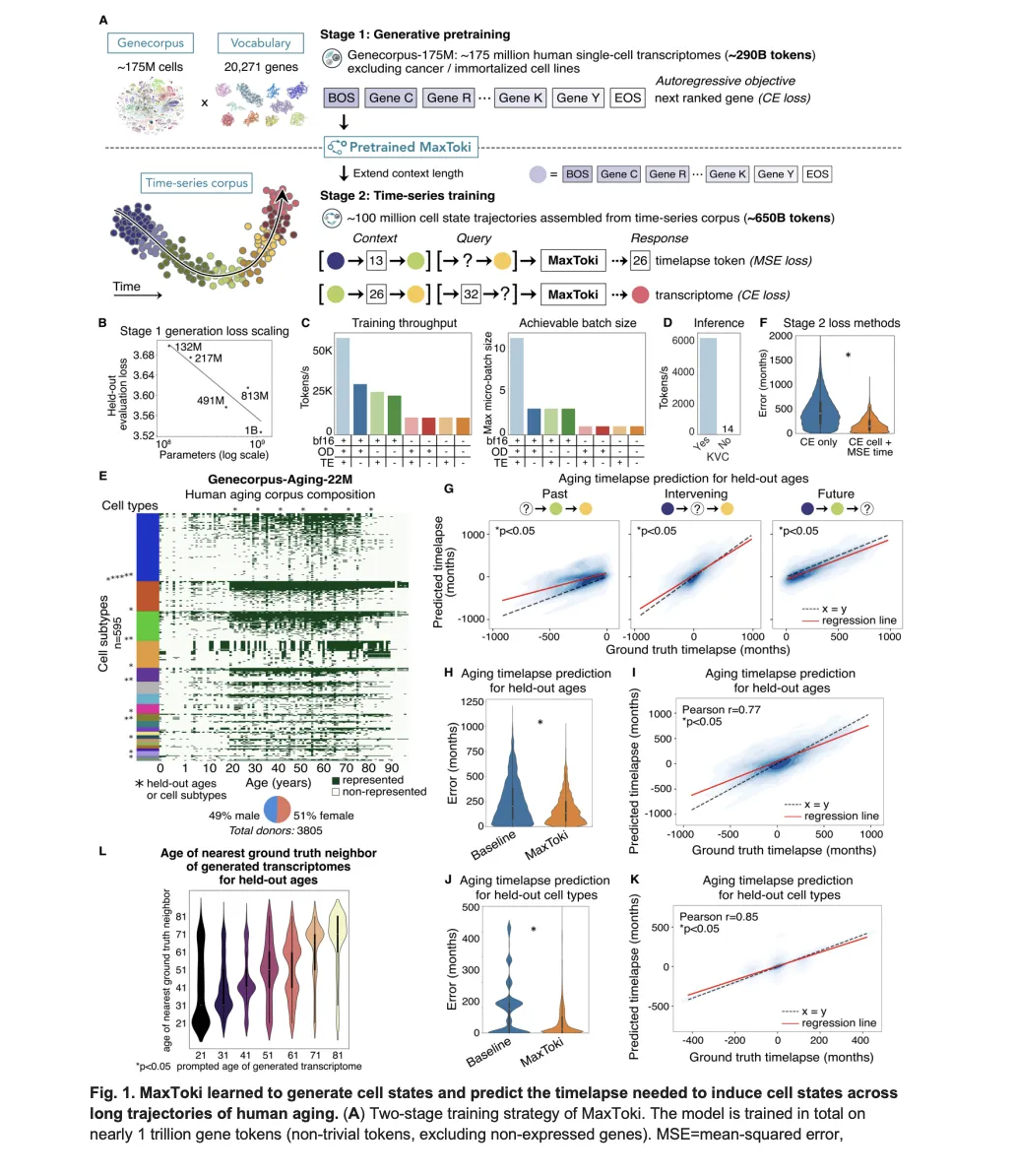
🧠MaxToki is a new AI foundation model that can predict cellular aging patterns and trajectories, addressing a key limitation in existing biological models that only analyze cells as static snapshots. The technology represents a significant advancement in computational biology by incorporating temporal dynamics into cellular analysis.
AIBullisharXiv – CS AI · Mar 315/10