AIBullisharXiv – CS AI · Mar 277/10
🧠Ming-Flash-Omni is a new 100 billion parameter multimodal AI model with Mixture-of-Experts architecture that uses only 6.1 billion active parameters per token. The model demonstrates unified capabilities across vision, speech, and language tasks, achieving performance comparable to Gemini 2.5 Pro on vision-language benchmarks.
🧠 Gemini
AIBullisharXiv – CS AI · Mar 127/10
🧠Researchers introduce MoE-SpAc, a new framework for efficient Mixture-of-Experts model inference on edge devices that achieves 42% improvement over existing baselines. The system uses speculative decoding as a memory management tool and demonstrates 4.04x average speedup across benchmarks.
AIBullishMarkTechPost · Mar 117/10
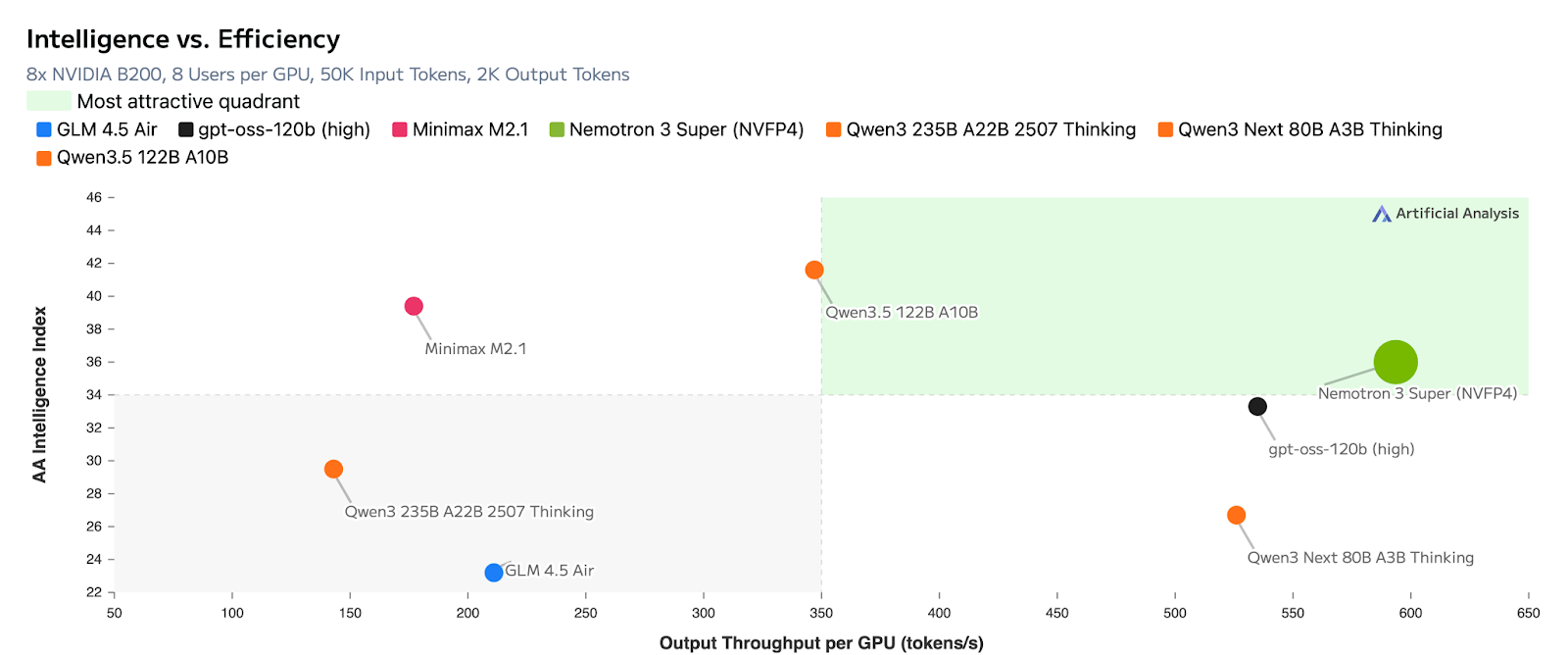
🧠NVIDIA has released Nemotron 3 Super, a 120 billion parameter open-source AI model designed for multi-agent applications. The hybrid Mamba-Attention MoE model delivers 5x higher throughput and bridges the gap between proprietary frontier models and transparent open-source alternatives.
🏢 Nvidia
AIBullisharXiv – CS AI · Mar 46/102
🧠Researchers propose Router Knowledge Distillation (Router KD) to improve retraining-free compression of Mixture-of-Experts (MoE) models by calibrating routers while keeping expert parameters unchanged. The method addresses router-expert mismatch issues that cause performance degradation in compressed MoE models, showing particularly strong results in fine-grained MoE architectures.
AINeutralarXiv – CS AI · Mar 37/104
🧠Researchers analyzed 20 Mixture-of-Experts (MoE) language models to study local routing consistency, finding a trade-off between routing consistency and local load balance. The study introduces new metrics to measure how well expert offloading strategies can optimize memory usage on resource-constrained devices while maintaining inference speed.
AINeutralarXiv – CS AI · May 126/10
🧠Researchers introduce Hi-MoE, a hierarchical Mixture-of-Experts framework that addresses a fundamental routing trade-off in sparse MoE models by implementing two-stage optimization: inter-group load balancing and intra-group expert specialization. Tested on large-scale NLP and vision tasks, Hi-MoE achieves 5.6% perplexity improvements and superior expert balance compared to existing methods.
🏢 Meta🏢 Perplexity
AIBullisharXiv – CS AI · Mar 96/10
🧠Researchers introduce MoEless, a serverless framework for serving Mixture-of-Experts Large Language Models that addresses expert load imbalance issues. The system reduces inference latency by 43% and costs by 84% compared to existing solutions by using predictive load balancing and optimized expert scaling strategies.
AIBullisharXiv – CS AI · Mar 37/1010
🧠TriMoE introduces a novel GPU-CPU-NDP architecture that optimizes large Mixture-of-Experts model inference by strategically mapping hot, warm, and cold experts to their optimal compute units. The system leverages AMX-enabled CPUs and includes bottleneck-aware scheduling, achieving up to 2.83x performance improvements over existing solutions.
AIBullisharXiv – CS AI · Mar 36/103
🧠Researchers have introduced PiKV, an open-source KV cache management framework designed to optimize memory and communication costs for Mixture of Experts (MoE) language models across multi-GPU and multi-node inference. The system uses expert-sharded storage, intelligent routing, adaptive scheduling, and compression to improve efficiency in large-scale AI model deployment.