AINeutralarXiv – CS AI · Jun 197/10
🧠Researchers introduce Multi-LCB, an extension of the LiveCodeBench evaluation framework that tests large language models across twelve programming languages instead of just Python. The benchmark reveals significant performance disparities across languages and evidence of Python overfitting in current LLMs, establishing a more rigorous standard for assessing real-world multilingual code generation capabilities.
AIBullisharXiv – CS AI · Jun 107/10
🧠Whisfusion introduces a masked diffusion decoder that achieves faster speech-to-text processing than Whisper-large-v3 while matching or exceeding its accuracy across multilingual benchmarks. By replacing autoregressive decoding with parallel diffusion decoding, the system runs 4-5x faster while maintaining competitive performance with leading ASR systems, establishing non-autoregressive diffusion as a viable paradigm for high-throughput transcription.
AIBullisharXiv – CS AI · Jun 87/10
🧠Researchers have developed dots.tts, a 2-billion parameter text-to-speech model that achieves state-of-the-art performance through innovations in continuous speech modeling, full-history conditioning, and self-corrective training. The model demonstrates exceptional multilingual capabilities and enables low-latency speech generation, with code and weights released open-source under Apache 2.0 license.
AIBullisharXiv – CS AI · Mar 46/104
🧠Researchers developed a new method to reduce content biases in large language models' reasoning tasks by transforming syllogisms into canonical logical representations with deterministic parsing. The approach achieved top-5 rankings on the multilingual SemEval-2026 Task 11 benchmark while offering a competitive alternative to complex fine-tuning methods.
AIBullishOpenAI News · Feb 67/106
🧠OpenAI outlines its approach to AI localization, demonstrating how global frontier models can be adapted to different languages, legal frameworks, and cultural contexts while maintaining safety standards. This initiative aims to make advanced AI accessible worldwide through localized implementations.
AIBullishOpenAI News · Dec 97/105
🧠OpenAI has partnered with Deutsche Telekom to deliver multilingual AI experiences to millions across Europe. The collaboration will also see ChatGPT Enterprise implemented internally at Deutsche Telekom to enhance employee workflows and drive innovation.
AIBullishHugging Face Blog · Jul 237/106
🧠Meta has released Llama 3.1 in three model sizes (405B, 70B, and 8B parameters) with enhanced multilingual capabilities and extended context length. These open-source models represent a significant advancement in AI accessibility and performance across multiple languages and longer conversational contexts.
AINeutralHugging Face Blog · Jun 96/10
🧠Researchers benchmark frontier automatic speech recognition (ASR) systems on code-switched speech, where bilingual speakers mix languages mid-conversation. The study evaluates how well modern voice AI handles this common real-world scenario, revealing performance gaps that matter for customer service applications.
AINeutralarXiv – CS AI · Jun 96/10
🧠Researchers have developed a novel framework extending Shapley Values—a traditional explainability method—to multimodal large language models that process both text and audio. The work introduces computational optimizations and a preprocessing technique called Spectrogram-Guided Phonetic Alignment to make the analysis feasible, alongside an open-source tool for visualization, revealing that input modality significantly affects model attribution patterns.
AINeutralarXiv – CS AI · Jun 26/10
🧠A research team won first place in the SemEval-2026 Task-1 humor generation competition by developing a system that generates diverse joke candidates and selects the best ones using a preference model trained on human comparisons. The approach addresses the core challenge that humor is subjective and audience-dependent, rather than objectively measurable, achieving top rankings across English, Chinese, and Spanish subtasks.
AINeutralarXiv – CS AI · May 76/10
🧠Researchers achieved second place in SemEval-2026's multilingual polarization detection task by fine-tuning Gemma models with synthetic data augmentation across 22 languages. Their ensemble approach combining LoRA-adapted 12B and 27B parameter models with LLM-generated training data achieved a mean macro-F1 of 0.811, demonstrating the effectiveness of synthetic data strategies and per-language optimization for multilingual NLP tasks.
🧠 GPT-4
AINeutralarXiv – CS AI · Apr 76/10
🧠A research study reveals that AI model performance rankings change dramatically based on the evaluation language used, with GPT-4o performing best in English while Gemini leads in Arabic and Hindi. The study tested 55 development tasks across five languages and six AI models, showing no single model dominates across all languages.
🧠 GPT-4🧠 Gemini
AIBullisharXiv – CS AI · Mar 276/10
🧠Voxtral TTS is a new multilingual text-to-speech AI model that can generate natural speech from just 3 seconds of reference audio. In human evaluations, it achieved a 68.4% win rate over ElevenLabs Flash v2.5 for voice cloning, demonstrating superior naturalness and expressivity.
AIBearisharXiv – CS AI · Mar 276/10
🧠Researchers introduced WildASR, a multilingual diagnostic benchmark revealing that current ASR systems suffer severe performance degradation in real-world conditions despite achieving near-human accuracy on curated tests. The study found that ASR models often hallucinate plausible but unspoken content under degraded inputs, creating safety risks for voice agents.
AIBullisharXiv – CS AI · Mar 266/10
🧠Researchers have introduced MedAidDialog, a multilingual medical dialogue dataset covering seven languages, and developed MedAidLM, a conversational AI model for preliminary medical consultations. The system uses parameter-efficient fine-tuning on small language models to enable deployment without high-end computational infrastructure while incorporating patient context for personalized consultations.
AINeutralarXiv – CS AI · Mar 266/10
🧠Researchers demonstrate that current multilingual watermarking methods for LLMs fail to maintain robustness across medium- and low-resource languages, particularly under translation attacks. They introduce STEAM, a new detection method using Bayesian optimization that improves watermark detection across 133 languages with significant performance gains.
AIBullishMarkTechPost · Mar 176/10
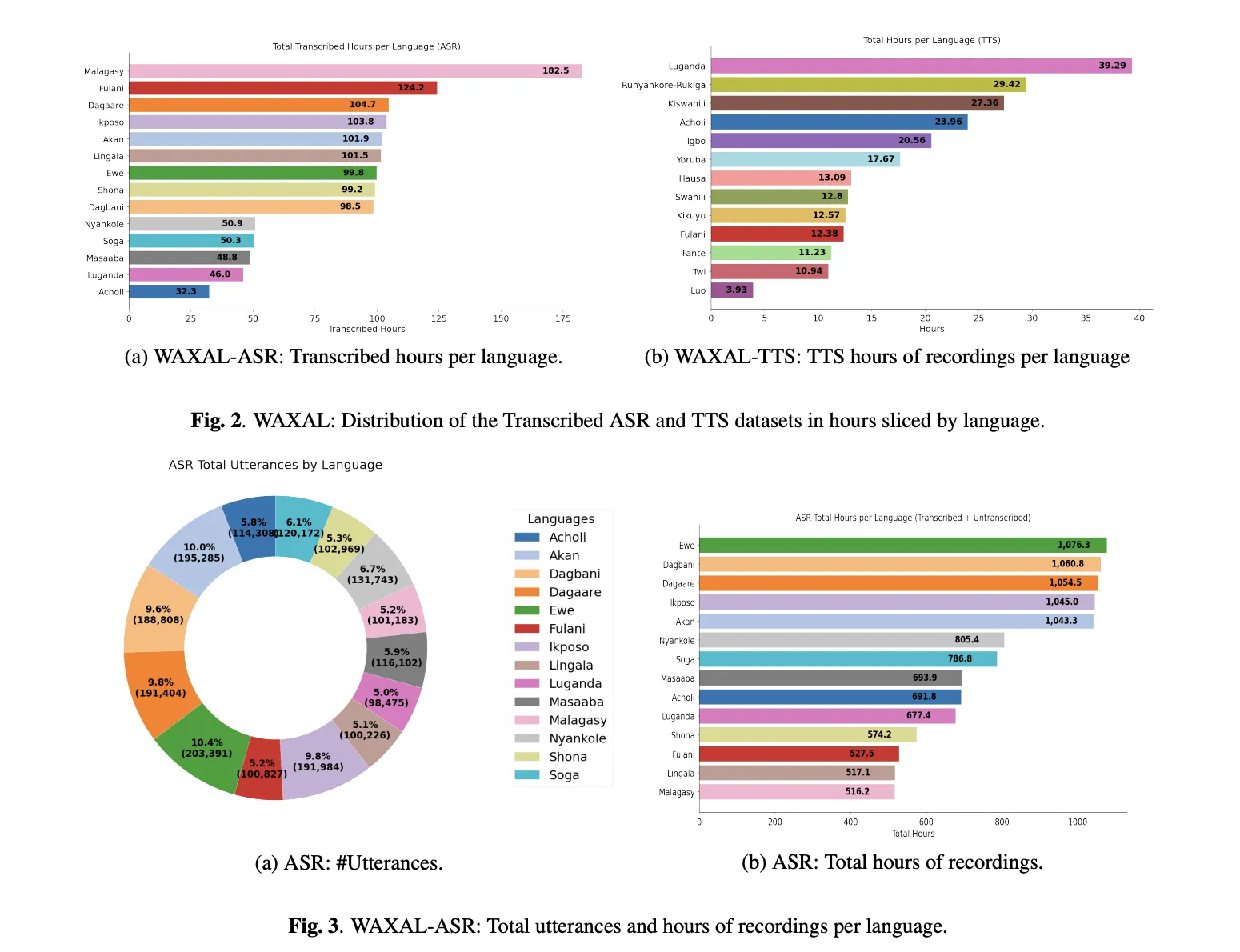
🧠Google AI has released WAXAL, an open multilingual speech dataset covering 24 African languages to improve Automatic Speech Recognition and Text-to-Speech systems. This addresses the significant data distribution problem where African languages remain poorly represented in speech technology training corpora.
🏢 Google
AIBullisharXiv – CS AI · Mar 176/10
🧠Researchers introduce SPLARE, a new method that uses sparse autoencoders (SAEs) to improve learned sparse retrieval in language models. The technique outperforms existing vocabulary-based approaches in multilingual and out-of-domain settings, with SPLARE-7B achieving top results on multilingual retrieval benchmarks.
AIBullishMarkTechPost · Mar 166/10
🧠IBM has released Granite 4.0 1B Speech, a compact multilingual speech-language model optimized for automatic speech recognition and translation. The model is specifically designed for enterprise and edge deployments where memory efficiency, low latency, and compute optimization are critical alongside performance quality.
AINeutralarXiv – CS AI · Mar 126/10
🧠Researchers introduce DIBJudge, a new framework to address systematic bias in large language models that favor machine-translated text over human-authored content in multilingual evaluations. The solution uses variational information compression to isolate bias factors and improve LLM judgment accuracy across languages.
AIBullisharXiv – CS AI · Mar 55/10
🧠Researchers have released Tucano 2, an open-source suite of Portuguese language models ranging from 0.5-3.7 billion parameters, featuring enhanced datasets and training recipes. The models achieve state-of-the-art performance on Portuguese benchmarks and include capabilities for coding, tool use, and chain-of-thought reasoning.
AIBullisharXiv – CS AI · Mar 55/10
🧠Researchers introduce ToMCLIP, a new framework that improves multilingual vision-language models by using topological alignment to better preserve the geometric structure of shared embedding spaces. The method shows enhanced performance on zero-shot classification and multilingual image retrieval tasks.
AIBullisharXiv – CS AI · Mar 35/104
🧠Researchers developed EstLLM, enhancing Estonian language capabilities in multilingual LLMs through continued pretraining of Llama 3.1 8B with balanced data mixtures. The approach improved Estonian linguistic performance while maintaining English capabilities, demonstrating that targeted continued pretraining can substantially improve single-language performance in multilingual models.
AINeutralGoogle Research Blog · Jan 276/105
🧠ATLAS presents new scaling laws for multilingual generative AI models, providing practical frameworks for understanding how model performance scales across different languages and model sizes. This research offers valuable insights for optimizing multilingual AI system development and deployment strategies.
AIBullishHugging Face Blog · Jul 86/105
🧠SmolLM3 represents a new compact language model that combines multilingual capabilities with long-context reasoning abilities. The model appears to be designed for efficiency while maintaining strong performance across multiple languages and complex reasoning tasks.