AINeutralarXiv – CS AI · Mar 54/10
🧠Researchers have created CzechTopic, a new benchmark dataset for evaluating AI models' ability to identify specific topics within historical Czech documents. The study compared various large language models and BERT-based models, finding significant performance variations with the strongest models approaching human-level accuracy in topic detection.
AINeutralarXiv – CS AI · Mar 44/102
🧠Researchers developed new prompting-based approaches using multimodal large language models to generate real-time video commentary that considers both content relevance and timing. The study introduces dynamic interval-based decoding that adjusts prediction timing based on utterance duration, showing improved alignment with human commentary patterns without requiring model fine-tuning.
AIBullisharXiv – CS AI · Mar 44/103
🧠Researchers propose ASEGR, a novel AI framework that enhances product recommendation systems by extracting sensory attributes from user reviews using large language models. The system uses a two-stage pipeline where an LLM extracts structured sensory data which is then distilled into compact embeddings for sequential recommendation models.
AINeutralarXiv – CS AI · Mar 44/103
🧠Researchers developed a novel approach using instruction-tuned Large Language Models to improve argumentative component detection in text analysis. The method reframes the task as language generation rather than traditional sequence labeling, achieving superior performance on standard benchmarks compared to existing state-of-the-art systems.
AINeutralarXiv – CS AI · Mar 34/104
🧠Researchers have created CrimeNER, a specialized dataset of over 1,500 annotated crime-related documents for training named-entity recognition AI models. The study addresses the lack of quality training data in the crime domain by developing a database from terrorist attack reports and DOJ press notes, defining 22 types of crime-related entities.
AINeutralarXiv – CS AI · Mar 25/104
🧠A study evaluated large language models (Claude, Gemini, ChatGPT) translating Ancient Greek texts, finding high performance on previously translated works (95.2/100) but declining quality on untranslated technical texts (79.9/100). Terminology rarity was identified as a strong predictor of translation failure, with rare terms causing catastrophic performance drops.
AINeutralarXiv – CS AI · Mar 25/109
🧠Researchers explore using large language models (LLMs) as mediators rather than just moderators in online conflicts, developing a framework that combines judgment evaluation and empathetic intervention. Their study using Reddit data shows API-based models outperform open-source alternatives in de-escalating flame wars and fostering constructive dialogue.
AINeutralarXiv – CS AI · Mar 25/105
🧠Researchers developed LEC-KG, a new framework that combines Large Language Models with Knowledge Graph Embeddings to better extract and structure information from unstructured text. The system was tested on Chinese Sustainable Development Goal reports and showed significant improvements over traditional LLM approaches, particularly for identifying rare relationships in domain-specific content.
AINeutralarXiv – CS AI · Feb 274/104
🧠Researchers developed NovelQR, an AI framework for recommending quotations that are 'unexpected yet rational' by prioritizing novelty over surface-level topical relevance. The system uses a generative label agent to interpret deep meanings and a novelty estimator to rerank candidates, showing superior performance in human evaluations across bilingual datasets.
AIBullisharXiv – CS AI · Feb 274/106
🧠Researchers introduce Alignment-Aware Masked Learning (AML), a new training strategy for Referring Image Segmentation that improves pixel-level vision-language alignment. The approach achieves state-of-the-art performance on RefCOCO datasets by filtering poorly aligned regions and focusing on reliable visual-language cues.
AIBullisharXiv – CS AI · Feb 274/106
🧠Researchers developed ULTRA, a new AI architecture specifically designed for semantic content recommendation in Urdu, a low-resource language. The system uses a dual-embedding approach with query-length aware routing to improve news retrieval, achieving over 90% precision gains compared to existing methods.
AIBullishGoogle AI Blog · Feb 264/10
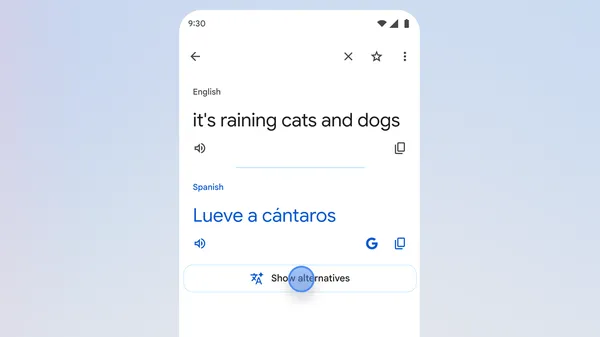
🧠Google has introduced new AI-powered features to Google Translate, including 'understand' and 'ask' buttons that help users navigate the complexities of natural language translation. These updates aim to provide more context and deeper understanding for users working with translations.
AINeutralHugging Face Blog · Dec 184/106
🧠The article title references Transformers v5 tokenization improvements, focusing on simplicity, clarity, and modularity. However, no article body content was provided to analyze the specific technical details or implications of these tokenization enhancements.
AINeutralGoogle Research Blog · Jun 34/106
🧠This article discusses a new AI research approach called Action-Based Contrastive Self-Training for improving multi-turn conversational AI systems. The method focuses on training AI models to better clarify and understand context in extended conversations.
AINeutralHugging Face Blog · Jul 104/107
🧠The article title indicates a focus on preference optimization techniques for Vision Language Models, which are AI systems that process both visual and textual information. This represents ongoing research in improving how these multimodal AI models align with human preferences and perform tasks.
AINeutralOpenAI News · Jun 204/107
🧠Researchers present a comprehensive approach to developing natural language classification systems for real-world content moderation. The work focuses on creating robust AI systems capable of detecting undesired content across various platforms and contexts.
AINeutralHugging Face Blog · Apr 44/106
🧠The article discusses Text2SQL implementation using Hugging Face Dataset Viewer API combined with Motherduck's DuckDB-NSQL-7B model. This represents a technical advancement in natural language to SQL query translation capabilities using modern AI infrastructure.
AINeutralHugging Face Blog · Nov 74/107
🧠This article appears to be a technical research study comparing the performance of three large language models (Roberta, Llama 2, and Mistral) for analyzing disaster-related tweets using LoRA fine-tuning techniques. The research focuses on evaluating how well these AI models can process and understand disaster-related social media content.
AINeutralOpenAI News · Jan 44/106
🧠The article discusses using GPT-3 technology to analyze customer feedback and extract fast, nuanced insights. This represents an application of AI language models for business intelligence and customer analytics purposes.
AINeutralarXiv – CS AI · Mar 34/106
🧠Researchers developed LexChronos, an AI framework that extracts structured event timelines from Indian Supreme Court judgments using a dual-agent architecture. The system achieved 0.8751 F1 score on synthetic data and showed 75% preference over unstructured approaches in legal text summarization tasks.
AINeutralHugging Face Blog · Mar 23/104
🧠The article appears to be about BERT (Bidirectional Encoder Representations from Transformers), a state-of-the-art natural language processing model. However, the article body is empty, preventing detailed analysis of the content or implications.
AINeutralHugging Face Blog · Apr 111/108
🧠The article title suggests coverage of Vision Language Models, which are AI systems that process both visual and textual information. However, the article body appears to be empty or incomplete, preventing detailed analysis of the content.