#neural-networks News & Analysis
Recent coverage of #neural-networks spans 385 indexed articles, with 70 published in the past month. The discussion involves significant research output, particularly from arXiv's computer science and AI sections, alongside analysis from crypto and technology outlets. Perplexity, Llama, and Nvidia emerge as the most frequently mentioned entities in this coverage.
Sentiment around the topic has softened over the past 30 days, with bullish commentary declining 18.2 percentage points from the previous quarter. Currently, 31.4% of recent articles adopt a bullish tone, while 58.6% remain neutral and 10% bearish. Scan the articles below to explore the latest developments and perspectives.
sentiment · last 30d (70 articles) · -18.2pp bullish vs prior 90dTop sources:arXiv – CS AI · 330Crypto Briefing · 2MarkTechPost · 2Apple Machine Learning · 2Decrypt · 1
Most-discussed entities:Perplexity · 9Llama · 7Nvidia · 3Gemini · 2
AIBullishOpenAI News · Oct 157/105
🧠OpenAI has trained neural networks to solve a Rubik's Cube using a human-like robot hand, with training conducted entirely in simulation using reinforcement learning and a new technique called Automatic Domain Randomization (ADR). The system demonstrates unprecedented dexterity and can handle unexpected physical situations it never encountered during training, showing reinforcement learning's potential for complex real-world applications.
AIBullishOpenAI News · Apr 237/105
🧠Researchers have developed the Sparse Transformer, a deep neural network that achieves new performance records in sequence prediction for text, images, and sound. The model uses an improved attention mechanism that can process sequences 30 times longer than previously possible.
AIBullishOpenAI News · Dec 147/108
🧠Researchers discovered that gradient noise scale can predict how well neural network training parallelizes across different tasks. This finding suggests that larger batch sizes will become increasingly useful for complex AI training, potentially removing scalability limits for future AI systems.
AIBearishOpenAI News · Jul 177/106
🧠Researchers have developed adversarial images that can consistently fool neural network classifiers across multiple scales and viewing perspectives. This breakthrough challenges previous assumptions that self-driving cars would be secure from malicious attacks due to their multi-angle image capture capabilities.
AIBullishOpenAI News · Apr 67/106
🧠OpenAI has developed an unsupervised machine learning system that learns to understand sentiment by only being trained to predict the next character in Amazon review text. This breakthrough demonstrates that neural networks can develop sophisticated understanding of human sentiment without explicit sentiment training data.
AIBullisharXiv – CS AI · Jun 256/10
🧠Researchers introduce SimPhysNet, a self-supervised learning algorithm that predicts laser welding penetration with 96.06% accuracy using only 200 labeled images—roughly 5% of typical datasets. The physics-informed neural network approach combines contrastive learning with few-shot learning to overcome the industrial manufacturing challenge of requiring extensive labeled data for quality assurance.
AIBullisharXiv – CS AI · Jun 256/10
🧠Researchers propose Future Decomposition Networks (FDN), a spatiotemporal forecasting model that prioritizes interpretability while matching state-of-the-art accuracy with significantly lower computational costs. The method decomposes predictions into classifiable components and reveals latent patterns, demonstrating effectiveness across hydrologic, traffic, and energy systems.
AINeutralarXiv – CS AI · Jun 255/10
🧠Researchers propose Recursive QLSTM, a quantum machine learning model that extends quantum long short-term memory networks through recursive metacore-based constructions for improved sequential data processing. The model demonstrates enhanced temporal information propagation across variable input sequence lengths, offering a flexible framework for quantum computing applications in time-series analysis.
AIBullisharXiv – CS AI · Jun 256/10
🧠Researchers demonstrate that Sharpness-Aware Minimization (SAM), a recently proposed neural network training method, significantly improves model calibration by reducing overconfidence in predictions. The study includes a new variant called CSAM that further enhances calibration performance across multiple datasets, with important implications for safety-critical AI applications.
AINeutralarXiv – CS AI · Jun 256/10
🧠Researchers introduce Clifford Kolmogorov-Arnold Networks (ClKAN), a new neural network architecture designed for function approximation within Clifford Algebra spaces. The approach uses Randomized Quasi-Monte Carlo grid generation to address computational scaling challenges in higher dimensions, with applications in scientific computing and physics simulations.
AIBullisharXiv – CS AI · Jun 256/10
🧠Researchers introduce EPTS, a new framework for compressing large language models that enables a single optimized model to perform efficiently across multiple sparsity levels, eliminating the need for separate optimization for each deployment scenario. This approach combines Multi-Sparsity Hierarchy LoRA and a Feature Mixer mechanism to maintain performance while reducing computational requirements.
AINeutralarXiv – CS AI · Jun 256/10
🧠Researchers demonstrate that logit distance—a measure based on differences in model predictions—better bounds representational similarity in neural networks than KL divergence does. The findings reveal that KL-based distillation can preserve predictive accuracy while failing to maintain the linear structure of internal representations, with implications for transfer learning and model compression.
AINeutralarXiv – CS AI · Jun 256/10
🧠Researchers demonstrate that natural language descriptions can significantly improve machine learning models solving inverse problems in hydrogeology, reducing reconstruction error by 81% compared to models without text conditioning. The study reveals that categorical geological classifications carry the most value, while detailed geometric descriptions provide secondary benefits, establishing language as a practical interface for encoding domain expertise into learned solvers.
AINeutralarXiv – CS AI · Jun 256/10
🧠EchoStyle introduces a text-driven framework for high-fidelity video stylization that addresses long-standing challenges like style drift and motion distortion. The research includes a reverse-synthesis pipeline that creates V-Style20k, a 20k video-pair dataset, and employs sliding-window inference to handle arbitrary-length videos with performance comparable to leading proprietary solutions.
AINeutralarXiv – CS AI · Jun 256/10
🧠Researchers develop grid-size-invariant neural network surrogate models for predicting rock-fluid interactions in porous media, offering a computationally cheaper alternative to traditional high-fidelity simulations. The approach demonstrates that UNet++ architecture outperforms standard UNet for this application, enabling significant memory reduction during training while maintaining prediction accuracy.
AINeutralarXiv – CS AI · Jun 255/10
🧠Researchers developed a machine learning approach that separates chess playing strength (Elo rating) from individual player style by using a rating-conditioned base model combined with learned player embeddings. The method achieves 27-37% relative improvement in move prediction accuracy over existing models while successfully disentangling stylistic preferences from playing skill level.
AINeutralGoogle Research Blog · Jun 246/10
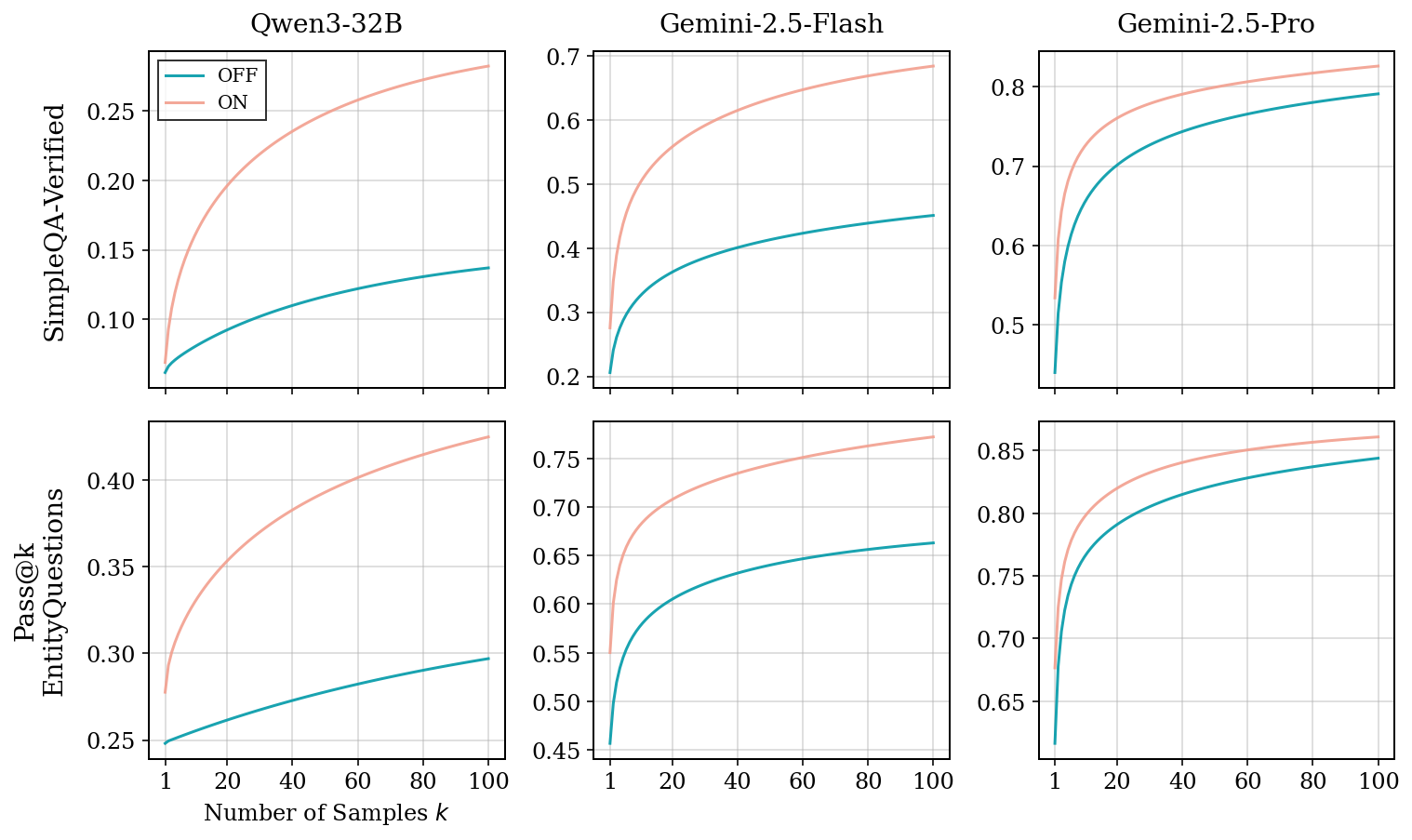
🧠Researchers demonstrate that reasoning processes enable large language models to effectively recall and utilize parametric knowledge stored in their weights, challenging previous assumptions about knowledge retrieval mechanisms. This finding has significant implications for understanding how LLMs access information and suggests that explicit reasoning may be essential for optimal knowledge extraction.
AINeutralarXiv – CS AI · Jun 236/10
🧠Researchers demonstrate that gated MLPs can be mathematically understood as rank-1 approximations to bilinear attention mechanisms, with nonlinearity placement breaking symmetry properties. This theoretical framework provides new insight into why gated MLPs perform effectively in practice and offers guidance for designing improved neural network architectures.
AINeutralarXiv – CS AI · Jun 236/10
🧠A new academic paper argues that modern deep learning systems validate associationist theories of human learning, showing that supervised learning with evaluative feedback underlies diverse AI systems from language models to game-playing agents. While this vindicates classical associationist principles of uniform, gradual error-driven learning, the paper emphasizes that contemporary AI success depends on computational architectures far beyond what classical associationists imagined.
AINeutralarXiv – CS AI · Jun 236/10
🧠Researchers have developed a dual-pathway brain-computer interface that decodes 3D shape perception and spatial orientation from EEG signals using a bio-inspired architecture. The model combines circular regression for angle prediction with diffusion-based 3D reconstruction, revealing that ventral, dorsal, and motor brain regions dynamically contribute to visual perception rather than static anatomical dominance.
AINeutralarXiv – CS AI · Jun 235/10
🧠Researchers introduce Neural Conjugate Aggregation Model (NCAM), a Bayesian framework for combining multiple biased sensor measurements without ground-truth labels. The method decomposes uncertainty sources and provides calibrated prediction intervals, with applications to sensor networks and scientific monitoring systems.
AINeutralarXiv – CS AI · Jun 236/10
🧠Researchers compare four neural network architectures for factual knowledge propagation in question-answering systems, finding that repeated shared memory access enables out-of-distribution generalization ('grokking'), but only architectures with fine-grained addressable memory can effectively propagate edited facts. The study dissociates learning capability from editing affordance, revealing that looped computation and explicit memory mechanisms serve different functional purposes.
AINeutralarXiv – CS AI · Jun 236/10
🧠Researchers establish theoretical limits on weight quantization in large language models, identifying 1.58-bit as the minimum precision threshold before expressive collapse occurs. The study demonstrates that model performance degrades polynomially as quantization bits decrease, providing theoretical foundations for optimizing model compression and inference acceleration techniques.
AINeutralarXiv – CS AI · Jun 236/10
🧠Researchers introduce SCENIC, a neural framework designed to optimize language models for edge IoT devices by enabling them to convert natural language commands into structured smart-home instructions. The system achieves 99% accuracy on benchmarks while reducing model size by 25% through pruning and quantization, addressing the practical challenge of deploying AI on memory-constrained devices.
🏢 Nvidia
AINeutralarXiv – CS AI · Jun 236/10
🧠Researchers have developed IRumAI, the first reinforcement learning agent for Indian Rummy, combining PPO with specialized neural network architecture to achieve 53.9% win rates against strong search-based opponents while running 7,000x faster. The breakthrough demonstrates how domain-specific RL design can overcome hidden-information game complexity without explicit search.