#open-source News & Analysis
The #open-source tag covers 340 indexed articles, with 39 published in the last 30 days. Recent coverage has maintained a predominantly bullish tone at 69.2%, though sentiment has softened by 5.8 percentage points compared to the prior quarter. ArXiv's computer science and AI sections dominate the source list, alongside specialized tech publishers.
Discussion frequently centers on Claude, Nvidia, and Hugging Face, often in connection with machine learning, large language models, research, and AI agents. The tag also intersects with cryptocurrency discussions, particularly around Bitcoin and Ethereum. Scan the articles below for the latest developments.
sentiment · last 30d (39 articles) · -5.8pp bullish vs prior 90dTop sources:arXiv – CS AI · 176MarkTechPost · 11The Register – AI · 4Decrypt · 4Bitcoin Magazine · 3
Most-discussed entities:Claude · 7Nvidia · 7Hugging Face · 7Gemini · 6Llama · 4
AIBullisharXiv – CS AI · Mar 267/10
🧠Researchers have created OSS-CRS, an open framework that makes DARPA's AI Cyber Challenge systems usable for real-world cybersecurity applications. The system successfully ported the winning Atlantis CRS and discovered 10 previously unknown bugs, including three high-severity issues, across 8 open-source projects.
AIBullishMarkTechPost · Mar 177/10
🧠Unsloth AI has released Unsloth Studio, an open-source, no-code local interface for fine-tuning large language models. The platform addresses infrastructure challenges by reducing VRAM requirements by 70% and eliminating the need for complex CUDA environment management.
AIBullishGoogle AI Blog · Mar 177/10
🧠Google announces new investments in open source security specifically designed for the AI era. The company is developing new tools and building code security solutions to address emerging security challenges in AI development.
AIBullisharXiv – CS AI · Mar 177/10
🧠Researchers introduce the Agent Lifecycle Toolkit (ALTK), an open-source middleware collection designed to address critical failure modes in enterprise AI agent deployments. The toolkit provides modular components for systematic error detection, repair, and mitigation across six key intervention points in the agent lifecycle.
AIBullisharXiv – CS AI · Mar 177/10
🧠Researchers introduced SOAR, a self-improving language model system that combines evolutionary search with hindsight learning for program synthesis tasks. The method achieved 52% success rate on the challenging ARC-AGI benchmark by iteratively improving through search and refinement cycles.
AIBullisharXiv – CS AI · Mar 177/10
🧠Researchers have introduced OpenSeeker, the first fully open-source search agent that achieves frontier-level performance using only 11,700 training samples. The model outperforms existing open-source competitors and even some industrial solutions, with complete training data and model weights being released publicly.
AIBullisharXiv – CS AI · Mar 177/10
🧠Researchers introduce EARCP, a new ensemble architecture for AI that dynamically weights different expert models based on performance and coherence. The system provides theoretical guarantees with sublinear regret bounds and has been tested on time series forecasting, activity recognition, and financial prediction tasks.
AIBullisharXiv – CS AI · Mar 177/10
🧠Researchers introduce POLCA (Prioritized Optimization with Local Contextual Aggregation), a new framework that uses large language models as optimizers for complex systems like AI agents and code generation. The method addresses stochastic optimization challenges through priority queuing and meta-learning, demonstrating superior performance across multiple benchmarks including agent optimization and CUDA kernel generation.
AIBullisharXiv – CS AI · Mar 167/10
🧠Researchers introduced QMatSuite, an open-source platform that enables AI agents to accumulate and apply knowledge across computational materials science experiments. The system demonstrated significant improvements, reducing reasoning overhead by 67% and improving accuracy from 47% to 3% deviation from literature benchmarks.
AIBullisharXiv – CS AI · Mar 127/10
🧠RedFuser is a new automated framework that optimizes AI model deployment by fusing cascaded reduction operations into single loops, achieving 2-5x performance improvements. The system addresses limitations in existing AI compilers that struggle with complex multi-loop operations like those found in attention mechanisms.
AIBearisharXiv – CS AI · Mar 127/10
🧠Researchers have developed a risk assessment framework for open-source Model Context Protocol (MCP) servers, revealing significant security vulnerabilities through static code analysis. The study found many MCP servers contain exploitable weaknesses that compromise confidentiality, integrity, and availability, highlighting the need for secure-by-design development as these tools become widely adopted for LLM agents.
AIBullishMarkTechPost · Mar 117/10
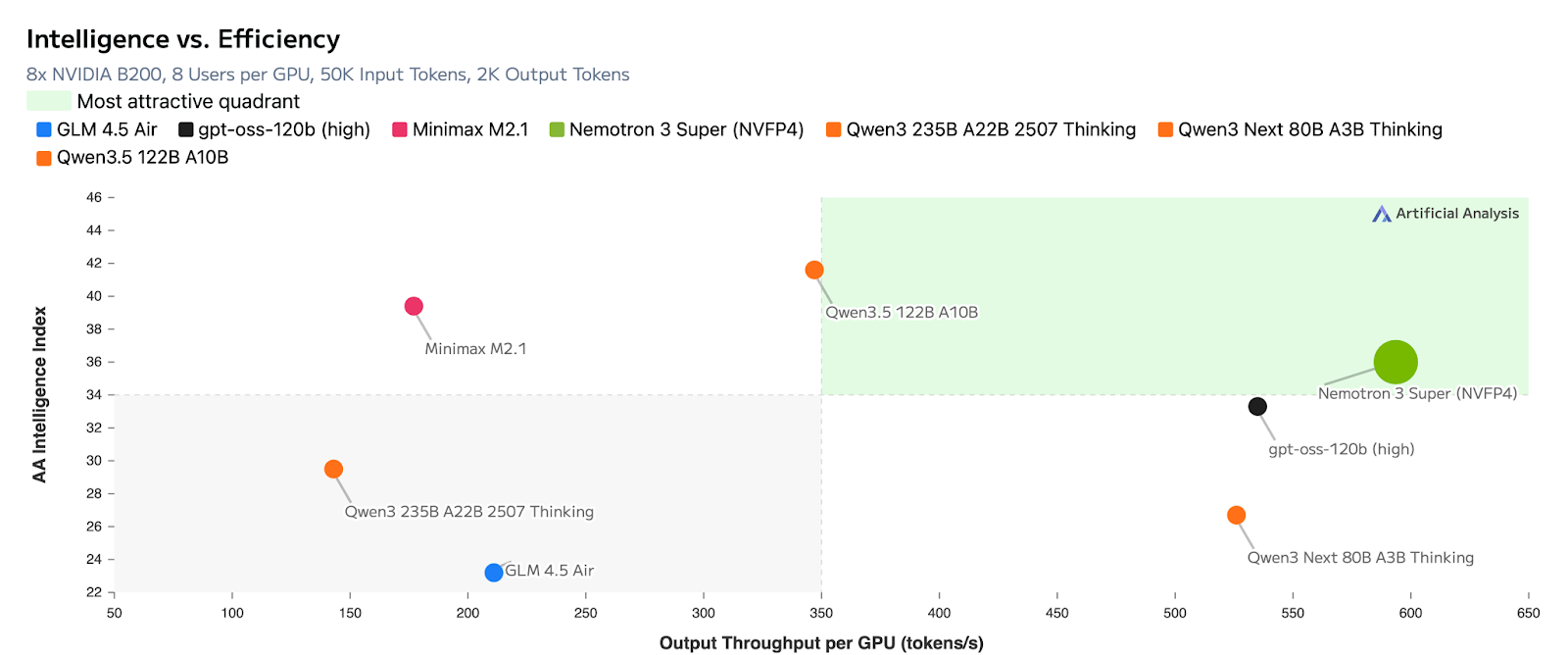
🧠NVIDIA has released Nemotron 3 Super, a 120 billion parameter open-source AI model designed for multi-agent applications. The hybrid Mamba-Attention MoE model delivers 5x higher throughput and bridges the gap between proprietary frontier models and transparent open-source alternatives.
🏢 Nvidia
AINeutralarXiv – CS AI · Mar 117/10
🧠Researchers have developed an open-source benchmark dataset to evaluate AI systems' compliance with the EU AI Act, specifically focusing on NLP and RAG systems. The dataset enables automated assessment of risk classification, article retrieval, and question-answering tasks, achieving 0.87 and 0.85 F1-scores for prohibited and high-risk scenarios.
AINeutralarXiv – CS AI · Mar 117/10
🧠Researchers introduce 'opaque serial depth' as a metric to measure how much reasoning large language models can perform without externalizing it through chain of thought processes. The study provides computational bounds for Gemma 3 models and releases open-source tools to calculate these bounds for any neural network architecture.
AIBullisharXiv – CS AI · Mar 117/10
🧠MASEval introduces a new framework-agnostic evaluation library for multi-agent AI systems that treats entire systems rather than just models as the unit of analysis. Research across 3 benchmarks, models, and frameworks reveals that framework choice impacts performance as much as model selection, challenging current model-centric evaluation approaches.
AINeutralDecrypt · Mar 117/10
🧠A Brookings report reveals China's AI strategy focuses on efficiency, open-source adoption, and practical real-world implementation, contrasting with the US approach of pursuing superintelligence. This strategic difference highlights divergent philosophies in AI development between the two major powers.
AINeutralArs Technica – AI · Mar 107/10
🧠The article explores the legal complexities surrounding AI's ability to rewrite open source code and whether such modifications constitute legitimate reverse engineering or create derivative works that must comply with original licensing terms. This raises important questions about intellectual property rights and licensing obligations in AI-generated code.
AIBullishMarkTechPost · Mar 107/10
🧠ByteDance has released DeerFlow 2.0, an open-source SuperAgent framework that orchestrates sub-agents, memory, and sandboxes to execute complex tasks autonomously. This represents a significant evolution from current AI assistants that primarily suggest actions to systems that can actually perform them.
🏢 Microsoft
AI × CryptoBullishCoinDesk · Mar 107/10
🤖AI-linked cryptocurrencies surged following reports that Nvidia plans to launch an open-source platform for autonomous AI agents. The rally helped AI tokens outperform the CoinDesk 20 index.
🏢 Nvidia
AIBullishWired – AI · Mar 97/10
🧠Nvidia is preparing to launch an open-source AI agent platform ahead of its annual developer conference. The new software approach will embrace AI agents similar to existing platforms like OpenClaw, marking Nvidia's strategic expansion into the AI agent ecosystem.
🏢 Nvidia
AIBullisharXiv – CS AI · Mar 67/10
🧠Researchers developed a memory management system for multi-agent AI systems on edge devices that reduces memory requirements by 4x through 4-bit quantization and eliminates redundant computation by persisting KV caches to disk. The solution reduces time-to-first-token by up to 136x while maintaining minimal impact on model quality across three major language model architectures.
🏢 Perplexity🧠 Llama
AIBullisharXiv – CS AI · Mar 67/10
🧠Researchers introduce SkillNet, an open infrastructure for creating, evaluating, and organizing AI skills at scale to address the problem of AI agents repeatedly rediscovering solutions. The system includes over 200,000 skills and demonstrates 40% improvement in agent performance while reducing execution steps by 30% across multiple testing environments.
AIBearishMIT Technology Review · Mar 56/10
🧠The article discusses how online harassment is evolving with AI technology, specifically mentioning an incident where Scott Shambaugh denied an AI agent's request to contribute to matplotlib software library. The piece appears to be part of a technology newsletter covering AI-related developments and their societal implications.
AINeutralarXiv – CS AI · Mar 57/10
🧠A study reveals that 74% of healthcare AI research papers still use private datasets or don't share code, creating reproducibility issues that undermine trust in medical AI applications. Papers that embrace open practices by sharing both public datasets and code receive 110% more citations on average, demonstrating clear benefits for scientific impact.
AIBullisharXiv – CS AI · Mar 56/10
🧠Researchers propose CoIPO (Contrastive Learning-based Inverse Direct Preference Optimization), a new method to improve Large Language Model robustness against noisy or imperfect user prompts. The approach enhances LLMs' intrinsic ability to handle prompt variations without relying on external preprocessing tools, showing significant accuracy improvements on benchmark tests.