AIBullishArs Technica – AI · Apr 157/10
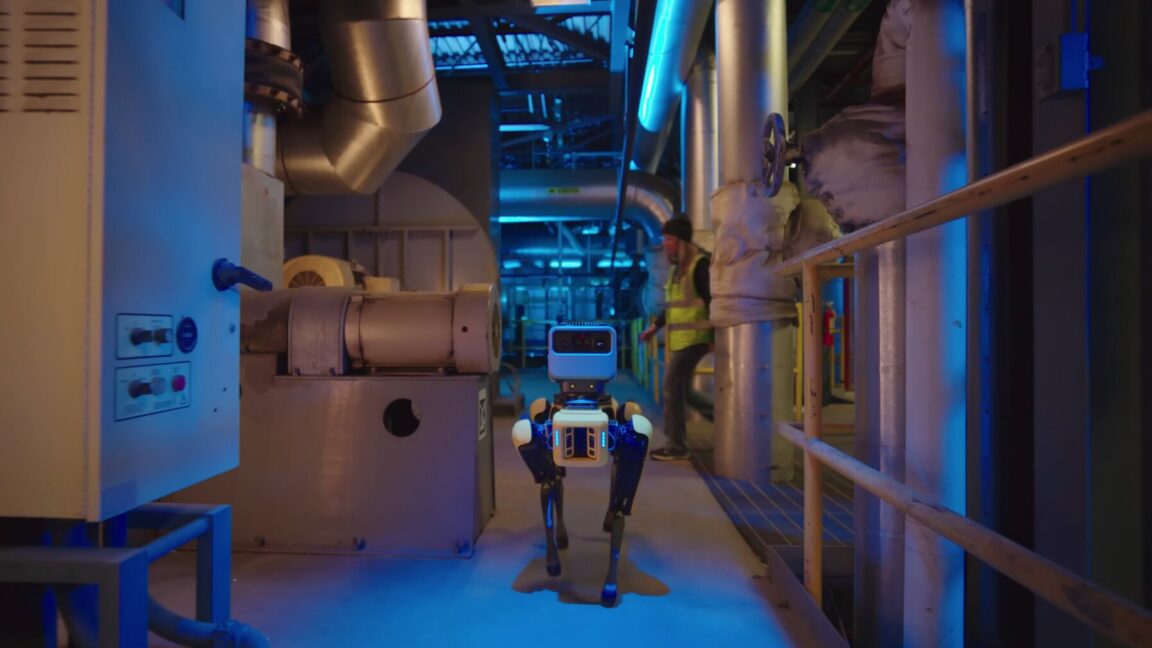
🧠Google has integrated its Gemini AI model into robotic systems that can autonomously read industrial gauges and thermometers during facility inspections. This advancement combines computer vision with large language models to enable robots to interpret analog instruments, improving automation capabilities in industrial monitoring and maintenance operations.
🧠 Gemini
AIBullisharXiv – CS AI · Jun 116/10
🧠Researchers introduce a data-efficient approach for Remaining Useful Life (RUL) prediction in industrial equipment using frozen pretrained time-series foundation models (Chronos-2) combined with lightweight regression heads. Testing on real-world sensor data demonstrates superior performance compared to traditional recurrent, convolutional, and Transformer-based models, suggesting foundation models offer practical advantages for predictive maintenance without extensive feature engineering.
AINeutralarXiv – CS AI · Jun 105/10
🧠Researchers propose a new fault diagnosis method using belief rule base (BRB) technology with enhanced robustness analysis to improve the reliability of equipment monitoring systems. The approach addresses sensor uncertainty and model vulnerability, demonstrating improved accuracy and robustness in real-world applications like diesel engine and bearing fault detection.
AINeutralarXiv – CS AI · Jun 96/10
🧠Researchers present two physics-constrained probabilistic frameworks (PC-SNGP and PC-SNER) for industrial prognostics that improve prediction accuracy and uncertainty quantification by maintaining awareness of input distance from training data. The methods use spectral normalization to preserve distance representations and dynamic weighting strategies, demonstrating improved performance on bearing failure prediction benchmarks while maintaining robustness under distributional shifts.
AIBullishAI News · Jun 56/10
🧠Shell is expanding its partnership with C3 AI to deploy autonomous AI agents for predictive maintenance across its operations, moving beyond basic anomaly detection to fully automated systems. The energy company currently monitors over 30,000 critical equipment assets using C3 AI's Reliability Suite and seeks to enhance operational efficiency through advanced automation.
AINeutralarXiv – CS AI · Jun 56/10
🧠Researchers present a machine learning framework that predicts functional performance and material fatigue for remanufactured tools in circular economy settings, using LSTM neural networks combined with finite-element stress analysis to assess whether returned products can safely re-enter production.
AINeutralarXiv – CS AI · Jun 46/10
🧠Researchers introduce TPA-AD, a two-stage machine learning method for detecting anomalies in bearing time-series data using only normal training samples. The approach generates synthetic anomalies near normal boundaries and uses contrastive learning to identify degradation patterns, demonstrating improved performance on bearing fault detection and broader applicability across 13 public anomaly detection datasets.
AINeutralarXiv – CS AI · Jun 26/10
🧠Researchers introduce PC-MambaSDE, a machine learning framework designed to predict remaining useful life in industrial equipment by combining continuous-time neural networks with physics-based constraints. The model handles irregular sensor data and prevents physically impossible degradation patterns, outperforming existing methods especially when observation data is sparse.
AIBullisharXiv – CS AI · Jun 26/10
🧠Researchers present RGPD, a physics-informed neural network framework that dynamically balances multiple loss functions to improve Remaining Useful Life (RUL) and State of Health (SoH) predictions across industrial assets. The model achieves up to 20% improvement in accuracy over existing methods by combining graph-based representation learning with reinforcement learning-driven adaptive weighting, demonstrating strong generalization across engine, bearing, and battery degradation datasets.
AINeutralarXiv – CS AI · Jun 16/10
🧠Researchers benchmarked five machine learning uncertainty quantification methods for predicting turbine gas temperature in engine health management systems. The study reveals distinct trade-offs between prediction interval coverage, width, and stability, providing practical guidance for selecting appropriate methods in real-world prognostics applications.
AINeutralarXiv – CS AI · Jun 16/10
🧠Researchers present a multi-task machine learning framework for predicting turbine remaining useful life (RUL) and thermal indicators with quantified uncertainty. The system combines convolutional neural networks with bidirectional LSTMs to handle heterogeneous real-world fleet data and provides prediction intervals rather than point estimates, enabling risk-aware maintenance decisions.
AINeutralarXiv – CS AI · Jun 16/10
🧠Researchers introduce STEP, a self-supervised learning method that creates interpretable representations of time series data showing irreversible state transitions like equipment degradation or task completion. The approach encodes progression information in geometric coordinates (polar angles and radius) without requiring labeled data, matching or exceeding black-box models while providing transparency into underlying mechanisms.
AINeutralarXiv – CS AI · May 286/10
🧠Researchers introduce Picid, a standardized evaluation infrastructure for Prognostics and Health Management (PHM) that addresses the reproducibility crisis in predictive maintenance across industries. The framework formalizes dataset construction, preprocessing, and evaluation metrics to enable fair comparisons of fault detection, diagnostics, and prognostics models across diverse domains like batteries, bearings, and engines.
🏢 Meta
AINeutralarXiv – CS AI · May 286/10
🧠A research paper compares rule-based and data-driven approaches in industrial monitoring systems, finding that rule-based systems offer interpretability and reliability while data-driven ML approaches provide superior anomaly detection and adaptability. The study proposes hybrid systems combining both methodologies as the optimal path forward for Industry 4.0 environments.
AINeutralarXiv – CS AI · May 116/10
🧠Researchers analyze generative models (VAEs, GANs, and Diffusion Models) within federated learning frameworks for predictive maintenance in IoT systems, revealing critical tradeoffs between model performance, communication efficiency, and training stability. The study introduces a taxonomy for partial component sharing that enables personalization while reducing bandwidth demands, with findings suggesting diffusion models may outperform alternatives in heterogeneous, bandwidth-constrained environments.
AIBullisharXiv – CS AI · Feb 276/106
🧠Researchers propose a new approach using Adversarial Inverse Reinforcement Learning for machinery fault detection that learns from healthy operational data without requiring manual fault labels. The framework treats fault detection as a sequential decision-making problem and demonstrates effective early fault detection on three benchmark datasets.
AINeutralarXiv – CS AI · Mar 34/106
🧠Researchers developed a multi-condition digital twin calibration framework for axial piston pumps that can simulate compound faults and enable zero-shot fault diagnosis. The physics-data coupled approach addresses data scarcity issues in traditional fault detection methods and demonstrates accurate reproduction of both single and compound faults in hydraulic systems.
$XRP$COMP