AIBearisharXiv – CS AI · Apr 137/10
🧠Researchers have identified and systematically studied correctness bugs in PyTorch's compiler (torch.compile) that silently produce incorrect outputs without crashing or warning users. A new testing technique called AlignGuard has detected 23 previously unknown bugs, with over 60% classified as high-priority by the PyTorch team, highlighting a critical reliability gap in a core tool for AI infrastructure optimization.
AIBullishMarkTechPost · Apr 67/10
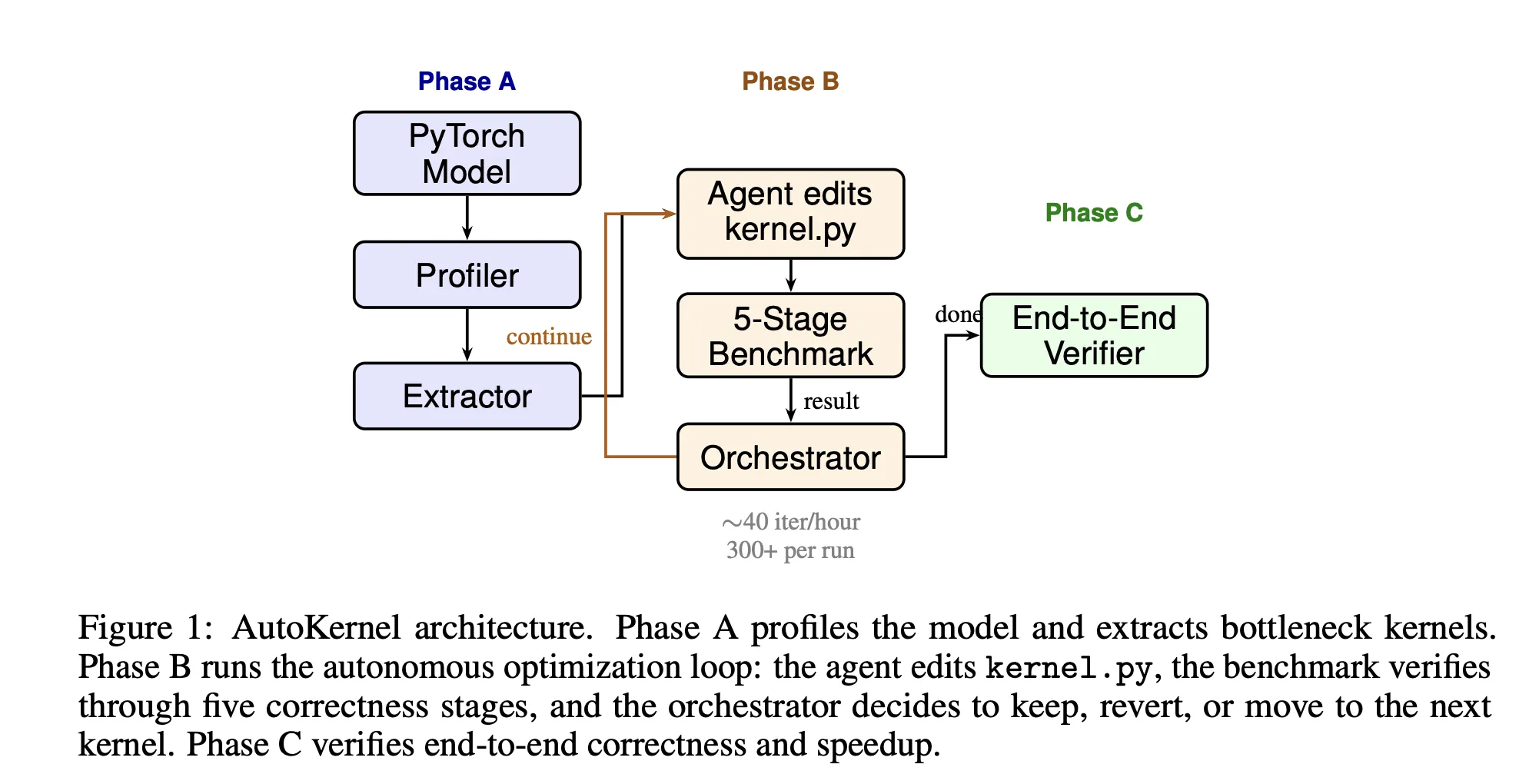
🧠RightNow AI has released AutoKernel, an open-source framework that uses autonomous LLM agents to optimize GPU kernels for PyTorch models. This tool aims to automate the complex process of writing efficient GPU code, addressing one of the most challenging aspects of machine learning engineering.
AIBullisharXiv – CS AI · Mar 267/10
🧠Researchers have developed DVM, a real-time compiler for dynamic AI models that uses bytecode virtual machine technology to significantly speed up compilation times. The system achieves up to 11.77x better operator/model efficiency and up to 5 orders of magnitude faster compilation compared to existing solutions like TorchInductor and PyTorch.
AI × CryptoBullisharXiv – CS AI · Mar 37/104
🤖TAO is a new verification protocol that enables users to verify neural network outputs from untrusted cloud services without requiring exact computation matches. The system uses tolerance-aware verification with IEEE-754 bounds and empirical profiles, implementing a dispute resolution mechanism deployed on Ethereum testnet.
$ETH$TAO
AINeutralHugging Face Blog · Jun 116/10
🧠This article demonstrates PyTorch profiling techniques for optimizing neural network performance, specifically comparing standard nn.Linear layers with fused MLP implementations. The work illustrates how developer-level optimization practices can significantly improve AI model efficiency, relevant to both open-source ML communities and production deployment scenarios.
AINeutralarXiv – CS AI · Jun 56/10
🧠Researchers introduced TensorBench, a 199-task benchmark for evaluating coding agents on a PyTorch-based tensor framework, addressing the trade-off between task difficulty and evaluation reliability in repository-level coding benchmarks. Testing seven frontier AI models revealed significant performance variation, with pass rates ranging from 64.8% to 22.1%, suggesting distinct strengths across different coding agent architectures.
AIBullisharXiv – CS AI · Jun 46/10
🧠StandardE2E introduces a unified framework that standardizes interfaces across six major autonomous driving datasets, eliminating the need for researchers to rebuild preprocessing pipelines for each dataset. By providing a single PyTorch DataLoader and canonical data schema, the framework accelerates end-to-end autonomous driving research and cross-dataset experimentation.
AIBullisharXiv – CS AI · Mar 36/107
🧠Researchers developed a dual-pipeline framework for bird image segmentation using foundation models including Grounding DINO 1.5, YOLOv11, and SAM 2.1. The supervised pipeline achieved state-of-the-art results with 0.912 IoU on the CUB-200-2011 dataset, while the zero-shot pipeline achieved 0.831 IoU using only text prompts.
AIBullisharXiv – CS AI · Mar 36/103
🧠TiledAttention is a new CUDA-based scaled dot-product attention kernel for PyTorch that enables easier modification of attention mechanisms for AI research. It provides a balance between performance and customizability, delivering significant speedups over standard attention implementations while remaining directly editable from Python.
$DOT
AIBullishHugging Face Blog · Sep 136/104
🧠The article discusses fine-tuning Meta's Llama 2 70B large language model using PyTorch's Fully Sharded Data Parallel (FSDP) technique. This approach enables efficient training of large AI models by distributing parameters across multiple GPUs, making advanced AI model customization more accessible.
AINeutralOpenAI News · Jan 306/105
🧠OpenAI has announced it is standardizing its deep learning framework on PyTorch, consolidating its AI development infrastructure. This decision represents a significant technical choice for one of the leading AI companies and could influence broader industry adoption patterns.
AINeutralHugging Face Blog · May 295/10
🧠This article provides a beginner's guide to PyTorch's torch.profiler tool, explaining how developers can identify performance bottlenecks in their machine learning models. The profiler is essential for optimizing neural network training and inference, helping practitioners understand where computational resources are being consumed.
AINeutralarXiv – CS AI · Mar 35/107
🧠Researchers developed SubstratumGraphEnv, a reinforcement learning framework that models Windows system attack paths using graph representations derived from Sysmon logs. The system combines Graph Convolutional Networks with Actor-Critic models to automate cybersecurity threat analysis and identify malicious process sequences.
AIBullishApple Machine Learning · Feb 244/103
🧠Researchers introduce depyf, a new tool designed to make PyTorch 2.x's compiler more transparent for machine learning researchers. The tool decompiles bytecode back into readable source code, helping researchers better understand and utilize the compiler's optimization capabilities.
AIBullishHugging Face Blog · May 215/108
🧠nanoVLM is introduced as a simplified repository for training Vision Language Models (VLMs) using pure PyTorch. The project aims to make VLM training more accessible by providing a streamlined approach without complex dependencies.
AINeutralHugging Face Blog · Jan 164/104
🧠The article appears to be about integrating timm (PyTorch Image Models) with Hugging Face Transformers library, allowing users to utilize any timm model within the transformers ecosystem. This represents a technical development in AI model interoperability and tooling.
AINeutralHugging Face Blog · Dec 244/106
🧠The article appears to be a technical guide focused on visualizing and understanding GPU memory usage in PyTorch, a popular machine learning framework. This type of content typically helps developers optimize their AI model training and deployment by better managing memory resources.
AINeutralHugging Face Blog · Mar 184/108
🧠The article appears to be about Quanto, a new PyTorch quantization backend designed for Optimum, though no article body content was provided for analysis. This likely relates to AI model optimization and efficiency improvements in machine learning frameworks.
AINeutralHugging Face Blog · Jan 24/105
🧠The article title suggests content about optimizing PyTorch Transformers using Intel's Sapphire Rapids processors, indicating a technical deep-dive into AI model acceleration hardware. However, the article body appears to be empty or not provided, preventing detailed analysis of the actual implementation details or performance improvements.
AINeutralHugging Face Blog · Oct 214/107
🧠The article appears to be a technical guide covering distributed training methodologies in machine learning, progressing from PyTorch DDP to Accelerate to Trainer frameworks. However, the article body was not provided, limiting the ability to analyze specific content and implications.
AINeutralHugging Face Blog · Sep 274/109
🧠The article appears to be about Hugging Face's Accelerate library and how it enables running very large AI models using PyTorch. However, the article body is empty, making it impossible to provide specific technical details or implications.
AIBullishHugging Face Blog · May 25/104
🧠The article discusses PyTorch Fully Sharded Data Parallel (FSDP), a technique for accelerating large AI model training by distributing model parameters, gradients, and optimizer states across multiple GPUs. This approach enables training of larger models that wouldn't fit on single devices while improving training efficiency and speed.
AIBullishHugging Face Blog · Nov 194/105
🧠The article discusses methods for accelerating PyTorch distributed fine-tuning using Intel's hardware and software technologies. It focuses on optimizations for training deep learning models more efficiently on Intel infrastructure.
AINeutralHugging Face Blog · Oct 103/105
🧠Arm announces its participation at the PyTorch Conference, indicating the chip designer's continued involvement in the AI and machine learning ecosystem. The announcement appears to be a simple conference participation notice without additional details about specific presentations or initiatives.
AINeutralHugging Face Blog · Feb 63/103
🧠The article appears to be about optimizing PyTorch Transformers performance using Intel Sapphire Rapids processors, but the article body content is missing from the provided text.