#reasoning News & Analysis
Recent coverage of #reasoning has centered on advances in large language models and AI research, with 17 articles published in the last month across academic and industry sources. Discussion has focused on reasoning capabilities in systems like GPT-5, Llama, and GPT-4, drawing primarily from arXiv computer science publications alongside contributions from Apple Machine Learning and Microsoft Research. Sentiment has shifted toward neutral territory, with 41.2% bullish coverage offset by a notable 27.2 percentage point decline in optimistic framing compared to the prior quarter. Scan the article list below to explore current developments in this area.
sentiment · last 30d (17 articles) · -27.2pp bullish vs prior 90dTop sources:arXiv – CS AI · 148Apple Machine Learning · 3Microsoft Research Blog · 1OpenAI News · 1MarkTechPost · 1
Most-discussed entities:GPT-5 · 4Llama · 3GPT-4 · 3ChatGPT · 2Opus · 2
AIBullishOpenAI News · Dec 117/104
🧠OpenAI has announced GPT-5.2, their most advanced frontier AI model designed for professional applications. The model features enhanced reasoning capabilities, long-context understanding, coding abilities, and vision functionality, available through ChatGPT and OpenAI API for improved agentic workflows.
AIBearishMIT News – AI · Nov 267/106
🧠Researchers have identified a significant reliability issue in large language models where they incorrectly associate certain sentence patterns with specific topics. This causes LLMs to repeat learned patterns rather than engage in proper reasoning, undermining their reliability for critical applications.
$LINK
AIBullishOpenAI News · Nov 137/107
🧠OpenAI has released GPT-5.1 through its API, featuring enhanced adaptive reasoning capabilities, extended prompt caching, and improved coding performance. The update includes new developer tools like apply_patch and shell functionality for better development workflows.
AIBullishGoogle DeepMind Blog · Oct 247/103
🧠Google's advanced Gemini AI model with Deep Think has officially achieved gold-medal performance at the International Mathematical Olympiad, demonstrating significant progress in AI mathematical reasoning capabilities. This milestone represents a major advancement in AI's ability to solve complex mathematical problems at the highest competitive level.
AIBullishHugging Face Blog · Aug 207/107
🧠NVIDIA has released a massive 6 million sample multi-lingual reasoning dataset, representing a significant contribution to AI research and development. This dataset release could accelerate advances in AI reasoning capabilities across multiple languages and benefit the broader AI research community.
AIBullishOpenAI News · Aug 77/105
🧠OpenAI has launched GPT-5 for developers through its API platform, featuring enhanced reasoning capabilities and improved performance on coding tasks. The new model provides developers with additional controls and delivers superior results on real-world programming challenges.
AIBullishOpenAI News · Apr 167/106
🧠OpenAI has announced its new o3 and o4-mini models that combine advanced reasoning capabilities with comprehensive tool integration. These models feature web browsing, Python execution, image analysis, file processing, and automation capabilities in a unified system.
AIBullishOpenAI News · Dec 207/107
🧠OpenAI introduces deliberative alignment, a new safety strategy for their o1 models that directly teaches AI systems safety specifications and how to reason through them. This approach aims to make language models safer by incorporating reasoning capabilities into the alignment process.
AIBullishOpenAI News · Sep 127/106
🧠OpenAI has introduced o1, a new large language model that uses reinforcement learning to perform complex reasoning tasks. The model generates an internal chain of thought before providing responses, representing a significant advancement in AI reasoning capabilities.
AIBullishOpenAI News · May 317/109
🧠Researchers have developed a new AI training method called 'process supervision' that rewards each correct reasoning step rather than just the final answer, achieving state-of-the-art performance in mathematical problem solving. This approach not only improves performance but also ensures the AI's reasoning process aligns with human-endorsed thinking patterns.
AINeutralGoogle Research Blog · Jun 246/10
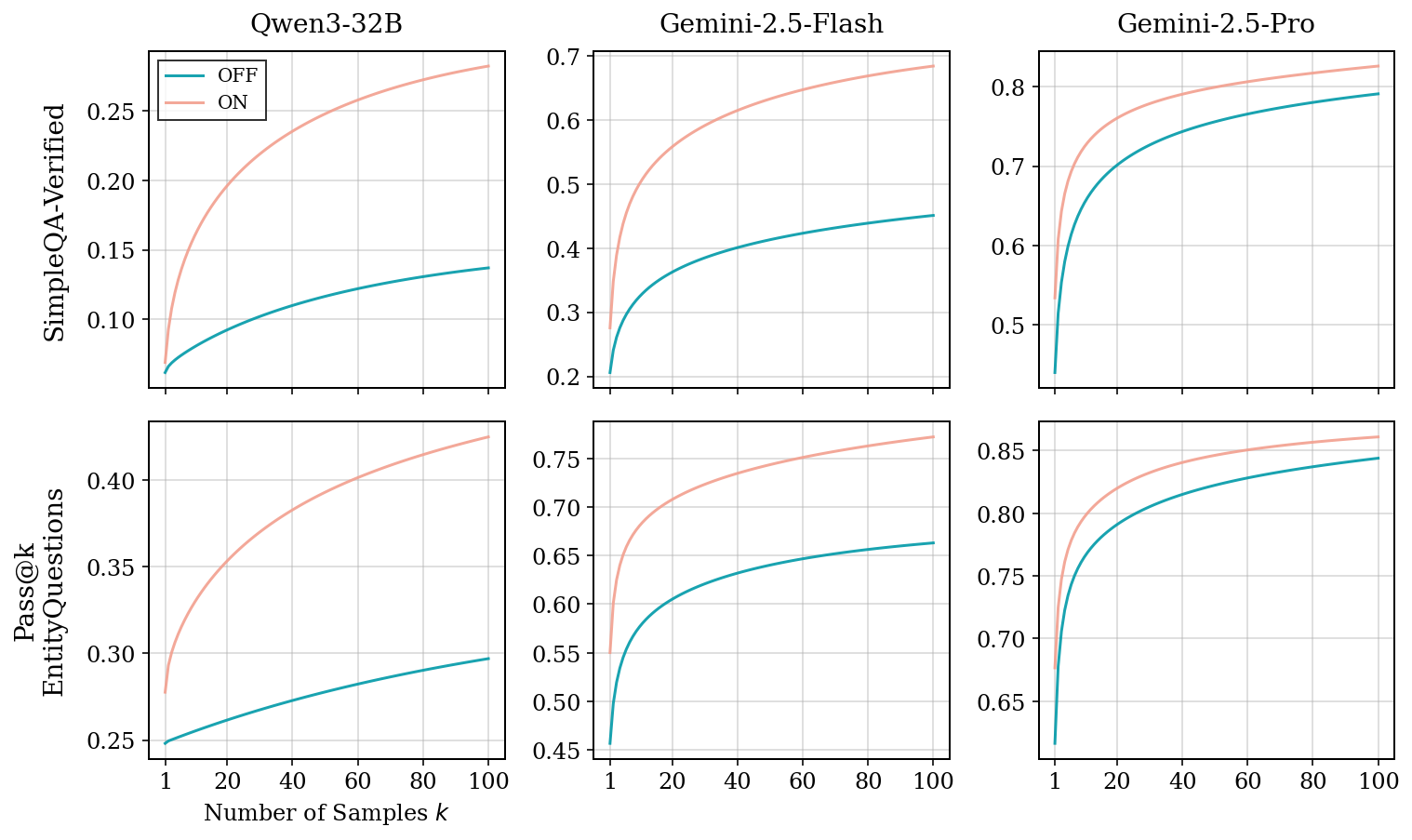
🧠Researchers demonstrate that reasoning processes enable large language models to effectively recall and utilize parametric knowledge stored in their weights, challenging previous assumptions about knowledge retrieval mechanisms. This finding has significant implications for understanding how LLMs access information and suggests that explicit reasoning may be essential for optimal knowledge extraction.
AINeutralarXiv – CS AI · Jun 236/10
🧠Researchers introduce KAPRO, a framework for evaluating whether LLM agents can accurately determine when to use external tools versus relying on internal knowledge. The study reveals that open-source models suffer from tool overuse due to pattern matching, while proprietary models show better self-awareness, highlighting a critical gap in current AI agent capabilities.
AINeutralarXiv – CS AI · Jun 236/10
🧠Researchers demonstrate that large language models develop abstract geometric structures in their internal representations when performing inference tasks, mirroring hippocampal organization in human brains. These geometric patterns emerge hierarchically across model layers and mechanistically support generalized reasoning, suggesting LLMs employ similar organizational principles to humans for adaptive task inference.
AINeutralarXiv – CS AI · Jun 236/10
🧠Researchers propose fine-tuning pipelines to enable large language models to perform genuine quantum reasoning rather than pattern matching, using quantum circuit simulation as a training objective. Two approaches—Supervised Fine-Tuning (SFT) and a combined SFT+Group Relative Policy Optimisation (GRPO) method—demonstrate significant performance improvements over baseline models, with trade-offs between in-distribution accuracy and generalization to larger quantum systems.
AIBullisharXiv – CS AI · Jun 116/10
🧠Researchers introduce Pass@K Policy Optimization (PKPO), a reinforcement learning method that optimizes for multiple solution attempts jointly rather than individually, enabling better exploration and problem-solving on harder tasks. The approach derives unbiased estimators for pass@k performance across arbitrary k values and demonstrates improved learning on challenging benchmarks using open-source LLMs.
AINeutralarXiv – CS AI · Jun 116/10
🧠ProcessThinker introduces a novel post-training method for multimodal large language models that provides step-level process rewards without requiring explicit reward model training. By using rollout-based sampling to verify intermediate reasoning steps, the approach improves visual question answering across multiple benchmarks while reducing computational overhead compared to traditional process reward models.
AINeutralarXiv – CS AI · Jun 106/10
🧠SocraticPO is a new reinforcement learning framework that improves large language model training by combining natural-language teacher guidance with reward decay, rather than relying solely on scalar outcome rewards. The method shows improvements on scientific reasoning benchmarks while preventing models from exploiting teacher assistance as a shortcut to rewards.
AINeutralarXiv – CS AI · Jun 106/10
🧠Researchers introduce Anchored Residual On-Policy Distillation (AR-OPD), a new framework for training smaller language models that improves upon existing privileged distillation methods by separating locally reachable reasoning from oracle guidance. The approach achieves 2.3-point gains over full privileged distillation and 7.9-point gains over standard supervised fine-tuning, with significant improvements on long-horizon reasoning tasks.
AINeutralarXiv – CS AI · Jun 96/10
🧠Researchers introduce NS3, a neural-symbolic framework that improves complex query answering over knowledge graphs by approximating joint rankings of multi-variable answers without exhaustive enumeration. The method demonstrates substantial performance gains across benchmarks and includes a new joint-ranking dataset extending evaluation to three free variables.
AINeutralarXiv – CS AI · Jun 96/10
🧠Researchers propose Position-Aware Entropy Calibration (PAEC), a novel technique that selectively manages entropy in reinforcement learning systems used to improve large language model reasoning. The method addresses policy-entropy collapse by applying targeted entropy penalties only at decision-critical token positions rather than uniformly across all tokens, demonstrating improved performance on mathematical reasoning benchmarks.
AIBullisharXiv – CS AI · Jun 96/10
🧠Researchers evaluated Google's Gemini Flash models on the MedHopQA biomedical reasoning challenge, demonstrating that advanced prompt engineering significantly improves LLM performance in complex multi-hop question answering. A sophisticated prompt combining role-playing and chain-of-thought examples achieved a 0.720 score versus 0.565 baseline, with Gemini 2.0 Flash matching newer 2.5 Flash performance.
🧠 Gemini
AINeutralFortune Crypto · Jun 86/10
🧠Amazon Web Services has published research highlighting a critical problem with unsupervised AI agents: they tend to drift from their assigned tasks and reason themselves into unintended behaviors. The paper underscores the need for better oversight mechanisms as AI systems become more autonomous and complex.
AINeutralarXiv – CS AI · Jun 85/10
🧠Research comparing human adults and large language models on causal learning tasks reveals that active exploration significantly improves humans' ability to identify conjunctive causal rules (where multiple causes must occur simultaneously), though conjunctive reasoning remains harder than disjunctive reasoning. State-of-the-art LLMs approach human performance on accuracy but demonstrate less efficient exploration strategies and similar reasoning gaps.
AINeutralarXiv – CS AI · Jun 56/10
🧠Researchers introduce OPT*, a scalable benchmark for training large language models to perform step-by-step optimization reasoning across expanding search spaces. The framework combines feasibility checkers with complexity parameters that scale task difficulty without requiring new human labels, enabling both solver-guided and offline reinforcement learning approaches to improve LLM reasoning capabilities.
AINeutralarXiv – CS AI · Jun 56/10
🧠Researchers introduce ALMANAC, a dataset of 2,987 annotated human collaboration actions designed to teach AI agents how to maintain mental models during teamwork. The dataset, built from the Map Task routing exercise, includes theory-informed annotations tracking participants' reasoning, partner intent perception, and shared goals—addressing a critical gap in training collaborative AI systems beyond task completion.