AIBullishCrypto Briefing · Jun 247/10
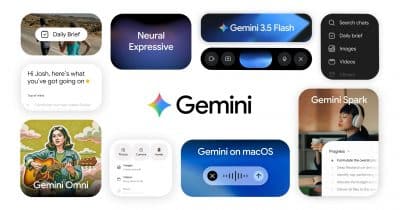
🧠Google's Gemini 3.5 Flash has integrated computer use capabilities, enabling smaller teams to automate complex tasks through AI. This development democratizes advanced automation technology, potentially reshaping how organizations across various industries leverage artificial intelligence for operational efficiency.
🧠 Gemini
AIBullishTechCrunch – AI · Jun 237/10
🧠Anthropic has launched Claude Tag, a Slack integration that embeds AI directly into team workflows. The feature represents a strategic move beyond productivity automation—it allows Claude to continuously learn organizational context, institutional knowledge, and enterprise processes to deepen its value as an embedded AI teammate.
🏢 Anthropic🧠 Claude
AIBullishBlockonomi · Jun 117/10
🧠IBM and ServiceNow have announced a multi-year strategic partnership focused on accelerating enterprise AI deployment and modernizing legacy infrastructure, with major rollout expected by H2 2026. The collaboration aims to enable large-scale AI adoption across enterprise systems by combining IBM's AI and infrastructure expertise with ServiceNow's workflow automation platform.
AIBullishcrypto.news · Jun 97/10
🧠JPMorgan Chase is planning to deploy longer-running AI agents for corporate workflows later this year, according to Chief Analytics Officer Derek Waldron. This advancement reflects the banking industry's push to extend AI agent capabilities beyond short-duration tasks, aligning with broader enterprise adoption trends.
AIBullisharXiv – CS AI · Jun 97/10
🧠HARBOR is an automated framework that uses specialized AI agents to streamline reinforcement learning workflows for robot training, eliminating manual environment setup, reward shaping, and hyperparameter tuning. Demonstrated across 16 robotic tasks, the system reduces engineering effort while maintaining competitive performance and enabling real-world robot deployment.
AIBullisharXiv – CS AI · Jun 97/10
🧠SKILL.nb is a new framework that improves AI agent reliability by selectively formalizing workflow steps based on execution evidence, storing them as versioned notebooks with natural language guidance and executable code. The system achieved 53.7% success on web automation tasks and retained 91.7% performance across multiple re-executions, significantly outperforming existing baselines in handling environment drift and task specification changes.
AIBullishOpenAI News · Jun 47/10
🧠Endava is leveraging AI agents, ChatGPT Enterprise, and Codex to transform its software delivery processes, automating workflows and accelerating development cycles. The initiative represents a broader enterprise shift toward AI-native operations that prioritizes efficiency and developer productivity.
🧠 ChatGPT
AIBullisharXiv – CS AI · May 297/10
🧠Researchers introduce VFEAgent, a multimodal AI framework that automates Finite Element Analysis (FEA) workflows by processing images and text descriptions to generate complete engineering simulations. The system combines vision-language models with self-debugging code synthesis to achieve higher reliability than existing LLM approaches, potentially reducing manual engineering work.
AIBullisharXiv – CS AI · May 277/10
🧠GraphMind is an AI system that automates complex operational workflows by extracting structured action graphs from human resolution traces and using multi-agent reasoning to execute and adapt them. Deployed across cloud database services, it demonstrates significant improvements in incident mitigation with reduced hallucinations and demonstrates how operational AI systems can learn and improve from execution feedback.
AIBullisharXiv – CS AI · May 47/10
🧠Researchers at an academic medical center developed ChatEHR, an LLM system integrated into electronic health records that enables both automated clinical tasks and interactive use across patient timelines. Over 1.5 years, the platform achieved adoption by 1,075 users conducting 23,000 sessions, generating an estimated $6M in first-year savings while maintaining vendor-agnostic governance.
AIBullishOpenAI News · Jul 177/105
🧠OpenAI introduces a new ChatGPT agent that can think and act autonomously using various tools to complete complex tasks such as research, booking services, and creating presentations. This advancement represents a significant step toward more capable AI agents that can handle multi-step workflows with user guidance.
AIBullishOpenAI News · Mar 257/108
🧠Hebbia has developed AI-powered research automation that can handle 90% of finance and legal work tasks, leveraging OpenAI's technology. This represents a significant advancement in AI-driven workflow automation for professional services industries.
AIBullishArs Technica – AI · Jun 256/10
🧠Notion is discontinuing its email application and pivoting toward AI agents to manage user inboxes instead. This strategic shift reflects broader industry recognition that traditional email interfaces are becoming obsolete as AI-powered automation becomes the preferred method for handling communications.
AIBullisharXiv – CS AI · Jun 256/10
🧠Researchers demonstrate that combining the FABRIC testbed with LLM-based coding assistants can significantly reduce the effort required to reproduce published scientific experiments. The AI-assisted approach achieved 4-6x reduction in reproduction effort across three case studies, though human intervention remained necessary for complex analytical workflows.
AIBullisharXiv – CS AI · Jun 236/10
🧠Researchers introduced PathLab, an AI-powered autonomous framework that translates natural language into computational pathology workflows, eliminating the need for programming expertise. The system demonstrated performance equivalent to expert implementations across 12 datasets while enabling non-technical domain experts to independently design and execute pathology studies.
AINeutralarXiv – CS AI · Jun 236/10
🧠Researchers introduce Process-Reward Tactic Evolution, a training framework that enables LLM agents to reliably execute complex bioinformatics workflows in Galaxy by accumulating reusable tactics from verified workflow rollouts. The approach combines process verification, curriculum learning, and tactic libraries to improve long-horizon task completion, biological correctness, and execution efficiency compared to baseline methods.
AINeutralarXiv – CS AI · Jun 236/10
🧠SQLConductor is a new AI framework that improves Text-to-SQL systems—tools that convert natural language queries into database commands—by using adaptive, step-wise orchestration rather than fixed pipelines. The system achieves 73.2% execution accuracy on complex database queries while using smaller, frozen models, suggesting significant efficiency gains for database accessibility applications.
AINeutralarXiv – CS AI · Jun 196/10
🧠Researchers introduce IHBench, a benchmark for evaluating how voice agents recover from user interruptions while executing multi-step workflows in enterprise settings. Testing 27 model configurations reveals closed-weight models (OpenAI, Google) significantly outperform open-weight alternatives in handling interruptions, recovering 3.3x more gracefully and maintaining task completion rates.
🏢 OpenAI
AIBullishCrypto Briefing · Jun 186/10
🧠OpenAI has introduced a Record & Replay plugin for Codex that enables users to automate workflows by recording and replaying actions. The tool aims to convert manual, individual processes into scalable automations that can be shared across enterprises, potentially improving operational efficiency.
🏢 OpenAI
AIBullishCrypto Briefing · Jun 186/10
🧠Gradial has secured $65 million in funding to develop AI agents capable of automating enterprise marketing workflows. The platform aims to reduce time-to-market and improve compliance for large organizations deploying agentic AI in marketing operations.
AINeutralarXiv – CS AI · Jun 116/10
🧠Researchers developed EeVA, an LLM-based workflow tool that assists non-specialists in conducting structured ethical deliberation across multiple frameworks rather than providing definitive answers. Proof-of-concept testing on three real-world cases demonstrated the system's ability to synthesize complex ethical perspectives, identify convergences and tensions, and communicate findings accessibly to non-ethicists.
AINeutralarXiv – CS AI · Jun 116/10
🧠Researchers present ShipFinance.ai, an AI-powered system using large language models to streamline ship finance loan origination by automating document processing, information extraction, and workflow management across complex maritime lending. The system addresses growing complexity in the sector driven by environmental regulations and ESG reporting requirements, offering maritime finance professionals tools to manage increasingly sophisticated underwriting processes.
AINeutralarXiv – CS AI · Jun 106/10
🧠Researchers introduce Workflow-GYM, a benchmark for evaluating AI agents on complex, long-horizon professional GUI tasks across specialized software environments. Testing reveals that even state-of-the-art models achieve only 30% success rates, exposing significant limitations in agent consistency, error handling, and domain-specific software comprehension.
AIBullisharXiv – CS AI · Jun 86/10
🧠Researchers introduce W2S, a framework for automatically constructing high-quality skills for large language model agents by decomposing execution traces into workflow structures, semantics, and attachments. The approach outperforms traditional summarization methods by 10.5%, demonstrating that treating traces as executable specifications rather than text yields more reliable agent behavior.
AINeutralarXiv – CS AI · Jun 86/10
🧠Researchers propose a framework for AI-powered code review that transitions human reviewers from manual inspectors to supervisory operators of specialized agents. The five-stage workflow addresses the bottleneck created by AI coding assistants that increase code production velocity faster than traditional review processes can handle, while maintaining human control at critical quality gates.