Real-time AI-curated news from 96,738+ articles across 50+ sources. Sentiment analysis, importance scoring, and key takeaways — updated every 15 minutes.
AINeutralarXiv – CS AI · May 286/10
🧠RankTuner, a new fine-tuning mechanism, introduces probability-entropy calibration to improve supervised learning in large language models. By combining ground-truth probability with token entropy metrics through a Relative Rank Indicator, the approach achieves better performance on mathematical reasoning and code generation tasks compared to single-metric baselines.
AINeutralarXiv – CS AI · May 286/10
🧠Researchers introduce SAME, a new approach for training Multimodal Large Language Models that can continuously learn new tasks without forgetting previous capabilities. The method addresses fundamental problems in continual learning by stabilizing how AI systems route tasks to specialized expert networks and preventing knowledge degradation over time.
AINeutralarXiv – CS AI · May 286/10
🧠Researchers introduce ECHO, a novel test-time reinforcement learning algorithm that addresses rollout collapse and noisy pseudo-labels through entropy-confidence hybrid optimization. The method improves sampling efficiency and training robustness across mathematical and visual reasoning benchmarks while performing better under limited computational budgets.
AINeutralarXiv – CS AI · May 286/10
🧠Researchers introduce BudgetMem, a runtime memory framework for LLM agents that uses query-aware routing to dynamically allocate computational resources across memory modules at three cost tiers. The system employs reinforcement learning to optimize the performance-cost trade-off, demonstrating improvements over static memory approaches across multiple benchmark datasets.
AINeutralarXiv – CS AI · May 286/10
🧠Researchers demonstrate that singular vectors of attention matrices in language models reliably align with learned feature representations, providing theoretical justification for using this mathematical approach to identify interpretable features. The work bridges mechanistic interpretability research by validating why this alignment occurs and proposing testable predictions for detecting it in real models.
AINeutralarXiv – CS AI · May 286/10
🧠Researchers provide the first rigorous theoretical analysis of temperature scaling, a widely-used technique for controlling uncertainty in machine learning models. The study reveals that while temperature scaling reliably increases entropy in classifiers, it does not necessarily increase diversity in large language models as commonly claimed, and establishes temperature scaling as the unique linear calibration method that preserves hard predictions.
AINeutralarXiv – CS AI · May 286/10
🧠Researchers introduce AlphaForgeBench, a new evaluation framework that addresses critical instability issues in Large Language Models deployed as trading agents. Rather than having LLMs generate discrete trading actions, the framework redefines their role as quantitative researchers producing alpha factors and strategies, enabling deterministic, reproducible evaluation aligned with real-world financial workflows.
AIBullisharXiv – CS AI · May 286/10
🧠Researchers introduce InfoNoise, an adaptive noise scheduling method for diffusion model training that dynamically reallocates computational resources toward the most informative denoising levels. By estimating conditional-entropy-rate profiles during training, the approach matches or exceeds fixed schedules on image benchmarks while achieving up to 3x computational efficiency gains on diverse tasks including DNA and language generation.
AINeutralarXiv – CS AI · May 286/10
🧠Researchers present SLOT, a comprehensive taxonomy for understanding security vulnerabilities in retrieval-augmented generation (RAG) systems that extend LLMs with external knowledge. The framework categorizes attacks and defenses across four dimensions—attack surface, defense layer, security objective, and target scope—while identifying structural gaps in current evaluation methods and proposing future research directions for securing RAG pipelines.
AIBullisharXiv – CS AI · May 286/10
🧠A new framework argues that AI in biomedicine is transitioning from predictive systems based on historical data to interventional intelligence that can model biological responses to novel therapies. The shift reflects a fundamental architectural limitation: traditional AI cannot reason about unseen interventions, making disease-level models that simulate outcomes under perturbation essential for clinical decision-making.
AINeutralarXiv – CS AI · May 286/10
🧠Researchers introduce MAVEN, a multi-agent framework that improves text-to-video generation's ability to accurately represent multiple cultures within single prompts. The team contributes a new benchmark dataset of 243 culturally grounded prompts across Chinese, American, and Romanian cultures, demonstrating that specialized agent-based prompt refinement significantly enhances cultural fidelity while maintaining visual quality.
AINeutralarXiv – CS AI · May 286/10
🧠Researchers introduce Vision-OPD, a self-distillation framework that improves multimodal large language models' ability to detect fine-grained visual details by training full-image models to match the performance of crop-focused models. The technique achieves competitive results against larger models without requiring external teachers, labels, or inference-time tools, addressing a critical weakness in current MLLMs.
AINeutralarXiv – CS AI · May 286/10
🧠Researchers identify a critical failure mode in test-time reinforcement learning (TTRL) where majority voting locks onto incorrect answers, permanently suppressing correct signals in low-ability problems. They introduce TTRL-Guard, a framework using flip-rate monitoring and selective updating to prevent this 'Correct-Answer Extinction Window,' achieving 54% relative improvement on AIME 2025 benchmarks.
AIBullisharXiv – CS AI · May 286/10
🧠Researchers propose a case-aware medical image classification framework that leverages multimodal knowledge graphs to retrieve similar historical cases and integrate external clinical knowledge, improving diagnostic accuracy through interpretable evidence-based reasoning rather than relying solely on isolated visual analysis.
AIBullisharXiv – CS AI · May 286/10
🧠Researchers propose SSDAU, a novel data augmentation method for Joint Entity and Relation Extraction that preserves semantic structure and context awareness. The approach significantly outperforms existing methods by reducing F1 score degradation to 8.26% compared to 31.91% for baseline approaches, addressing a critical challenge in NLP model generalization.
AINeutralarXiv – CS AI · May 286/10
🧠KT4EQG is a new educational framework that combines knowledge tracing with AI-powered question generation to create personalized exercise questions for students. The system uses machine learning to model each student's knowledge state and generates customized questions designed to maximize learning outcomes, demonstrating superior effectiveness compared to non-personalized approaches.
AINeutralarXiv – CS AI · May 286/10
🧠Researchers propose a novel machine learning framework for estimating individual treatment effects from graph-structured data that explicitly models differentiated networked effects—how neighbors of varying importance and scales influence outcomes. The method uses partial attention mechanisms and message amplifiers to improve accuracy in observational studies across commerce and medicine.
AINeutralarXiv – CS AI · May 286/10
🧠Researchers empirically tested whether increased compute can overcome imperfect verifier performance in reinforcement learning from verifiable rewards (RLVR), finding that verifier quality and training compute are not interchangeable. The study reveals that false negatives degrade model performance more severely than false positives, and compute scaling alone cannot close performance gaps caused by supervision noise.
AIBullishCrypto Briefing · May 286/10
🧠Pete Koomen discusses how AI serves as a foundational organizational layer that enhances intelligence and empowers finance teams through internal tools and large language models. LLMs are democratizing data access for non-technical users, enabling broader organizational capability in managing complex data across modern enterprises.
CryptoBearishNewsBTC · May 286/10
⛓️Ethereum has declined below $2,050 and is consolidating losses above the $2,000 support level, with technical indicators showing bearish momentum. The cryptocurrency faces resistance at $2,090, and a failure to break above this level could trigger further downside toward $1,920 and below.
$BTC$ETH
CryptoNeutralNewsBTC · May 286/10
⛓️Bitcoin's funding rate has turned positive, indicating dominant bullish sentiment among perpetual futures traders despite recent price pullbacks. The cryptocurrency experienced $104 million in liquidations over the past 24 hours, with $85 million from long positions, creating potential for further cascading liquidations if the market declines sharply.
$BTC$LINK🧠 DALL E
GeneralNeutralCrypto Briefing · May 286/10
📰The Pentagon has awarded Microsoft a $9.7 billion contract to centralize software license procurement across the Department of Defense. The deal aims to streamline defense operations, reduce costs, and establish a model for future government IT contracting.
AI × CryptoNeutralCrypto Briefing · May 286/10
🤖TSMC CEO C.C. Wei announced a profit-sharing increase exceeding 30% for employees, a move designed to retain talent in competitive semiconductor markets. The initiative presents a double-edged outlook: while it strengthens workforce retention, potential resource constraints could emerge if revenue growth decelerates, potentially affecting shareholder dividends and capital allocation toward long-term R&D investments.
GeneralBearishFortune Crypto · May 286/10
📰Salesforce is executing a $25 billion stock buyback program funded partly through debt, while simultaneously cutting its cash flow guidance in half for fiscal 2027. The company returned $27.5 billion to shareholders in Q1 FY2027, signaling aggressive capital allocation despite operational cash generation concerns.
CryptoBearishCrypto Briefing · May 286/10
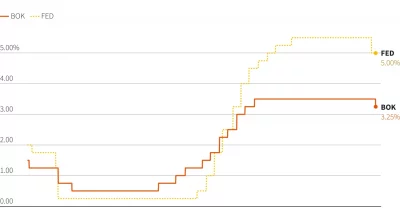
⛓️South Korea's central bank maintained its policy rate at 2.5% despite inflation rising above its target level, a decision that may provide short-term stability for the won but could trigger future rate hikes that would redirect capital away from cryptocurrencies toward traditional savings instruments.