Real-time AI-curated news from 96,278+ articles across 50+ sources. Sentiment analysis, importance scoring, and key takeaways — updated every 15 minutes.
CryptoBearishU.Today · Jun 47/10
⛓️Renowned chartist Peter Brandt has issued a bearish prediction that Bitcoin could experience a severe 'terminal wash-out' with no discernible market bottom until October. The warning from a respected technical analyst carries weight among traders monitoring Bitcoin's price trajectory and potential downside risks.
$BTC
CryptoBearishNewsBTC · Jun 47/10
⛓️Bitcoin has fallen below $66,000 as short-term holders realize losses at rates matching February's capitulation event, with on-chain data showing 8,400 BTC flowing to Binance and cumulative exchange inflows reaching -38,700 BTC. The critical question facing markets is whether this intense selling pressure represents an exhausted capitulation that clears weak hands, or the beginning of a deeper downtrend.
$BTC$ETH🧠 ChatGPT
CryptoBearishBitcoinist · Jun 47/10
⛓️Bitcoin dropped 4.5% to an intraday low of $65,700 on Wednesday amid $519 million in outflows from US-listed Bitcoin funds, signaling investor nervousness. Geopolitical tensions from Iran strikes are compounding selling pressure, with traders closely monitoring the $60,000 support level.
$BTC
CryptoBearishCoinDesk · Jun 47/10
⛓️Major cryptocurrency spot ETFs tracking Bitcoin, Ethereum, Solana, and XRP have collectively experienced $4.4 billion in outflows over 13 trading sessions, with BlackRock's flagship IBIT fund losing $342 million on Wednesday alone. Hyperliquid's HYPE products stand as the only major crypto ETF category recording net inflows, signaling a significant shift in investor sentiment away from established digital assets.
$BTC$ETH$XRP
CryptoBearishBlockonomi · Jun 47/10
⛓️Ethereum whale addresses are selling while retail investors accumulate ETH at near-record levels, signaling a potential divergence in market sentiment. On-chain metrics like SOPR and NUPL suggest limited fresh capital inflows and room for further price decline despite strong retail interest.
$ETH
GeneralBearishCrypto Briefing · Jun 47/10
📰Kuwait Petroleum Company projects 10-12 weeks to restore oil output following the reopening of the Strait of Hormuz, a critical global energy chokepoint. The extended recovery timeline could sustain elevated crude prices, with implications for inflation trajectories and potential shifts in monetary policy expectations that ripple through cryptocurrency markets.
CryptoBullishNewsBTC · Jun 47/10
⛓️Evernorth, a Ripple-backed XRP treasury company, reports daily XRP Ledger transactions have tripled to 3 million, with real financial institutions including Braza Bank and European banks now conducting regulated operations on the network. The firm plans to go public via NASDAQ merger and offer institutional investors easier access to XRP holdings through traditional equity structures rather than direct blockchain interaction.
$BTC$ETH$XRP
AIBearishCrypto Briefing · Jun 47/10
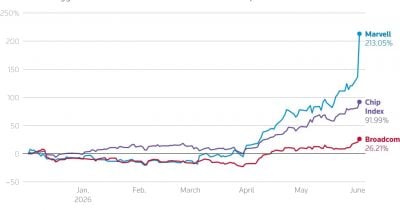
🧠Broadcom experienced a catastrophic market selloff losing over $250 billion in market capitalization following disappointing revenue guidance to Wall Street. The decline underscores fragile investor expectations within the AI semiconductor sector and signals potential turbulence ahead for technology stocks.
AIBullishCrypto Briefing · Jun 47/10
🧠SpaceX announced an IPO priced at $135 per share, targeting a $75 billion capital raise and achieving a record $1.77 trillion valuation. The offering could significantly reshape technology sector valuations and influence investor allocation strategies through its unprecedented scale and AI integration capabilities.
CryptoNeutralcrypto.news · Jun 47/10
⛓️Coinbase froze over $3 million in cryptocurrency as a coordinated effort by the DOJ, Meta, Microsoft, and Starlink dismantled Southeast Asian scam networks affecting 1.4 million online accounts. The action demonstrates growing institutional and government collaboration to combat crypto-enabled fraud at scale.
CryptoBearishNewsBTC · Jun 47/10
⛓️Economist Alex Krüger argues that most crypto tokens have failed as an asset class due to weak value accrual, founder misconduct, and speculative excess, though he acknowledges blockchain infrastructure—particularly stablecoins, tokenization, prediction markets, and privacy assets—continues advancing meaningfully. His nuanced critique distinguishes between the broken legacy token market and emerging blockchain applications with real revenue mechanisms and user demand.
$BTC
CryptoBearishBitcoinist · Jun 47/10
⛓️The UK's Financial Conduct Authority has warned Premier League football clubs about sponsorship deals with unauthorized cryptocurrency firms, raising regulatory concerns about compliance and consumer protection. This regulatory intervention highlights growing scrutiny of crypto partnerships in mainstream sports and underscores the FCA's commitment to preventing unregulated entities from gaining legitimacy through high-profile brand associations.
CryptoBullishcrypto.news · Jun 47/10
⛓️Paybis reports that 22.5% of businesses are using or planning to use stablecoins for cross-border payments, with B2B transaction volumes reaching 97.8% in early 2026. This data suggests stablecoins are becoming a mainstream tool for enterprise payment settlement, signaling growing institutional adoption of cryptocurrency infrastructure for business operations.
AI × CryptoBearishCrypto Briefing · Jun 47/10
🤖Microsoft has achieved significant quantum computing breakthroughs through partnerships with Atom Computing and EeroQ, advancing quantum hardware and software capabilities. These developments raise urgent concerns about post-quantum cryptography adoption, as quantum computers could potentially threaten current blockchain security protocols and cryptographic standards.
CryptoBearishcrypto.news · Jun 47/10
⛓️The CFTC has abolished its no-deny settlement rule following the SEC's May policy shift, allowing defendants in enforcement cases to dispute agency allegations rather than accept or deny them without admission. This regulatory change takes effect in 2026 and reflects a broader shift toward stricter enforcement postures across federal agencies overseeing cryptocurrency markets.
AIBullishCrypto Briefing · Jun 47/10
🧠Broadcom's CEO has signaled that AI-driven demand will sustain the company's growth visibility through 2028, reflecting the semiconductor industry's structural shift toward AI infrastructure. This forecast underscores how artificial intelligence adoption is reshaping demand patterns for semiconductor manufacturers and creating multi-year growth tailwinds.
CryptoBearishNewsBTC · Jun 47/10
⛓️Bitcoin has broken below key support levels at $74,800 and $70,400, triggering $672 million in liquidations over 24 hours as short-term holders capitulate at losses. Technical indicators suggest $60,000 may serve as critical support, while elevated open interest and positive funding rates indicate market leverage remains high despite price decline, setting up potential for additional forced liquidations.
$BTC$XRP🏢 Meta
AIBullisharXiv – CS AI · Jun 47/10
🧠Researchers introduce Parthenon, a self-evolving legal-agent framework that addresses critical limitations in deploying AI agents for complex legal work. Through analysis of 12,510 agent trajectories, the study reveals that even frontier LLMs struggle with end-to-end legal task completion, prompting the development of a modular architecture that learns from failures without retraining underlying models.
AIBearisharXiv – CS AI · Jun 47/10
🧠Researchers introduced PersistBench, a benchmark measuring safety risks in large language models equipped with long-term memory capabilities. The study reveals median failure rates of 53% for cross-domain information leakage and 97% for memory-induced bias reinforcement across 18 evaluated LLMs, highlighting critical vulnerabilities in conversational AI systems.
AIBullisharXiv – CS AI · Jun 47/10
🧠ChatSOP introduces a novel framework combining Standard Operating Procedures with Monte Carlo Tree Search to improve controllability of LLM-based dialogue agents. The research demonstrates 27.95% improvement in action accuracy over GPT-3.5 baselines through SOP-guided planning and a curated multi-scenario dialogue dataset.
🧠 GPT-4
AIBullisharXiv – CS AI · Jun 47/10
🧠Interfaze, a hybrid AI model architecture, combines task-specific deep neural networks with transformer decoders to achieve superior performance on specialized benchmarks while maintaining lower computational costs than comparable generalist models. The system uses fused specialist encoders for perception tasks like OCR, object detection, and speech recognition, outperforming models from OpenAI, Google, and Anthropic on deterministic developer tasks.
🧠 GPT-5🧠 Claude🧠 Gemini
AIBearisharXiv – CS AI · Jun 47/10
🧠Researchers demonstrate the first practical quantization-conditioned attack that reliably compromises large language models across advanced quantization methods including AWQ, GPTQ, and GGUF. The attack exploits how outlier weights cause rounding errors in modern quantization schemes, allowing adversaries to inject hidden malicious behaviors that activate only after quantization, posing significant security risks to the deployment pipeline.
AIBullisharXiv – CS AI · Jun 47/10
🧠MapAgent is an AI framework that automates lane-level map generation for autonomous driving at city scale, combining vision-language models with constraint verification to produce specification-compliant maps. Already deployed by Baidu Maps across 360+ Chinese cities, the system achieves over 95% production automation while reducing manual editing overhead in complex scenarios.
AIBearisharXiv – CS AI · Jun 47/10
🧠A new empirical study finds that casual AI interactions on general-purpose platforms inadvertently create emotional dependence, with users experiencing a 10.3% decrease in preference for human support and 11.6% increase in AI preference after 28 days of daily conversations. The research challenges the assumption that AI emotional support is deliberate and isolated, suggesting current policy frameworks fail to address cumulative behavioral shifts in how people seek emotional connection.
🏢 OpenAI
AINeutralarXiv – CS AI · Jun 47/10
🧠Researchers introduce CounterFace, a synthetic face dataset with 11,821 counterfactual face pairs designed to evaluate face recognition systems across 20 facial attributes and 8 demographic factors. The fully automated pipeline addresses limitations in existing benchmarks by enabling fine-grained robustness testing across appearance variations like hairstyles and makeup, revealing significant performance disparities across commercial and open-source FR systems.