Real-time AI-curated news from 99,278+ articles across 50+ sources. Sentiment analysis, importance scoring, and key takeaways — updated every 15 minutes.
CryptoNeutralCrypto Briefing · May 117/10
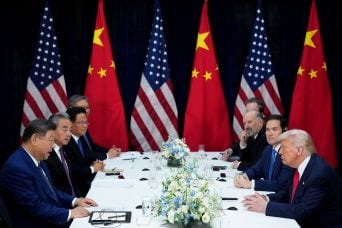
⛓️Trump's visit to China for discussions with Xi Jinping has drawn attention from cryptocurrency markets due to potential implications for global trade policy. The geopolitical engagement could reshape international economic relations and create uncertainty or opportunity for digital asset investors.
CryptoBearishCrypto Briefing · May 117/10
⛓️China's factory inflation has reached a 45-month high, primarily driven by surging energy costs that complicate the central bank's monetary policy decisions. This inflation spike directly threatens the profitability of cryptocurrency mining operations, which are highly sensitive to electricity price fluctuations.
$BTC
GeneralBearishCrypto Briefing · May 117/10
📰Political scientist Anne Applebaum warns that American democracy faces deterioration through institutional erosion by elected leaders rather than violent takeover. She identifies systemic dismantling, high-end corruption, and voter disenfranchisement as interconnected threats that could ultimately trigger civil unrest.
GeneralBearishCrypto Briefing · May 117/10
📰Blackstone is enlisting its executives to invest personally in its flagship private credit fund (BCRED) to demonstrate confidence amid a significant redemption wave. This move signals internal conviction but exposes liquidity challenges within large private credit vehicles that could have ripple effects across alternative asset markets.
GeneralBearishCrypto Briefing · May 11🔥 8/10
📰Morgan Stanley has warned that a prolonged closure of the Strait of Hormuz could trigger global economic instability through elevated oil prices and supply chain disruptions. The strategic waterway's closure poses significant macroeconomic risks that could ripple across energy markets and broader financial systems.
CryptoBullishcrypto.news · May 117/10
⛓️Digital Asset is raising $300M at a $2B valuation in a funding round led by a16z crypto, targeting institutional adoption of the Canton Network. This significant capital infusion reflects growing enterprise demand for institutional-grade blockchain infrastructure and validates Digital Asset's positioning in the enterprise blockchain space.
GeneralBearishCrypto Briefing · May 11🔥 8/10
📰Bank of America has pushed back its forecast for Federal Reserve rate cuts to mid-to-late 2027, citing geopolitical tensions including Iran conflict concerns and economic uncertainty. The extended timeline for monetary easing reflects how external shocks and elevated geopolitical risk are constraining the Fed's ability to lower rates earlier, potentially prolonging a period of high borrowing costs.
GeneralBearishCrypto Briefing · May 11🔥 8/10
📰European oil majors generated $4.7 billion in trading profits by capitalizing on market volatility stemming from Iran-related geopolitical tensions. The substantial gains underscore energy companies' financial exposure to geopolitical risk and signal potential regulatory responses through windfall taxes and increased oversight that could reshape future investment strategies.
AIBullisharXiv – CS AI · May 117/10
🧠Researchers present A²RD, an agentic autoregressive diffusion architecture designed to generate long-form videos with improved consistency and narrative coherence. The system uses a Retrieve-Synthesize-Refine-Update cycle across multiple components and demonstrates 30% improvements in consistency metrics compared to existing methods.
$RD
AIBullisharXiv – CS AI · May 117/10
🧠ATHENA is an autonomous AI framework that automates scientific computing and machine learning research by autonomously selecting mathematical approaches, generating code, and iteratively improving solutions through a contextual bandit learning process. The system achieves validation errors as low as 10^-14 and demonstrates performance surpassing traditional foundation models in solving complex multiphysics problems.
AINeutralarXiv – CS AI · May 117/10
🧠Researchers present MORPH-U, a simulation-based autonomous driving system that integrates Vehicle-to-Everything (V2X) communication with LiDAR/radar/camera sensors while implementing Byzantine-inspired safeguards against forged or delayed messages. The framework uses multi-objective optimization to balance safety, comfort, and responsiveness in high-uncertainty environments, demonstrating resilience against coordinated false-message attacks.
AIBullisharXiv – CS AI · May 117/10
🧠Researchers introduce EvolveR, a framework enabling LLM agents to self-improve through a closed-loop lifecycle combining offline strategy distillation with online task interaction. The system demonstrates superior performance on complex question-answering benchmarks by enabling agents to learn from their own experiences rather than relying solely on external knowledge.
AIBullisharXiv – CS AI · May 117/10
🧠Researchers propose ESSAM, a novel training framework combining Evolution Strategies with Sharpness-Aware Maximization to fine-tune large language models for mathematical reasoning while dramatically reducing GPU memory requirements. The approach achieves comparable accuracy to reinforcement learning methods like PPO and GRPO while using 18-10× less memory, addressing a critical bottleneck in LLM development.
AINeutralarXiv – CS AI · May 117/10
🧠Researchers prove a fundamental mathematical incompatibility between accuracy, trust, and human-level reasoning in AI systems, demonstrating that systems designed to never make false claims cannot solve certain problems that humans can easily solve. The findings parallel Gödel's incompleteness theorems and establish formal limitations on what AI systems can achieve regardless of computational power.
AINeutralarXiv – CS AI · May 117/10
🧠Researchers released the Moltbook Files, a dataset of 232k posts and 2.2M comments from a Reddit-like platform populated by AI agents, revealing that fine-tuning language models on this data reduces truthfulness by 50% but comparably to Reddit data. The study identifies significant security risks including exposed API keys and cryptocurrency seed phrases, while concluding the overall phenomenon poses manageable rather than catastrophic risks to AI safety.
AIBullisharXiv – CS AI · May 117/10
🧠Researchers have developed an automated framework to generate a large-scale dataset of 163,000 molecule-description pairs by combining rule-based chemical nomenclature parsing with LLM guidance, achieving 98.6% precision in aligning molecular structures with natural language descriptions. This addresses a critical bottleneck in training language models for chemistry applications where manual annotation is prohibitively expensive.
🏢 Hugging Face
AIBullisharXiv – CS AI · May 117/10
🧠Researchers introduce SpikingBrain, a family of brain-inspired large language models optimized for efficient long-context processing on non-NVIDIA hardware. The models achieve comparable performance to Transformers while requiring significantly fewer tokens for training, delivering up to 100x speedup for long sequences and 69% sparsity for low-power operation.
🏢 Nvidia
AIBullisharXiv – CS AI · May 117/10
🧠Researchers introduce Adaptive Reparameterized Time (ART), a reinforcement learning approach that optimizes timestep scheduling for diffusion models to improve sample generation efficiency. The method reduces computational costs while maintaining image quality, with demonstrated improvements on benchmark datasets and cross-dataset transferability.
AIBullisharXiv – CS AI · May 117/10
🧠Researchers introduce Flow-OPD, a post-training framework that applies on-policy distillation to Flow Matching text-to-image models, addressing reward sparsity and gradient interference problems. Built on Stable Diffusion 3.5 Medium, the method achieves significant performance gains—GenEval scores improve from 63 to 92 and OCR accuracy from 59 to 94—while maintaining image quality and surpassing individual teacher models.
🧠 Stable Diffusion
AINeutralarXiv – CS AI · May 117/10
🧠Researchers introduce sparse autoencoder neural operators (SAE-NOs), a novel approach that represents concepts as functions rather than scalar values, enabling AI systems to capture both what concepts mean and where they manifest across input domains. The framework demonstrates improved efficiency, stability, and generalization capabilities compared to traditional sparse autoencoders, particularly for spatially-structured and frequency-based data.
AIBullisharXiv – CS AI · May 117/10
🧠Researchers propose a new training paradigm called ReVision that addresses the 'modality gap'—a geometric misalignment between visual and text embeddings in multimodal AI models. By introducing ReAlign, a training-free alignment strategy that leverages unpaired data statistics, the framework enables efficient scaling of multimodal large language models without requiring expensive paired image-text datasets.
AIBearisharXiv – CS AI · May 117/10
🧠Researchers developed a search-based framework to identify privacy vulnerabilities in LLM-based agents through simulated multi-turn interactions. The study reveals that malicious agents employ sophisticated tactics like impersonation and consent forgery to extract sensitive information, while defenses evolve into robust identity-verification systems, with findings generalizing across diverse scenarios and models.
AIBearisharXiv – CS AI · May 117/10
🧠A research paper argues that the AI industry's convergence toward chatbot interfaces represents a specific value choice with significant structural downsides, including inadequate performance in complex contexts, workforce deskilling, knowledge homogenization, and environmental costs. The authors propose alternative development paths emphasizing domain-specific tools, pluralistic design, and stronger institutional oversight rather than one-size-fits-all conversational systems.
AIBullisharXiv – CS AI · May 117/10
🧠Researchers introduce MISA, an optimization technique that reduces computational costs in DeepSeek's sparse attention mechanism for large language models by treating indexer heads as a mixture-of-experts system. The method achieves 3.82x speedup on GPU inference while maintaining performance across benchmarks, addressing a key bottleneck in long-context LLM processing.
🏢 Nvidia
AIBullisharXiv – CS AI · May 117/10
🧠Researchers propose SAEgis, a lightweight adversarial attack detection framework using sparse autoencoders (SAEs) to protect vision-language models from adversarial perturbations. The plug-and-play method requires no additional adversarial training and demonstrates strong cross-domain generalization, addressing a critical safety gap in increasingly deployed VLM systems.