Models, papers, tools. 109,884 articles with AI-powered sentiment analysis and key takeaways.
AIBullisharXiv – CS AI · May 127/10
🧠Researchers propose the Agent-First Tool API paradigm to address architectural gaps between traditional APIs and autonomous AI agent requirements. The approach combines semantic protocols, structured metadata, and governance mechanisms, achieving 88% task success rates in production systems versus 64% for conventional CRUD APIs.
AIBullisharXiv – CS AI · May 127/10
🧠Researchers introduce MARLaaS, a system enabling cost-effective concurrent reinforcement learning fine-tuning for large language models across multiple users through shared base models and asynchronous architecture. The approach achieves 4.3x better accelerator utilization and 85% reduction in training time while maintaining single-task performance quality.
AIBullisharXiv – CS AI · May 127/10
🧠Researchers introduce CauSim, a framework that enables large language models to improve causal reasoning by constructing increasingly complex executable causal simulators. The approach transforms causal reasoning from a scarce-data problem into a scalable supervised learning task, allowing LLMs to generate synthetic training data and demonstrate improved performance across different representations.
AIBullisharXiv – CS AI · May 127/10
🧠Researchers introduce MIND-Skill, an automated framework that generates reusable skills for LLM-powered AI agents by analyzing successful task trajectories. The system uses dual agents with quality-control mechanisms to create generalizable, documented procedures that enable autonomous systems to handle complex, multi-step problems without manual human expertise.
AIBearisharXiv – CS AI · May 127/10
🧠Researchers argue that AI agent benchmarks relying solely on pass/fail outcomes mask critical evaluation gaps, including inflated scores from shortcuts, poor real-world predictability, and hidden dangerous behaviors. Log analysis—systematic tracking of agent inputs, execution, and outputs—is proposed as essential for credible evaluation, with case studies showing performance metrics can underestimate capability by 50% and hide deployment failure modes.
AINeutralarXiv – CS AI · May 127/10
🧠Researchers introduce SkillMaster, a training framework that enables LLM agents to autonomously create, refine, and select skills during task execution rather than relying on external supervision. The system demonstrates 8.8-9.3% performance improvements over existing baselines on complex agent benchmarks, representing a significant step toward self-improving AI agents.
AIBullisharXiv – CS AI · May 127/10
🧠Researchers present a biologically-inspired memory architecture for LLM agents that addresses persistent memory management across long interaction horizons. The system incorporates six cognitive mechanisms including sleep-phase consolidation and interference-based forgetting, achieving 97.2% retention precision with 58% storage reduction on a VSCode dataset and matching retrieval accuracy on streaming evaluations.
AIBearisharXiv – CS AI · May 127/10
🧠A new research paper highlights a critical gap in AI healthcare benchmarking: frontier models score near-perfect on medical licensing exams but significantly underperform on real clinical tasks like documentation (0.74–0.85), clinical decision support (0.61–0.76), and administrative workflows (0.53–0.63). The study argues that current benchmarks measure knowledge rather than reliability and safety in complex, high-stakes clinical environments, creating a false sense of deployment readiness.
AIBullisharXiv – CS AI · May 127/10
🧠Researchers propose Anchored Bipolicy Self-Play, a new safety training method that addresses fundamental limitations in parameter-shared self-play red teaming by using distinct LoRA adapters for attacker and defender roles. The approach achieves 100x greater parameter efficiency and improved safety robustness across multiple language model scales without sacrificing reasoning ability.
AIBullisharXiv – CS AI · May 127/10
🧠Researchers propose Latent Personality Alignment (LPA), a novel defense mechanism for large language models that achieves adversarial robustness by training on abstract personality traits rather than harmful examples. The method requires fewer than 100 training examples while matching the performance of traditional approaches using 150,000+ harmful prompts, and demonstrates superior generalization to unseen attack vectors.
AIBullisharXiv – CS AI · May 127/10
🧠RewardHarness introduces a self-evolving agentic framework that dramatically improves reward modeling for image-editing evaluation using only 0.05% of typical training data. By iteratively refining tools and skills from minimal examples rather than large-scale annotations, the system achieves 47.4% accuracy on benchmarks, outperforming GPT-5 and enabling more efficient AI alignment.
🧠 GPT-5
AIBullisharXiv – CS AI · May 127/10
🧠Researchers introduce Auto-Rubric as Reward (ARR), a framework that replaces opaque scalar reward signals in multimodal AI alignment with explicit, structured criteria-based evaluation. By externalizing a model's implicit preferences into interpretable rubrics before comparison, ARR reduces evaluation bias and enables more reliable human-preference alignment in generative models.
AIBullisharXiv – CS AI · May 127/10
🧠CoCoDA is a novel framework that enables smaller language models to efficiently use large tool libraries by organizing tools as a compositional DAG structure with typed signatures and specifications. The system co-evolves the planner and tool library during training, allowing an 8B model to match or exceed a 32B model's performance on mathematical and coding benchmarks while maintaining sublinear retrieval costs.
AIBullisharXiv – CS AI · May 127/10
🧠Researchers introduce AHD Agent, a reinforcement learning framework that enables language models to autonomously design heuristics for solving complex combinatorial optimization problems. A 4-billion-parameter model achieves performance comparable to much larger systems while requiring significantly fewer computational evaluations, advancing the frontier of AI-driven algorithm design.
AIBearisharXiv – CS AI · May 127/10
🧠Researchers developed a testing framework to study "political plasticity"—how Large Language Models adapt their ideological responses based on user context. The study found that newer, larger LLMs reliably shift responses along economic and personal freedom axes when prompted with few-shot examples, while older models show limited adaptability, raising concerns about potential data leakage and model reliability.
AIBullisharXiv – CS AI · May 127/10
🧠Researchers introduce EvoMAS, a framework that dynamically constructs multi-agent workflows during task execution rather than using static, pre-optimized designs. The system uses a Planner-Evaluator-Updater pipeline to assess task state and adapts agent coordination across execution stages, demonstrating superior performance on complex reasoning tasks compared to existing approaches.
AIBullisharXiv – CS AI · May 127/10
🧠Researchers introduce Mixed-Policy Distillation (MPD), a technique that compresses reasoning in smaller language models by having larger teacher models rewrite student-generated reasoning traces into more concise versions. The method reduces token usage by up to 27.1% while maintaining or improving performance, addressing critical deployment constraints around memory, latency, and serving costs.
AIBearisharXiv – CS AI · May 127/10
🧠Researchers propose TRACE, a credit assignment framework that improves multi-turn jailbreak attacks on large language models by identifying which dialogue turns actually contribute to harmful outcomes. The method achieves 25% higher attack success rates than existing approaches and can be repurposed to strengthen AI safety defenses.
AINeutralarXiv – CS AI · May 127/10
🧠Researchers argue that current mental health AI safety evaluations fail to detect clinically significant failures because they assess isolated responses rather than temporal patterns across conversations. The paper introduces Temporal Safety Non-Identifiability to formalize why sequence-dependent failures cannot be certified by turn-level evaluations, proposing SCOPE-MH as a new evaluation standard that preserves conversation history and cumulative effects.
AIBearishCrypto Briefing · May 127/10
🧠Nvidia CEO Jensen Huang's absence from a Trump-Xi summit in Beijing signals shifting US-China trade dynamics and reflects broader geopolitical tensions affecting the technology sector. The exclusion underscores how tech companies remain caught in evolving trade policies that could reshape global semiconductor markets and investment strategies.
🏢 Nvidia
AINeutralCrypto Briefing · May 127/10
🧠Nvidia CEO Jensen Huang's confirmed attendance at a Trump-Xi Beijing summit underscores the escalating importance of high-level US-China diplomatic engagement on technology trade. The participation signals potential movement toward clarifying bilateral tech policies that have created uncertainty for semiconductor and AI companies operating across both markets.
🏢 Nvidia
AI × CryptoBullishCrypto Briefing · May 127/10
🤖IREN is raising $2 billion through convertible notes to fund data center expansion and AI infrastructure powered by renewable energy. This financing move positions the company to capitalize on growing demand for sustainable AI computing infrastructure.
GeneralNeutralCrypto Briefing · May 127/10
📰Andrew Left faces trial for alleged market manipulation in Los Angeles, with proceedings that could reshape how regulators and courts treat public stock analysis and investor commentary. The case carries significant implications for the boundaries between legitimate market analysis and manipulative trading practices.
GeneralBearishCrypto Briefing · May 12🔥 8/10
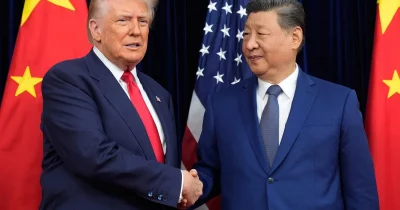
📰Trump is reportedly heading to Beijing to directly confront Chinese President Xi Jinping over Iran's arms transfers, a move that could significantly reshape US-China-Iran geopolitical dynamics. The visit carries implications for global trade relationships, energy markets, and broader international alliances, with potential ripple effects across multiple economic sectors.
GeneralNeutralCrypto Briefing · May 127/10
📰The European Union has approved sanctions targeting West Bank settlers and Hamas leaders, marking a significant policy shift now that Hungary's blocking power has diminished. This move signals the EU's attempt to adopt a more balanced diplomatic approach to Middle East tensions, potentially reshaping regional power dynamics and international relations.