Models, papers, tools. 109,915 articles with AI-powered sentiment analysis and key takeaways.
AIBearisharXiv – CS AI · May 97/10
🧠Researchers have identified a fundamental vulnerability in multimodal large language models where safety mechanisms can be bypassed by exploiting the tension between hiding harmful intent and maintaining reconstructability. The study demonstrates that character-removed text variants combined with keyword-related distractor images achieve effective jailbreaks, revealing that models' own reconstruction capabilities become a security liability.
AINeutralarXiv – CS AI · May 97/10
🧠Researchers introduce SkillRet, a large-scale benchmark dataset containing 17,810 public agent skills designed to evaluate how language model agents retrieve appropriate tools from massive skill libraries. The benchmark demonstrates that current retrieval methods struggle significantly with realistic large-scale deployments, though task-specific fine-tuning improves performance by up to 16.9 points on key metrics.
AINeutralarXiv – CS AI · May 97/10
🧠Researchers have identified a geometric framework explaining how language models fail through two distinct mechanisms: parametric memory conflicting with working memory, and hallucination from absent learned facts. Both failures produce confident outputs despite being mechanistically different, but hidden-state geometry and 'geometric margin' metrics can distinguish them more reliably than traditional entropy-based detection methods.
AINeutralarXiv – CS AI · May 97/10
🧠A new economic framework argues that AI agents function as production technology converting compute capital into cognitive labor, rather than being labor themselves. This shift means wage equilibrium for human cognitive workers will be anchored to compute capital rental rates rather than traditional labor markets, with human wages bounded by a formula incorporating compute intensity and relative productivity.
AIBullisharXiv – CS AI · May 97/10
🧠Researchers propose Lorem Perturbation for Exploration (LoPE), a training technique that addresses the zero-advantage problem in reinforcement learning for large language models by prepending random Latin-based text to prompts, enabling broader reasoning exploration across 1.7B to 7B parameter models.
🏢 Perplexity
AIBullisharXiv – CS AI · May 97/10
🧠Researchers introduce BeliefMem, a novel memory architecture for LLM agents that retains multiple candidate conclusions with associated probabilities instead of committing to single deterministic interpretations. This probabilistic approach preserves uncertainty, allows agents to update confidence as new evidence arrives, and demonstrates superior performance on LoCoMo and ALFWorld benchmarks compared to existing memory methods.
AIBullisharXiv – CS AI · May 97/10
🧠Researchers present FinRAG-12B, a 12-billion parameter language model specifically optimized for banking applications that achieves GPT-4.1-level performance on citation grounding while maintaining safer refusal rates and operating at 20-50x lower cost. The model is already deployed across 40+ financial institutions with proven 7.1 percentage point improvements in query resolution.
🧠 GPT-4
AIBullisharXiv – CS AI · May 97/10
🧠Researchers introduce LANTERN, a framework that uses large language models to automatically generate task descriptions and intelligently aggregate knowledge from multiple source tasks for reinforcement learning. The system achieves 40-60% improvements in sample efficiency by adaptively weighting source policies based on task similarity and managing teacher-student knowledge transfer through uncertainty-aware gating.
AIBearisharXiv – CS AI · May 97/10
🧠Researchers have identified a critical architectural flaw in large vision-language models: attention mechanisms are largely redundant and misallocate computational resources, with random attention weights performing comparably to learned ones. This finding challenges fundamental assumptions about Transformer design and suggests current LVLMs inefficiently process visual information despite their scale.
AIBullisharXiv – CS AI · May 97/10
🧠Researchers introduce FinAgent-RAG, an advanced AI framework designed to answer complex financial questions by combining iterative retrieval, reasoning, and self-verification. The system achieves 76-78% accuracy on financial benchmarks while reducing computational costs by 41%, demonstrating practical viability for institutional financial analysis.
AINeutralarXiv – CS AI · May 97/10
🧠Researchers demonstrate that large reasoning models (LRMs) expose safety vulnerabilities in their intermediate reasoning traces that don't appear in final answers, creating a blind spot in current safety evaluation practices. Using adaptive multi-principle steering, they achieve up to 40.8% reduction in unsafe outputs while maintaining task accuracy, suggesting safety must be evaluated across the full reasoning-answer trajectory rather than just final responses.
AIBullisharXiv – CS AI · May 97/10
🧠Researchers propose constant-context skill learning, a framework enabling LLM agents to learn reusable task procedures as lightweight modules rather than storing long prompts in memory. The approach reduces token usage per inference by 2-7x while maintaining or improving performance across multiple benchmark environments, addressing the privacy-capability tradeoff in agent deployment.
🧠 Llama
AINeutralarXiv – CS AI · May 97/10
🧠Researchers introduce XL-SafetyBench, a comprehensive safety evaluation framework for large language models across 10 country-language pairs with 5,500 test cases. The study reveals that frontier LLMs show decoupled jailbreak robustness and cultural awareness, while local models often exhibit apparent safety driven by generation failure rather than genuine alignment.
AIBullisharXiv – CS AI · May 97/10
🧠Researchers introduce DomLoRA, a parameter-efficient fine-tuning method that identifies a single 'dominant adaptation module' where most gradient energy concentrates, achieving superior performance with only 0.7% of standard LoRA's trainable parameters. The discovery reveals that optimal adapter placement is architecture-dependent but task-stable across instruction following, reasoning, and code generation applications.
AINeutralarXiv – CS AI · May 97/10
🧠Researchers developed a causal analysis framework to audit bias in Large Language Models across seven global models, revealing that Western AI systems exhibit higher refusal rates for specific demographics while Eastern models show low intervention rates with regional sensitivities. The study demonstrates that traditional fairness metrics significantly overestimate demographic bias by conflating cultural context with model behavior, challenging current approaches to AI safety evaluation.
🧠 Llama
AINeutralarXiv – CS AI · May 97/10
🧠A new research paper identifies authorization propagation as a critical but underexplored security problem in multi-agent AI systems, distinct from prompt injection vulnerabilities. The paper argues that identity governance must become foundational infrastructure in AI orchestration, with seven structural requirements for maintaining authorization invariants across distributed agent interactions.
AIBullisharXiv – CS AI · May 97/10
🧠Researchers demonstrate that int4 quantization of KV caches on Apple Silicon's unified memory architecture actually improves performance over fp16, delivering 3-8% faster inference while reducing memory usage by 3x. This inverts the traditional quality-latency tradeoff through a fused Metal kernel combining sign-randomized FFT, per-channel scaling, and int4 packing, with applications from 1B to 1.5B parameter models.
🏢 Hugging Face
AI × CryptoNeutralarXiv – CS AI · May 97/10
🤖Researchers propose adapting centuries-old human anti-collusion mechanisms to multi-agent AI systems, which increasingly demonstrate coordinated behavior similar to market cartels. The paper develops a taxonomy of five human strategies—sanctions, leniency, monitoring, market design, and governance—and maps them to AI interventions, while identifying critical implementation challenges like agent attribution and identity fluidity.
AI × CryptoBullisharXiv – CS AI · May 97/10
🤖Researchers demonstrated quantum-enhanced large language models by integrating Cayley-parameterised unitary adapters into pre-trained LLMs and executing them on IBM's 156-qubit quantum processor. The approach improved Llama 3.1 8B's perplexity by 1.4% using only 6,000 additional parameters, marking the first practical validation of quantum-classical hybrid AI on real quantum hardware at scale.
🏢 Perplexity🧠 Llama
AI × CryptoNeutralCrypto Briefing · May 97/10
🤖China has unveiled the LineShine supercomputer with ambitions to surpass the US's El Capitan system, potentially reshaping global technological competition. This development carries significant implications for AI advancement, cryptographic capabilities, and the broader geopolitical tech landscape.
AIBullishCrypto Briefing · May 97/10
🧠Jan Leike has assumed leadership of Anthropic's alignment science team, signaling the company's commitment to advancing AI safety research. This move could establish new industry standards for AI alignment and influence how the broader tech sector approaches safety-critical AI development.
🏢 Anthropic
AI × CryptoBearishCrypto Briefing · May 97/10
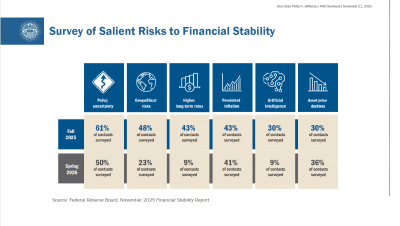
🤖The Federal Reserve's Spring 2026 survey identifies geopolitical tensions and artificial intelligence risks as primary threats to financial stability. These concerns could disrupt energy markets, compromise cybersecurity infrastructure, and reshape employment dynamics across the global economy.
GeneralBearishCrypto Briefing · May 97/10
📰The S&P 500 options market has accumulated $2.6 trillion in call options, driven by AI enthusiasm and triggering a gamma squeeze dynamic. This shift signals that derivatives-driven mechanics may increasingly override traditional valuation frameworks in determining short-term equity price movements.
GeneralBearishCrypto Briefing · May 97/10
📰US Central Command has confirmed the deployment of three naval destroyers (USS Truxtun, Rafael Peralta, and Mason) to the Arabian Sea following Iranian attacks. The increased military presence in this critical energy corridor raises concerns about potential disruptions to regional stability and global energy markets, which could have cascading effects on cryptocurrency mining operations that depend on stable power supplies.
AINeutralCrypto Briefing · May 97/10
🧠SpaceX has entered a partnership with Anthropic to enhance AI compute capabilities, potentially reshaping competition with OpenAI. The development highlights growing concerns about tech industry transformation efficiency and the critical importance of model optimization in the AI race.
🏢 OpenAI🏢 Anthropic