
Yann LeCun’s paper reveals conditions for LeJEPA to learn world models
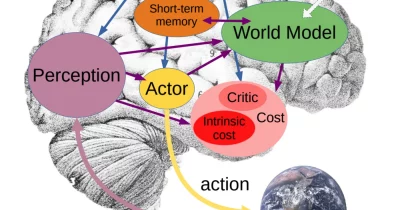
Yann LeCun's research paper outlines the specific conditions necessary for LeJEPA (Joint-Embedding Predictive Architecture) to effectively learn world models, potentially advancing AI's ability to understand complex systems. However, practical implementation faces significant hurdles due to environmental variability and real-world complexity.
Yann LeCun's latest research contributes to the foundational understanding of how modern AI systems can learn predictive models of the world—a critical capability for developing more generalized and robust artificial intelligence. LeJEPA represents a shift toward self-supervised learning approaches that reduce dependence on labeled data, a computational and economic advantage in scaling AI systems. The paper's identification of specific conditions for successful world model learning provides a theoretical framework that researchers can test and refine.
LeCun's work builds on decades of machine learning research aimed at creating systems that understand causal relationships and can predict future states based on incomplete information. World models serve as the cognitive backbone for embodied AI, enabling systems to simulate outcomes before taking actions—mimicking human reasoning patterns. This research aligns with broader industry efforts to move beyond pattern recognition toward more interpretable, generalizable AI architectures.
The significance for the AI ecosystem lies in advancing training efficiency and model capabilities without proportional increases in computational costs. Developers and researchers working on robotics, autonomous systems, and complex simulation environments could benefit from more efficient learning paradigms. However, LeCun's acknowledgment that environmental variability presents persistent challenges highlights why deployment-ready world models remain elusive despite theoretical progress.
The field should watch for empirical validation of these conditions across diverse domains and whether practical implementations can overcome the variability problem. Breakthroughs here could accelerate timelines for embodied AI and more capable autonomous systems, while continued obstacles may suggest the need for hybrid approaches combining multiple learning strategies.
- →LeJEPA's theoretical conditions for world model learning offer a roadmap for more efficient AI training approaches
- →Environmental variability remains a major practical barrier despite theoretical understanding
- →Successful world models could significantly reduce computational requirements for AI development
- →The research supports broader shifts toward self-supervised learning over labeled-data dependency
- →Real-world deployment challenges suggest hybrid methodologies may be necessary for production systems