
Last Week in AI #341 - Musk loses to OpenAI, Google's IO updates, OpenAI solves Erdős
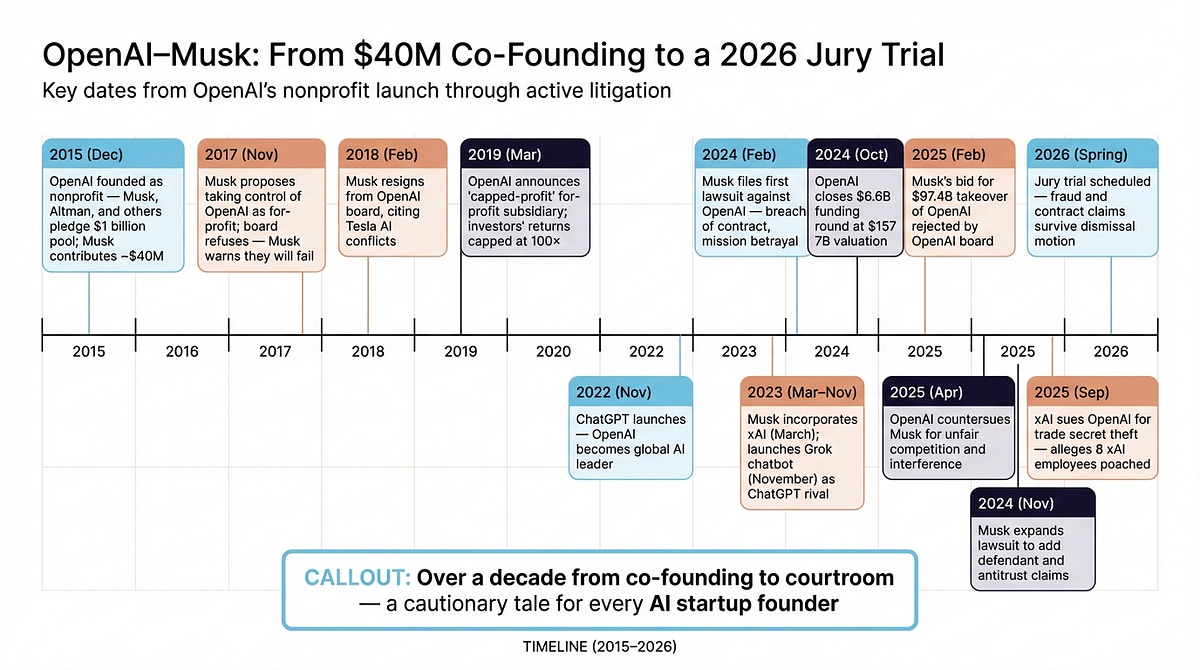
Elon Musk's $150 billion lawsuit against OpenAI and Sam Altman was dismissed, marking a significant legal defeat for the Tesla CEO. Simultaneously, Google unveiled substantial updates to its Gemini app at IO 2026 designed to compete directly with ChatGPT and Claude, while OpenAI achieved a notable breakthrough in solving the Erdős problem.
Musk's legal loss represents a watershed moment in the ongoing dispute over OpenAI's corporate structure and alleged deviation from its non-profit mission. The dismissal signals that courts are unlikely to intervene in internal disputes between founders and organizations over philosophical direction, particularly when contractual language is ambiguous. This outcome potentially shields OpenAI from precedent-setting litigation that could have complicated its operations and governance, allowing the company to continue its commercial trajectory without legal entanglement from its co-founder.
Google's IO 2026 announcements demonstrate the intensifying competition in the generative AI space. The Gemini updates suggest Google is investing heavily to close the perception gap with OpenAI's ChatGPT and Anthropic's Claude, indicating the search giant recognizes its market position requires aggressive feature development. This competitive pressure validates the broader AI arms race, with major tech companies allocating substantial resources to capture enterprise and consumer mindshare in AI applications.
OpenAI's solution to the Erdős problem—a long-standing mathematical challenge—showcases AI's capability in complex reasoning and mathematical problem-solving. This breakthrough extends beyond theoretical significance; it demonstrates practical applications of advanced language models in domains requiring deep computational logic. For the industry, this validates investor confidence in AI's trajectory toward solving increasingly difficult problems.
These developments collectively illustrate AI's maturation as an industry. Legal defeats don't derail market leaders, competitive pressure drives innovation, and technical breakthroughs expand AI's addressable markets. Developers and enterprises should monitor Google's Gemini evolution and OpenAI's continued capability demonstrations when evaluating platform commitments.
- →Musk's $150 billion lawsuit dismissal removes significant legal uncertainty from OpenAI's operations and governance.
- →Google's aggressive Gemini updates at IO 2026 signal intensifying competition requiring continuous feature innovation across all major AI platforms.
- →OpenAI's Erdős problem solution demonstrates AI capability in advanced mathematical reasoning with potential implications for scientific and enterprise applications.
- →The dismissal establishes legal precedent that corporate disputes between founders and organizations are unlikely to receive court intervention.
- →Market competition is accelerating AI development cycles, benefiting developers with more capable tools but requiring strategic platform selection.