
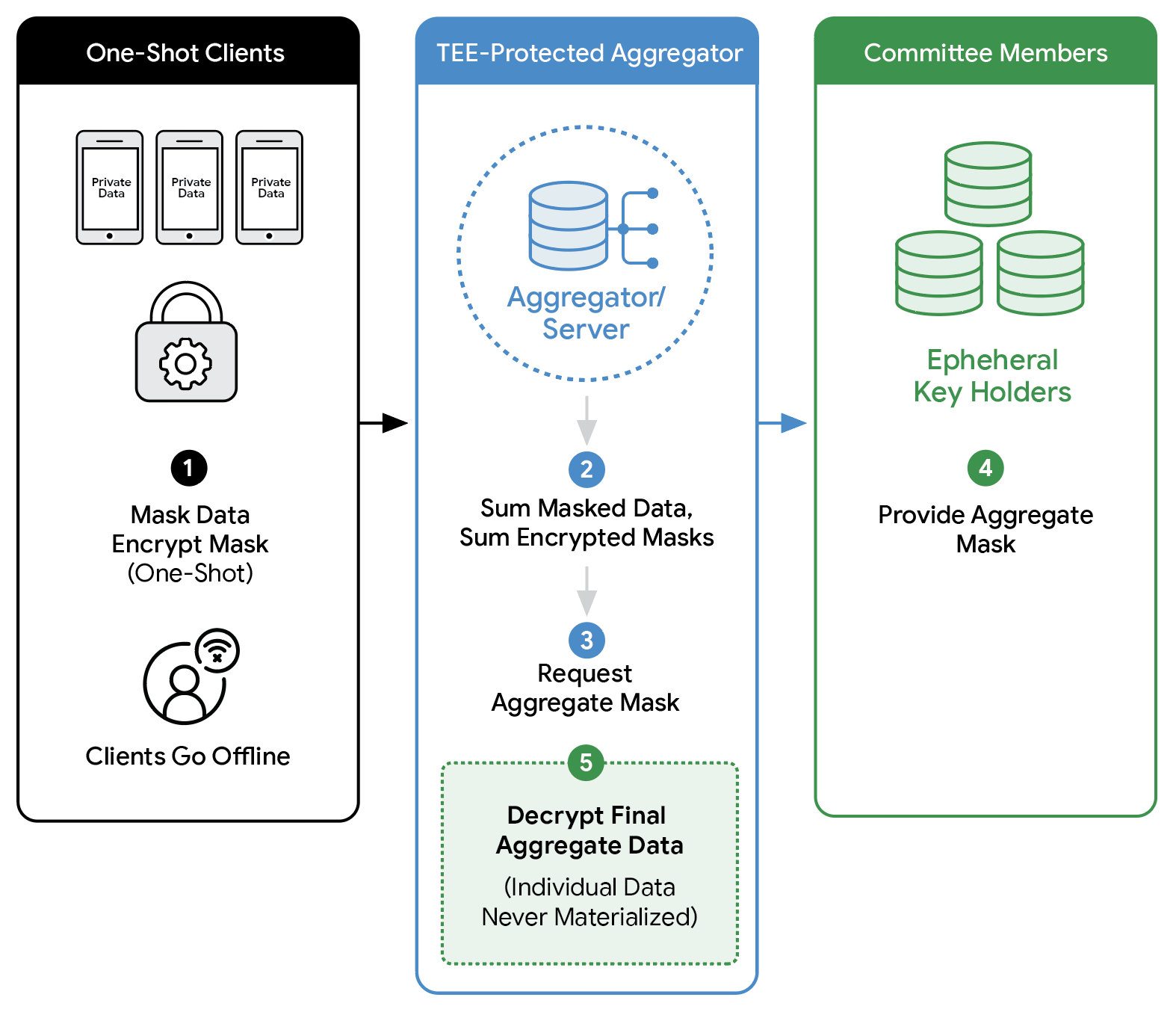
Zero-trust aggregation enables private analytics by aggregating sensitive data without exposing individual records, combining security protocols with privacy-preserving computation. This approach addresses the growing tension between data utility and user privacy, allowing organizations to extract insights while maintaining cryptographic guarantees against unauthorized access or data breaches.
Zero-trust aggregation represents a technical solution to a fundamental problem in modern data infrastructure: extracting value from sensitive information without creating honeypots for attackers or violating user privacy. The architecture assumes no participant is inherently trustworthy, requiring cryptographic proof at every aggregation step rather than relying on perimeter security or organizational policies. This shift reflects lessons learned from high-profile breaches where internal access controls proved insufficient.
The approach builds on decades of cryptographic research—including homomorphic encryption, secure multiparty computation, and differential privacy—but applies them pragmatically to real-world analytics workloads. Organizations increasingly face regulatory pressure from GDPR, CCPA, and emerging frameworks that penalize data minimization failures, making privacy-by-design solutions economically necessary rather than optional. Blockchain and decentralized applications face similar pressures when aggregating user behavior, making this framework particularly relevant to Web3 analytics and governance systems.
For developers and infrastructure teams, zero-trust aggregation reduces liability exposure while maintaining analytical capability—a critical tradeoff as regulatory scrutiny intensifies. Investors in privacy-focused infrastructure see validation that privacy-preserving computation can scale beyond theoretical cryptography into production systems. The technology enables analytics platforms, analytics service providers, and decentralized applications to process sensitive user data while maintaining verifiable privacy guarantees, creating new market opportunities in regulated sectors where traditional analytics remain too risky.
- →Zero-trust aggregation enables data analytics without exposing individual records, combining security and privacy through cryptographic verification
- →Organizations can extract insights from sensitive data while maintaining regulatory compliance with GDPR, CCPA, and similar frameworks
- →The approach applies cryptographic primitives like homomorphic encryption and secure multiparty computation to practical analytics workloads
- →Privacy-preserving computation reduces liability and security risk compared to traditional centralized data collection models
- →Blockchain and decentralized systems can leverage this framework for user-friendly analytics without compromising privacy guarantees