AIBearishAI News · Jun 237/10
🧠Five Eyes intelligence agencies issued a rare joint warning on June 22, 2026, alerting the public that AI-driven cyber threats will impact individuals and organizations within months rather than years. The coordinated briefing from the US, UK, Canada, Australia, and New Zealand signals that AI-powered cyberattacks have moved from theoretical risk to imminent practical threat.
AI × CryptoBullishBlockonomi · Jun 117/10
🤖Tim Draper contends that quantum computing poses a greater risk to traditional banking infrastructure than to Bitcoin, citing banks' reliance on legacy systems and vulnerability to 'harvest now, decrypt later' attacks where encrypted data is stolen today for decryption once quantum computers become sufficiently powerful.
$BTC
GeneralBearishFortune Crypto · Jun 117/10
📰South Korea's financial regulators have imposed a record $409 million fine on Coupang after discovering that a former employee illegally accessed personal data from approximately 34 million user accounts. This represents the largest penalty ever issued to the e-commerce giant and underscores escalating regulatory enforcement around data security breaches in the region.
AIBearisharXiv – CS AI · Jun 97/10
🧠Researchers have identified significant privacy vulnerabilities in Multi-modal Large Language Models (MLLMs) that process both text and images, revealing these systems can leak sensitive information embedded in images or retained in memory. The study introduces MM-Privacy, a comprehensive dataset for evaluating privacy risks across multi-modal tasks, and demonstrates that task inconsistency contributes substantially to data exposure risks.
AIBearisharXiv – CS AI · Jun 87/10
🧠Researchers introduce SopriBench, a synthetic benchmark and Argus framework for detecting cumulative privacy leakage from social media posts. The work addresses gaps in multimodal privacy research by analyzing how scattered cues across text, images, and metadata can collectively expose sensitive user information like location and routines.
AIBearisharXiv – CS AI · Jun 27/10
🧠Researchers discovered that vision-language models trained on paired chest X-rays and medical reports can re-link de-identified images to their original reports through embedding similarity, creating a privacy vulnerability. The team demonstrated this risk scales with model specialization and developed a differential privacy technique that reduces re-linkage by 62% while preserving diagnostic utility.
AI × CryptoBullishBlockonomi · May 307/10
🤖Centralized AI inference systems create security vulnerabilities by logging and retaining user prompts containing valuable trading signals and proprietary information. Crypto infrastructure projects like NEAR, Phala, and Nillion are addressing this privacy gap through trusted execution environments (TEEs) and multi-party computation (MPC), enabling encrypted AI inference with minimal performance degradation.
$NEAR
GeneralBearishCrypto Briefing · May 287/10
📰Airwallex, a fintech payments company, is relocating staff from China following security allegations regarding unauthorized 'backdoor' access to US customer data. The move reflects escalating US-China tech tensions and raises critical national security concerns about data protection and foreign access to sensitive information.
AIBullishOpenAI News · May 187/10
🧠OpenAI and Dell have partnered to deploy Codex, OpenAI's AI coding model, in enterprise hybrid and on-premise environments, enabling organizations to implement AI-powered coding agents while maintaining data security and control. This collaboration addresses enterprise demand for deploying advanced AI capabilities within existing infrastructure rather than relying solely on cloud-based solutions.
🏢 OpenAI
AIBearisharXiv – CS AI · May 117/10
🧠Researchers demonstrate significant privacy vulnerabilities in tabular diffusion models (TDMs), which are increasingly used to generate synthetic data as privacy-preserving alternatives. Through membership inference attacks in both black-box and white-box settings, the study reveals that attackers can successfully breach these systems without perfect knowledge of training data or massive computational resources, while also exposing flaws in commonly-used privacy metrics.
AINeutralarXiv – CS AI · Mar 277/10
🧠Researchers propose a unified framework for AI security threats that categorizes attacks based on four directional interactions between data and models. The comprehensive taxonomy addresses vulnerabilities in foundation models through four categories: data-to-data, data-to-model, model-to-data, and model-to-model attacks.
CryptoBearishCrypto Briefing · Jun 246/10
⛓️Justin Jennings faces securities fraud charges for allegedly conducting insider trading using confidential information obtained from his girlfriend. The case highlights systemic vulnerabilities in data security practices within financial institutions and the ongoing risk of market manipulation through personal relationships and unauthorized information access.
AINeutralCrypto Briefing · Jun 236/10
🧠Meta has paused an internal mouse-tracking program as part of a data security review, highlighting tensions between AI development's data requirements and employee privacy protections. The decision underscores growing scrutiny of how tech companies source and handle sensitive data for machine learning initiatives.
AINeutralarXiv – CS AI · Jun 236/10
🧠Researchers present RUCA, a privacy-preserving data projection method that addresses the utility-privacy trade-off in machine learning by using compressive techniques to simultaneously maximize classification performance while minimizing private information inference. The approach demonstrates superior performance over existing methods on Census and Human Activity Recognition datasets, offering flexible control over privacy requirements.
GeneralBearishWired – AI · Jun 226/10
📰Meta has suspended an employee-tracking program after internally exposing sensitive data from the initiative. The pause reflects growing corporate accountability pressures around workplace surveillance and data security practices.
AINeutralThe Verge – AI · Jun 96/10
🧠Apple unveiled its AI strategy at WWDC 2026, emphasizing privacy as its competitive differentiator by processing AI features on-device and through a new 'Private Cloud Compute' service. The company is expanding cloud processing to Google's servers while claiming equivalent privacy protections, betting that its privacy-first approach will justify its late entry into the AI market.
🧠 ChatGPT
AINeutralarXiv – CS AI · Jun 26/10
🧠Researchers introduce non-transferable examples (NTEs), a novel data encoding technique that restricts unauthorized model access while preserving utility for authorized applications. The method leverages model-specific low-sensitivity subspaces to act as cryptographic-like controls on AI data usage, addressing regulatory demands for purpose limitation without requiring model retraining or deployment control.
GeneralBearishFortune Crypto · May 296/10
📰California has sued 23andMe over inadequate data security that allowed hackers to access personal information from nearly 7 million users in a 2023 breach. The company agreed to a $50 million settlement in the resulting class-action lawsuit, highlighting growing regulatory scrutiny of genetic testing companies' cybersecurity practices.
AINeutralarXiv – CS AI · May 296/10
🧠Researchers have developed Synthesis Data Reversion (SDR), a technique to detect unauthorized LLM training data even when that data has been deliberately obfuscated through stylistic transformation. The method works by inferring laundering patterns and generating synthetic queries that mimic the transformed data, effectively countering data laundering practices that previously evaded detection.
🧠 Llama
GeneralBullishGoogle Research Blog · May 276/10
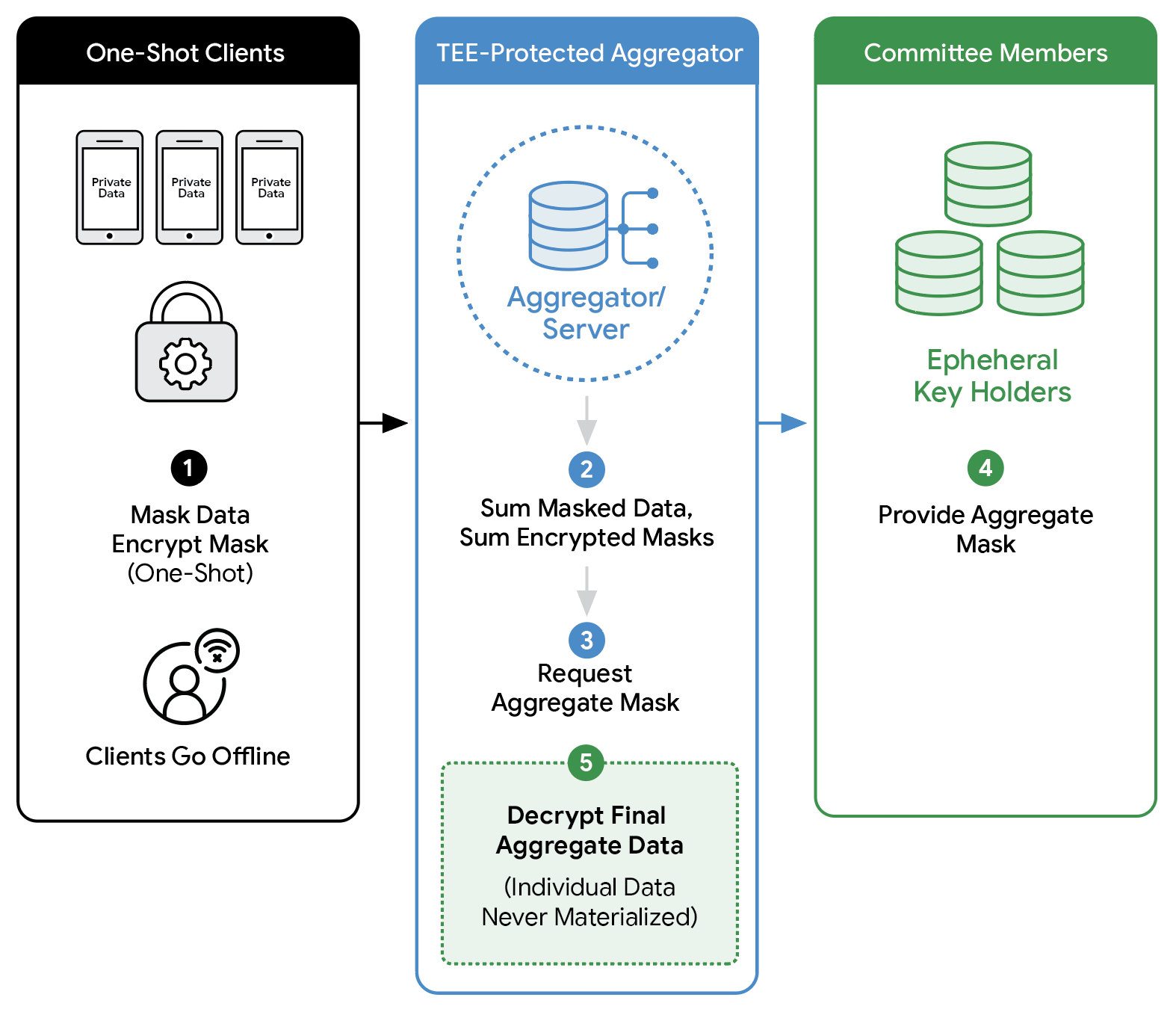
📰Zero-trust aggregation enables private analytics by aggregating sensitive data without exposing individual records, combining security protocols with privacy-preserving computation. This approach addresses the growing tension between data utility and user privacy, allowing organizations to extract insights while maintaining cryptographic guarantees against unauthorized access or data breaches.
AINeutralarXiv – CS AI · May 96/10
🧠Researchers have developed a new technique called Shallow Semantic Camouflage (SSC) to protect personal data from unauthorized use in AI model training. The work addresses a critical gap where existing data protection methods fail under modern pretraining-finetuning paradigms, demonstrating that frozen pretrained weights significantly weaken previous unlearnable example approaches.
AINeutralMIT News – AI · Jan 56/104
🧠MIT researchers have developed methods to test AI models used in clinical settings to prevent them from inadvertently revealing anonymized patient health data through memorization. This research addresses a critical privacy and security concern as healthcare AI systems become more prevalent.
AIBullishOpenAI News · Jul 186/105
🧠OpenAI has announced new administrative and compliance tools for ChatGPT Enterprise, including API integrations, SCIM provisioning, and GPT controls. These features are designed to help organizations manage compliance programs, enhance data security, and scale user access management more effectively.
AI × CryptoBullishHugging Face Blog · Nov 176/107
🤖The article discusses techniques for performing sentiment analysis on encrypted data using homomorphic encryption. This approach allows analysis of sensitive data while maintaining privacy, potentially enabling new applications in finance and other sectors requiring data confidentiality.
AINeutralGoogle Research Blog · Aug 204/108
🧠The article discusses differentially private partition selection, a technique for securing private data at scale. This represents an advancement in privacy-preserving algorithms that can protect sensitive information while still allowing for data analysis and processing.