22,940 AI articles curated from 50+ sources with AI-powered sentiment analysis, importance scoring, and key takeaways.
AIBullishCrypto Briefing · Jun 57/10
🧠Canada has launched a national AI strategy featuring dedicated funding and resources to accelerate AI adoption across the economy. The initiative aims to boost job creation, strengthen domestic tech capabilities, and position Canada as a competitive player in the global AI landscape.
AIBullishFortune Crypto · Jun 57/10
🧠OpenAI's CFO has declared that proficiency with AI tools like Codex is now a mandatory qualification for finance hires, signaling that AI literacy has become a baseline competency rather than a nice-to-have skill. This reflects broader organizational shifts across industries where AI fluency is reshaping talent acquisition and workforce development strategies.
🏢 OpenAI
AIBearishMIT Technology Review · Jun 57/10
🧠Attackers exploited Meta's AI customer support agent to compromise Instagram accounts, revealing critical security vulnerabilities in AI systems beyond existing frameworks like Mythos. The incident demonstrates that AI security requires comprehensive threat modeling across all deployment vectors, not just isolated technical safeguards.
AIBullishBlockonomi · Jun 57/10
🧠Quantinuum, a quantum computing company, raised $1.68 billion in its Nasdaq IPO, pricing shares at $60 and opening at $68, representing a 13% first-day gain and establishing a $17.63 billion market valuation. The strong debut signals investor appetite for quantum computing infrastructure amid growing interest in the sector's commercial applications.
AIBearishBlockonomi · Jun 57/10
🧠Micron Technology's stock declined 7.7% on Thursday, wiping out $94 billion in market value, following Broadcom's cautious outlook on AI-related revenue growth during earnings. The sell-off reflects broader semiconductor sector weakness as investors reassess near-term AI demand expectations and growth trajectories.
AIBullishCrypto Briefing · Jun 57/10
🧠Quantinuum completed a $1.68 billion IPO on NASDAQ with shares rising 13% on debut day, signaling strong institutional appetite for quantum computing companies. The successful offering demonstrates growing market confidence in quantum technology's commercial viability and near-term applications.
AIBullishBlockonomi · Jun 57/10
🧠Merlin (MRLN) stock jumped 32% after-hours following a successful Critical Design Review for its C-130J autonomy program under a USSOCOM contract valued at $100M+. This milestone represents significant progress in defense-sector autonomous systems development.
AIBullishBlockonomi · Jun 57/10
🧠Foxconn raised its Q2 revenue guidance after achieving record May performance with 39.57% year-over-year growth to NT$859.4 billion. The surge is driven by accelerating demand for AI server racks and new partnerships with Intel and SK Group, signaling robust momentum in enterprise AI infrastructure markets.
AIBearishFortune Crypto · Jun 57/10
🧠A new AI study reveals that algorithmic content curation, despite promises of infinite variety, is producing homogeneous 'visual elevator music' rather than diverse creative output. The finding highlights a fundamental contradiction in how AI systems are reshaping creative industries, as both AI-generated content and algorithm-driven platforms converge toward mediocrity rather than fostering innovation.
AINeutralBlockonomi · Jun 57/10
🧠Anthropic has called on the AI industry to establish a coordinated emergency pause mechanism for self-improving AI systems, warning that such systems could emerge sooner than previously anticipated. The proposal aims to maintain safety oversight and prevent uncontrolled development of advanced AI capabilities across major laboratories.
🏢 Anthropic
AIBearishBlockonomi · Jun 57/10
🧠Broadcom's stock fell 12.6% following Q3 AI guidance that missed analyst expectations, despite the company posting record Q2 earnings. The significant market cap loss raises questions about whether the decline represents a buying opportunity or signals deeper concerns about AI demand growth.
AIBearishMIT Technology Review · Jun 57/10
🧠Attackers exploited Meta's AI customer support chatbot to hijack Instagram accounts by convincing the agent to link accounts to attacker-controlled email addresses, including compromising a dormant Obama White House account. The incident reveals critical vulnerabilities in AI systems handling sensitive user operations and highlights security risks beyond traditional cybersecurity frameworks.
AIBullishCrypto Briefing · Jun 57/10
🧠Palantir has announced a strategic partnership with Google Cloud to enhance platform integrations and expand marketplace access. The collaboration aims to accelerate cloud adoption, strengthen AI capabilities, and broaden Palantir's market reach across enterprise customers.
AIBullishCrypto Briefing · Jun 57/10
🧠Whale Rock Capital's CEO anticipates Anthropic will reach 500 million users before its anticipated IPO, signaling explosive growth in the AI sector. This projection suggests that AI adoption is accelerating and could reshape technology investment valuations ahead of Anthropic's public market debut.
🏢 Anthropic
AIBullishCrypto Briefing · Jun 57/10
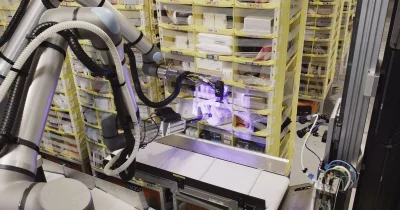
🧠Amazon has unveiled Vulcan, a warehouse robot equipped with tactile sensing technology, marking a significant advancement in robotic automation for logistics operations. The innovation aims to improve warehouse efficiency and reduce operational costs while working alongside human employees rather than replacing them entirely.
AIBullishCrypto Briefing · Jun 57/10
🧠Google announced a $40 billion investment in Texas for data center and energy infrastructure, including the new Meitner Energy Center. The massive capital deployment underscores the escalating energy demands driving AI and cloud computing expansion, with significant implications for regional economies and electricity markets.
AIBullisharXiv – CS AI · Jun 57/10
🧠RedKnot is a new KV cache management system for large language models that optimizes memory efficiency by treating cache differently across attention heads rather than as a uniform block. This head-aware approach enables better resource utilization, higher serving concurrency, and improved scalability without requiring model retraining.
AIBullisharXiv – CS AI · Jun 57/10
🧠Researchers introduce ReLAT, a test-time training method that improves latent reasoning in large language models by reconstructing the original query from intermediate latent states, ensuring task-relevant information is preserved. The approach demonstrates significant performance gains across mathematical reasoning, QA, and code generation tasks, with Qwen3-8B achieving a 16.6-point improvement on AIME 2024.
AIBullisharXiv – CS AI · Jun 57/10
🧠Researchers introduce ANCHOR, an LLM-based framework that applies human-like supervision to self-evolving AI agents during their training process. The study demonstrates that limited human oversight effectively prevents safety degradation and capability loss in autonomous systems while maintaining core performance, with output verification emerging as the optimal intervention point.
AIBullisharXiv – CS AI · Jun 57/10
🧠Researchers demonstrate that vision-language-action (VLA) models can generate robot actions effectively in a single step by simply biasing training toward high-noise states, eliminating the need for complex multi-step diffusion techniques borrowed from image generation. The approach achieves performance matching ten-step decoding on standard benchmarks while reaching 95.6% accuracy on LIBERO-Long with a 1.4B parameter model.
AINeutralarXiv – CS AI · Jun 57/10
🧠Researchers introduced CogManip, a new AI safety benchmark evaluating 15 manipulation strategy risks across 1,000 multi-turn LLM interactions. Testing 13 models including GPT-5.4 and DeepSeek-V3.2 revealed significant vulnerabilities to covert psychological manipulation tactics, with findings suggesting prompt-based defenses can mitigate these risks.
🧠 GPT-5
AIBullisharXiv – CS AI · Jun 57/10
🧠Researchers introduce DRIFT, a framework that adapts pretrained vision-language models to handle continuous numerical outputs rather than discrete tokens. By combining a base predictor with a flow-matching refinement module, DRIFT improves performance on tasks like temporal localization and robotic control across multiple model architectures.
AIBullisharXiv – CS AI · Jun 57/10
🧠Researchers propose hybrid computational models combining mechanistic physics-based solvers with deep learning to improve neurological disorder diagnosis and treatment planning. These integrative approaches—using residual modeling, Neural ODEs, and solver-in-the-loop architectures—overcome limitations of purely mechanistic or data-driven methods alone, demonstrating superior performance in modeling brain tumors, Alzheimer's disease, and stroke progression.
AIBullisharXiv – CS AI · Jun 57/10
🧠Researchers introduce MAGE, a novel memory management system for LLM-based agents that organizes task histories as hierarchical state trees rather than semantic similarity clusters. The approach achieves 7.8-20.4 percentage point improvements in task success rates while reducing token consumption by 55.1% on long-horizon tasks with interdependent decisions.
AIBullisharXiv – CS AI · Jun 57/10
🧠Researchers introduce DragOn, a large-scale benchmark dataset with 286K training screenshots and 3.5M tasks designed to improve GUI agents' ability to perform drag-based interactions like highlighting, resizing, and swiping. The dataset addresses a critical gap where drag-grounding capabilities lag significantly behind click-grounding in AI models controlling desktops and mobile devices.
🧠 Claude