22,940 AI articles curated from 50+ sources with AI-powered sentiment analysis, importance scoring, and key takeaways.
AIBullisharXiv – CS AI · Jun 17/10
🧠Researchers introduce Autonomous Agentic Data Engineering, a framework enabling LLMs to independently curate and optimize training data for model specialization. GPT-5.2 demonstrated the capability by improving a student model's performance by 57.29% through iterative, agent-driven data adaptation without human intervention.
🧠 GPT-5
AINeutralarXiv – CS AI · Jun 17/10
🧠Researchers demonstrate that large language models trained to produce dishonest outputs develop clear, detectable internal representations of deception across multiple architectures. Using linear probes on transformer models, the study achieves near-perfect accuracy in identifying synthetic dishonesty, with implications for AI safety monitoring and the feasibility of detecting deceptive alignment in advanced language models.
🧠 Llama
AINeutralarXiv – CS AI · Jun 17/10
🧠Researchers demonstrate that restructuring communication topology in multi-robot systems yields significantly larger performance improvements than scaling individual model sizes, with hierarchical interaction design improving performance by 47 points versus 9 points from doubling neural network capacity. This finding challenges the conventional focus on model scaling in AI systems and suggests interaction architecture may be equally or more critical for coordinated multi-agent performance.
AIBullisharXiv – CS AI · Jun 17/10
🧠Researchers introduce MHLF, a multigrid-hierarchical deep learning framework that accelerates computational fluid dynamics simulations for full-scale 3D aircraft by 3-8x while maintaining high-fidelity accuracy across subsonic, transonic, and supersonic flight regimes. This breakthrough addresses a critical bottleneck in aerospace design by enabling practical full-flow-field prediction for engineering-scale aircraft, moving beyond previous limitations of 2D or simplified models.
AINeutralarXiv – CS AI · Jun 17/10
🧠Researchers propose a semantic verification framework to evaluate robustness of clinical LLMs against prompt variations that preserve meaning. Testing 16 models reveals that domain-specific medical models show mixed results compared to general-purpose counterparts, with sensitivity to rephrasing posing safety risks in healthcare applications.
AIBearisharXiv – CS AI · Jun 17/10
🧠Researchers introduce NumLeak, a framework revealing that frontier large language models memorize public numeric benchmarks from pretraining data rather than genuinely understanding underlying concepts. The study demonstrates that models achieve near-perfect recall on financial and economic metrics when prompted with dates, but this performance collapses on recent holdout data, indicating memorization rather than reasoning capability.
AIBearisharXiv – CS AI · Jun 17/10
🧠Researchers demonstrate a novel poisoning attack on retrieval-augmented text-to-music systems where attackers inject malicious captions into music databases to manipulate generation outputs toward attacker-chosen targets while maintaining alignment with original user prompts. The attack reveals a critical integrity vulnerability in AI systems that depend on external knowledge bases for prompt augmentation.
AINeutralarXiv – CS AI · Jun 17/10
🧠Researchers have developed a foundational framework for managing catastrophic AI loss-of-control (LOC) incidents, shifting focus from prevention alone to active incident response and resilience. The taxonomy distinguishes between scenarios where control is impossible versus extremely costly, prescribing different management strategies including containment, threat neutralization, and automated circuit-breaker responses.
AIBullisharXiv – CS AI · Jun 17/10
🧠Researchers propose replacing the outdated point neuron model in artificial neural networks with a more biologically realistic cortical cell model, demonstrating improvements in expressivity, robustness, learning speed, and reduced memorization without increasing parameters. This fundamental advancement in neural architecture design could enhance AI system efficiency and performance across applications.
AIBullisharXiv – CS AI · Jun 17/10
🧠Researchers propose Feedback Distillation, a novel post-training method for language models that improves reasoning tasks by having models learn from their own feedback at the token level. Applied to Lean4 theorem-proving, the approach outperforms standard GRPO methods in trajectory diversity and scalability while complementing existing reinforcement learning approaches.
AIBullisharXiv – CS AI · Jun 17/10
🧠Researchers introduce SLAT, a reinforcement learning framework that reduces chain-of-thought reasoning in large language models by 50% while maintaining accuracy. The approach identifies and suppresses redundant, low-utility reasoning segments rather than applying uniform length penalties, addressing computational inefficiency in advanced AI reasoning systems.
AIBullisharXiv – CS AI · Jun 17/10
🧠COLLEAGUE.SKILL is an open-source system that automates the conversion of expert knowledge traces into portable, inspectable AI agent skills through a structured distillation workflow. The framework enables person-grounded agents to encode human expertise, decision-making patterns, and communication styles as versioned, correctable skill packages that can be deployed across multiple agent hosts.
AIBullisharXiv – CS AI · Jun 17/10
🧠Researchers introduce LLM-FACETS, an open-source framework designed to make LLM auditing accessible to non-technical practitioners while preserving data privacy. The system addresses regulatory compliance needs outlined in the EU AI Act and NIST frameworks by providing browser-based evaluation tools that keep sensitive data on self-hosted servers rather than transmitting it to external services.
AIBullisharXiv – CS AI · Jun 17/10
🧠TRINE is a new FPGA accelerator and compiler that enables efficient end-to-end inference for multimodal AI models (combining vision transformers, CNNs, and language models) without requiring reconfiguration. The system achieves up to 22.57x latency reduction compared to RTX 4090 GPUs while consuming only 20-21W, demonstrating significant energy efficiency gains for embedded AI deployment.
AIBearisharXiv – CS AI · Jun 17/10
🧠Researchers introduce EUDAIMONIA, a benchmark testing whether large language models maintain healthy social dynamics with users. Evaluating 22 recent LLMs including Claude-Opus-4.7 and GPT-5.5, they find even the strongest models violate 30.7% and 27.2% of social-alignment checks respectively, indicating persistent design flaws that extended thinking cannot resolve.
🧠 GPT-5🧠 Claude
AIBearisharXiv – CS AI · Jun 17/10
🧠Researchers demonstrate a novel adversarial attack using genetic algorithm-based prompt injection that can deceive LLM-powered reverse engineering tools like GhidraMCP into misinterpreting binary executables. This vulnerability exploits how large language models process decompiled code through surreptitious string variable assignments, potentially allowing malware to bypass automated detection systems that rely on AI-driven analysis.
AIBearisharXiv – CS AI · Jun 17/10
🧠Researchers have demonstrated that agentic AI systems used for software reverse engineering are vulnerable to prompt injection attacks embedded in executable binaries, and have developed both offensive obfuscation techniques and defensive detection methods. This research highlights critical security gaps in AI-powered code analysis tools that organizations are beginning to deploy in production environments.
AIBullishCrypto Briefing · Jun 17/10
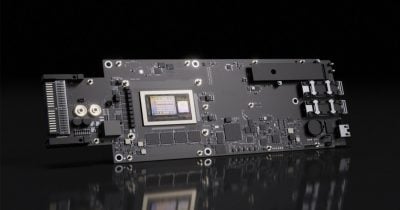
🧠Nvidia has unveiled the BlueField-4 STX, a specialized processor designed to handle AI storage operations autonomously with integrated security features. The technology aims to improve data center efficiency, scalability, and energy consumption for AI workloads by processing data at the storage layer rather than routing everything through central processors.
🏢 Nvidia
AIBullishCrypto Briefing · Jun 17/10
🧠Nvidia CEO Jensen Huang announced that AI companies are now generating profitable revenue from model outputs through token-based systems, marking a significant shift toward sustainable AI business models. This development indicates the AI industry is moving beyond initial scaling phases toward monetization, with potential implications for tech valuations and investment strategies.
🏢 Nvidia
AIBullishCrypto Briefing · May 317/10
🧠OpenAI is expanding its robotics division and ramping up hiring efforts to develop general-purpose robots capable of performing diverse tasks. This expansion signals the company's commitment to integrating advanced AI systems into physical automation, with potential implications for industrial automation, labor markets, and the broader AI sector.
🏢 OpenAI
AIBullishBlockonomi · May 317/10
🧠SK Hynix, a major semiconductor manufacturer, achieved a $1 trillion market capitalization following a 240% stock rally in 2025, driven by surging demand for AI memory chips. This milestone reflects the semiconductor industry's pivotal role in supporting AI infrastructure and highlights the substantial gains available in chipmaker equities during this AI boom.
AIBullishBlockonomi · May 317/10
🧠Nvidia and Microsoft are launching AI-powered Windows PCs featuring Nvidia chips next week, with Dell and Surface devices among the first to market. Nvidia stock trades at $211.14, down 1.45%, suggesting market participants may have already priced in the announcement or are taking profits ahead of the launch.
🏢 Nvidia
AIBullishBlockonomi · May 317/10
🧠Dell Technologies reported a historic 757% surge in AI server revenue reaching $16.1B, driving a 32% stock price increase and prompting the company to raise full-year guidance to $169B. Analyst price targets have been lifted to $550, reflecting strong market confidence in Dell's positioning within the booming AI infrastructure sector.
AINeutralCrypto Briefing · May 317/10
🧠The White House has submitted an AI legislative framework to Congress with the goal of creating unified federal regulations that could simplify compliance for startups and reduce fragmentation. However, the framework's effectiveness depends on Congress taking action, as continued inaction could leave a patchwork of state-level regulations that undermine the intended standardization benefits.
AIBullishCrypto Briefing · May 317/10
🧠OpenAI and Anthropic have launched multi-agent autonomous features designed for enterprise applications, potentially disrupting traditional business workflows by reducing dependency on middleware solutions. This development signals accelerating adoption of AI systems that can coordinate multiple specialized agents to solve complex problems at scale.
🏢 OpenAI🏢 Anthropic