AIBullishCrypto Briefing · Jun 247/10
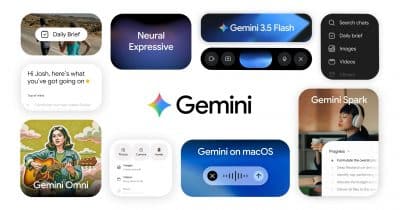
🧠Google's Gemini 3.5 Flash has integrated computer use capabilities, enabling smaller teams to automate complex tasks through AI. This development democratizes advanced automation technology, potentially reshaping how organizations across various industries leverage artificial intelligence for operational efficiency.
🧠 Gemini
AIBullishCrypto Briefing · Jun 97/10
🧠Cohere has released North Mini Code, a 30-billion parameter open-source coding model designed for enterprise developers. The model aims to democratize AI-powered coding tools by reducing computational costs and hardware requirements, potentially transforming how enterprises approach AI development and deployment.
🏢 Cohere
AIBullisharXiv – CS AI · Jun 87/10
🧠FreeAnimate introduces a training-free framework for human image animation that leverages diffusion models to achieve temporal consistency, identity preservation, and background stability without requiring substantial training data. The method uses preview-guided denoising and novel attention modules to match or exceed the quality of training-based approaches while offering improved generalization and accessibility.
AIBullishArs Technica – AI · Jun 37/10
🧠Google has released Gemma 4 12B, a lightweight open-source AI model designed to run efficiently on consumer laptops using a new encoding scheme and token prediction capabilities. The model represents a significant step toward democratizing access to advanced AI technology by reducing computational barriers for developers and individual users.
🏢 OpenAI
AIBullisharXiv – CS AI · May 97/10
🧠Litespark-Inference introduces custom SIMD kernels that enable efficient large language model inference on standard consumer CPUs by exploiting ternary neural networks (weights constrained to -1, 0, +1), replacing floating-point multiplication with simple addition and subtraction. The solution achieves dramatic performance improvements—9.2x faster latency and 52x higher throughput on Apple Silicon—making AI workloads accessible to billions of underutilized personal computers.
AI × CryptoBearishTechCrunch – AI · Apr 177/10
🤖OpenAI and other AI companies are consolidating power through aggressive acquisitions and selective model releases, while a widening knowledge gap between AI insiders and the general public reveals growing concerns about AI accessibility and control. The trend highlights mounting tension between rapid AI commercialization and public understanding of these transformative technologies.
🏢 OpenAI🏢 Anthropic
AIBullisharXiv – CS AI · Apr 157/10
🧠Researchers introduce AdaMCoT, a framework that improves multilingual reasoning in large language models by dynamically routing intermediate thoughts through optimal 'thinking languages' before generating target-language responses. The approach achieves significant performance gains in low-resource languages without requiring additional pretraining, addressing a key limitation in current multilingual AI systems.
AIBullishGoogle AI Blog · Feb 187/10
🧠Google announced new global partnerships and funding initiatives at the AI Impact Summit 2026 in India, focusing on making AI accessible and beneficial for everyone. The summit highlighted Google's commitment to expanding AI development through collaborative efforts and financial support.
AIBullishOpenAI News · Jan 167/104
🧠ChatGPT Go has launched globally, providing worldwide access to GPT-5.2 Instant with enhanced features including higher usage limits and extended memory capabilities. The service aims to make advanced AI technology more affordable and accessible to users internationally.
AIBullishGoogle DeepMind Blog · Feb 57/105
🧠Google has announced that Gemini 2.0 is now publicly available to all users. The release includes updates to Gemini 2.0 Flash and introduces two new variants: Gemini 2.0 Flash-Lite and Gemini 2.0 Pro Experimental.
AIBullishOpenAI News · Jul 187/105
🧠OpenAI has released GPT-4o mini, positioning it as the most cost-efficient small AI model currently available in the market. This represents OpenAI's push to democratize AI access through more affordable pricing while maintaining competitive performance capabilities.
AINeutralDecrypt – AI · Jun 236/10
🧠A developer has fine-tuned Qwen's open-source model to replicate Claude Fable's reasoning capabilities, then created an unrestricted version by removing safety guardrails. This development highlights the accessibility of advanced reasoning models and the dual-use nature of open-source AI, where the same technology enabling legitimate applications can be modified for unrestricted use.
🧠 Claude
AINeutralarXiv – CS AI · Jun 16/10
🧠A large-scale study of generative AI chatbot usage reveals significant disparities in how people worldwide adopt the technology based on income levels and language barriers. Low-income countries predominantly use AI for educational purposes, while wealthier nations engage more with leisure applications, suggesting the technology may either amplify or mitigate existing digital divides depending on language model improvements.
AIBullishFortune Crypto · May 306/10
🧠Samuel Smith, a 49-year-old London-based guitarist and singer-songwriter diagnosed with Parkinson's disease in 2020, has leveraged AI tools to continue creating Americana music despite losing much of his ability to play guitar physically. His use of artificial intelligence to adapt his creative process demonstrates how emerging technology can enable individuals with degenerative conditions to maintain professional artistic careers.
AIBullisharXiv – CS AI · May 296/10
🧠Researchers have released mcp-proto-okn, a Python-based server that enables AI assistants to query and integrate scientific knowledge graphs through natural language via the Model Context Protocol. The tool democratizes access to complex biomedical and scientific data by removing technical barriers to cross-domain knowledge graph analysis.
AIBullishCrypto Briefing · May 96/10
🧠Cliff Weitzman, founder of Speechify, discusses how volume and leverage drive market outcomes while highlighting his AI-powered text-to-speech platform's impact on accessibility for dyslexic and ADHD users. The interview explores growth dynamics and arbitrage opportunities in scaling technology solutions.
AINeutralarXiv – CS AI · May 96/10
🧠Researchers propose a cap-and-trade system for AI to incentivize computational efficiency and reduce environmental impact, addressing concerns that the industry's focus on hyper-scaling has marginalized smaller players and increased energy consumption. The market-based mechanism aims to lower emissions while creating economic opportunities for academics and smaller companies through monetized efficiency gains.
AINeutralarXiv – CS AI · May 46/10
🧠Researchers propose NDBench, a benchmark framework testing how frontier LLMs adapt outputs when given neurodivergence context in system prompts. The study finds that LLMs increase structural complexity (headings, steps, length) under explicit ND instructions, but persona assertion alone fails to suppress harmful behaviors—a critical finding for equitable AI system design.
AIBullishGoogle AI Blog · Feb 56/10
🧠Google has introduced the Natively Adaptive Interfaces (NAI) framework, a new AI-driven approach designed to make technology more adaptive, inclusive, and accessible for all users. The framework aims to create interfaces that can automatically adjust to individual user needs and preferences.
AIBullishMicrosoft Research Blog · Feb 56/103
🧠Microsoft Research launched Paza, a human-centered speech recognition pipeline, and PazaBench, the first benchmark leaderboard specifically designed for low-resource languages. The initiative covers 39 African languages with 52 models and has been tested with real communities to improve AI accessibility for underrepresented languages.
AIBullishGoogle DeepMind Blog · Mar 126/105
🧠Google has announced Gemma 3, positioning it as their most capable AI model that can run on a single GPU or TPU. This represents a significant advancement in making powerful AI models more accessible for individual developers and smaller organizations.
AIBullishOpenAI News · Jan 316/106
🧠OpenAI has announced o3-mini, positioning it as a cost-effective reasoning model that advances the frontier of affordable AI capabilities. This represents OpenAI's continued push to make advanced AI reasoning more accessible and economical for broader adoption.
AIBullishOpenAI News · Apr 16/106
🧠OpenAI is removing the signup requirement for ChatGPT, allowing users to access the AI chatbot instantly without creating an account. This move aims to lower barriers to entry and make AI more accessible to a broader audience.
AIBullishOpenAI News · May 186/106
🧠OpenAI has launched a ChatGPT mobile app for iOS devices, featuring conversation synchronization, voice input capabilities, and access to the latest model improvements. The app brings ChatGPT's AI capabilities to mobile users with enhanced accessibility features.
AIBullishHugging Face Blog · Feb 216/106
🧠Hugging Face and AWS have announced a strategic partnership to make AI development more accessible to developers and organizations. The collaboration aims to simplify AI model deployment and scaling through enhanced cloud infrastructure integration.